


Screenomics: A Framework to Capture and Analyze Personal Life Experiences and the Ways that Technology Shapes Them
- PMID: 33867652
- PMCID: PMC8045984
- DOI: 10.1080/07370024.2019.1578652
Screenomics: A Framework to Capture and Analyze Personal Life Experiences and the Ways that Technology Shapes Them
Abstract
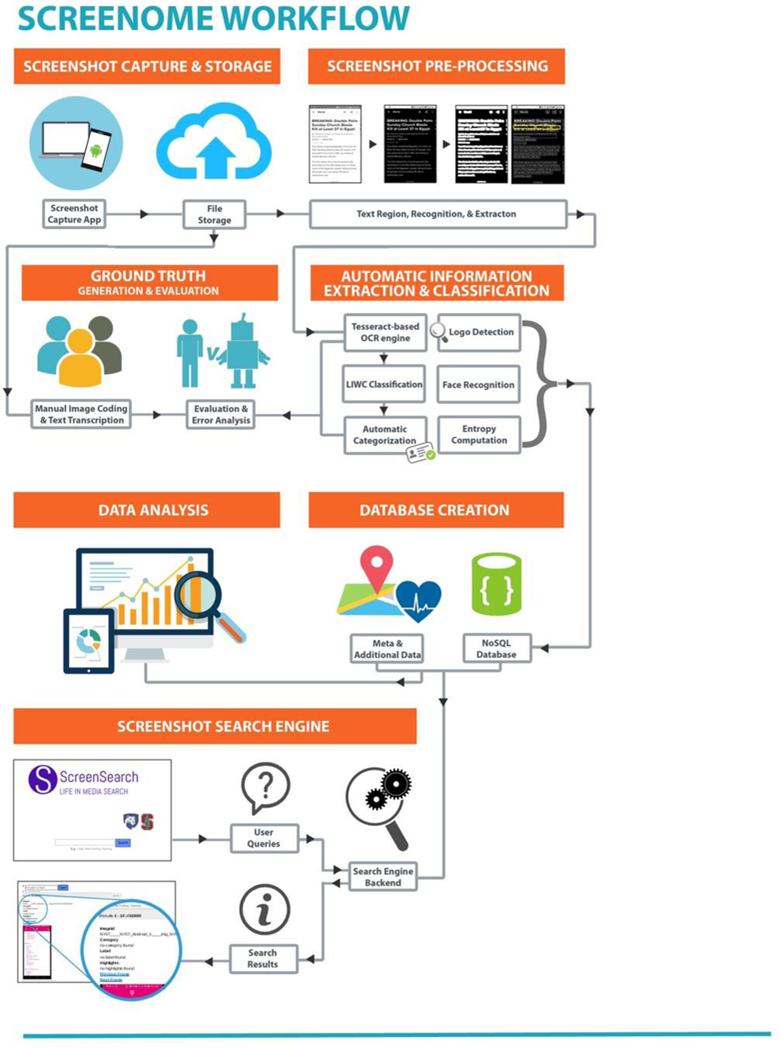
Digital experiences capture an increasingly large part of life, making them a preferred, if not required, method to describe and theorize about human behavior. Digital media also shape behavior by enabling people to switch between different content easily, and create unique threads of experiences that pass quickly through numerous information categories. Current methods of recording digital experiences provide only partial reconstructions of digital lives that weave - often within seconds - among multiple applications, locations, functions and media. We describe an end-to-end system for capturing and analyzing the "screenome" of life in media, i.e., the record of individual experiences represented as a sequence of screens that people view and interact with over time. The system includes software that collects screenshots, extracts text and images, and allows searching of a screenshot database. We discuss how the system can be used to elaborate current theories about psychological processing of technology, and suggest new theoretical questions that are enabled by multiple time scale analyses. Capabilities of the system are highlighted with eight research examples that analyze screens from adults who have generated data within the system. We end with a discussion of future uses, limitations, theory and privacy.
Keywords: Mobile; cognitive science; communication; internet use; personal tools; software development; visualization.
Figures
References
-
- Acquisti A, Brandimarte L, & Loewenstein G (2015). Privacy and human behavior in the age of information. Science, 347(6221), 509–514. - PubMed
-
- Agichtein E, Castillo C, Donato D, Gionis A, & Mishne G (2008, February). Finding high-quality content in social media. In Proceedings of the 2008 international conference on web search and data mining (183–194). ACM.
-
- Aharony N, Pan W, Ip C, Khayal I, & Pentland A (2011). Social fMRI: Investigating and shaping social mechanisms in the real world. Pervasive and Mobile Computing, 7(6), 643–659.
-
- Allcott H, & Gentzkow M (2017). Social media and fake news in the 2016 election. Journal of Economic Perspectives, 31(2), 211–36.
-
- Anderson C (2008). The end of theory: The data deluge makes the scientific method obsolete. Wired Magazine, 16(7), 16–07.
Grants and funding
LinkOut - more resources
Full Text Sources