


Genetic Variant XRCC1 rs1799782 (C194T) and Risk of Cancer Susceptibility in Indian Population: A Meta-analysis of Case-Control Studies
- PMID: 33867708
- PMCID: PMC7994473
- DOI: 10.1007/s12291-020-00877-7
Genetic Variant XRCC1 rs1799782 (C194T) and Risk of Cancer Susceptibility in Indian Population: A Meta-analysis of Case-Control Studies
Abstract
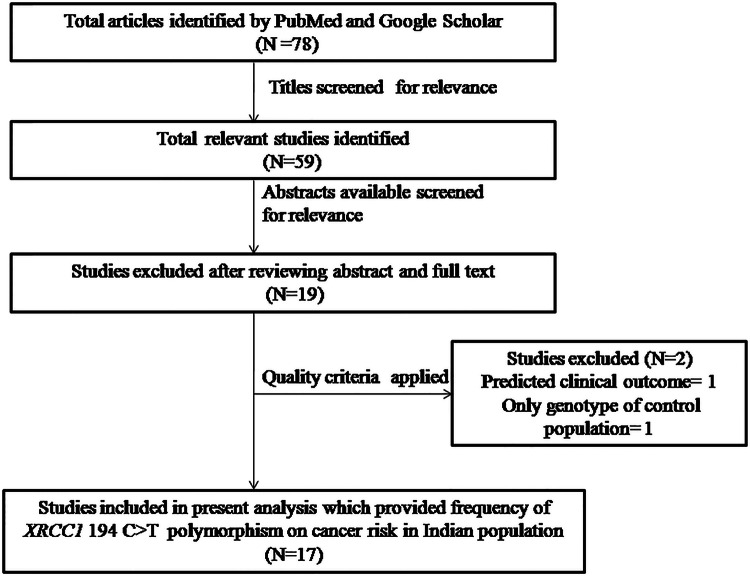
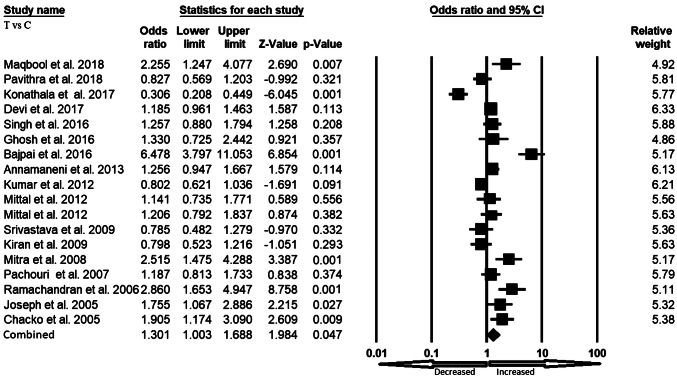
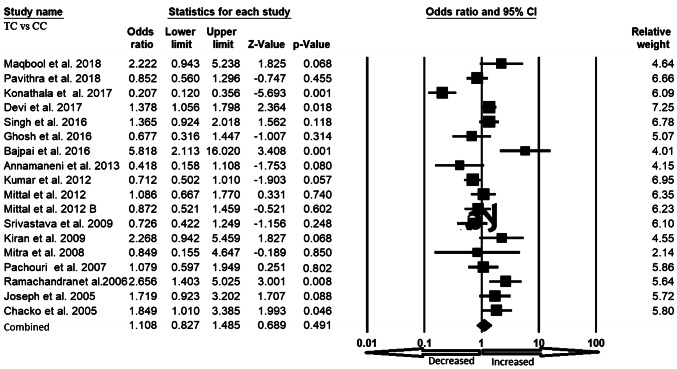
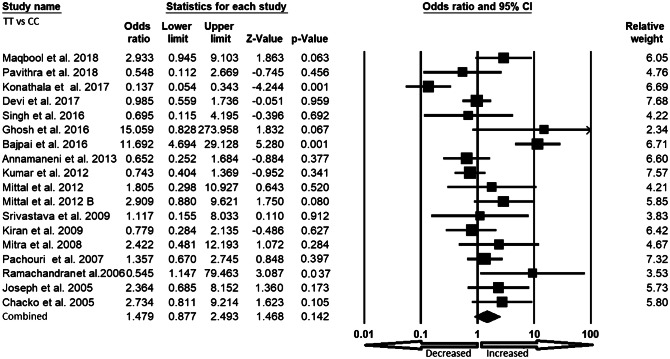
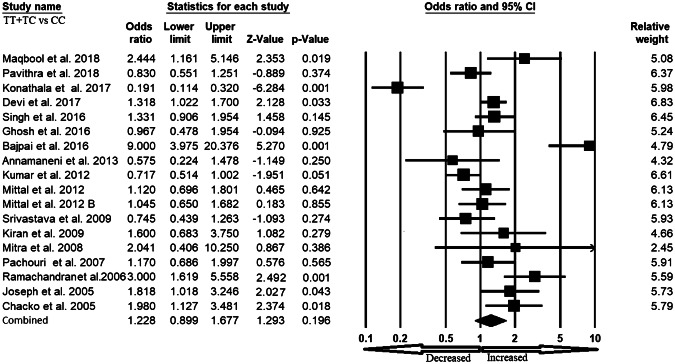
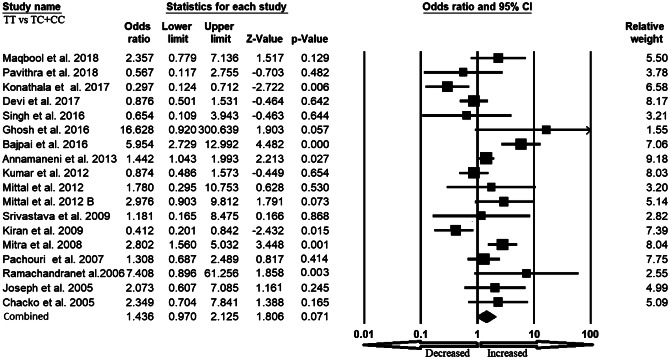
X-ray repair cross-complementing group 1 (XRCC1) plays a key role in the base excision repair pathway, as a scaffold protein that brings together proteins of the DNA repair complex. Several studies have reported contradictory results for XRCC1 exon 6 C>T (rs1799782) gene polymorphism and cancer risk in Indian population has provided inconsistent results. Therefore, we have performed this meta-analysis to evaluate the relationship between XRCC1 exon 6 C>T gene polymorphism and risk of cancer by published studies. We searched PubMed and Google scholar web databases to cover all studies published on association between XRCC1 exon 6 C>T gene polymorphism and cancer risk. The meta-analysis was carried out and pooled odds ratios (ORs) and 95% confidence intervals (95% CIs) were used to appraise the strength of association. In order to derive a more precise estimation of the association, A total of 3197 confirmed cancer cases and 3819 controls were included from eligible seventeen case-controls studies. Results from overall pooled analysis demonstrated suggested that that variant allele (T vs. C: OR 1.301, 95% CI 1.003-1.688, p = 0.047) was associated with the risk of overall cancer. Other genetic models; heterozygous (TC vs. CC: OR 1.108, 95% CI 0.827-1.485, p = 0.491), homozygous (TT vs. CC: OR 1.479, 95% CI 0.877-2.493, p = 0.142), dominant (TT+TC vs. CC: OR 1.228, 95% CI 0.899-1.677, p = 0.196) and recessive (TT vs. TC+CC: OR 1.436, 95% CI 0.970-2.125, p = 0.071) did not reveal statistical association. Publication bias observation was also considered and none was detected during the analysis. The present meta-analysis suggested that the variant allele T of XRCC1 exon 6 gene polymorphism was associated with the risk of cancer. It is therefore pertinent to confirm this finding in a large sample size to divulge the mechanism of this polymorphism and cancer risk in Indian population.
Keywords: Base excision repair pathway; Cancer; DNA repair gene; Indian population; Meta-analysis; Polymorphism.
© Association of Clinical Biochemists of India 2020.
Conflict of interest statement
Conflict of interestThe authors declare that they have no conflict of interest.
Figures
References
-
- Bray F, Ferlay J, Soerjomataram I, Siegel RL, Torre LA, Jemal A. Global cancer statistics 2018: GLOBOCAN estimates of incidence and mortality worldwide for 36 cancers in 185 countries. CA Cancer J Clin. 2018;68:394–424. - PubMed
-
- Takiar R, Nadayil D, Nandakumar A. Projections of number of cancer cases in India (2010–2020) by cancer groups. Asian Pac J Cancer Prev. 2010;11:1045–1049. - PubMed
-
- Pharoah PD, Dunning AM, Ponder BA, Easton DF. Association studies for finding cancer-susceptibility genetic variants. Nat Rev Cancer. 2004;4:850–860. - PubMed
-
- Lichtenstein P, Holm NV, Verkasalo PK, Iliadou A, Kaprio J, Koskenvuo M, Pukkala E, Skytthe A, Hemminki K. Environmental and heritable factors in the causation of cancer-analyses of cohorts of twins from Sweden, Denmark, and Finland. N Engl J Med. 2000;343:78–85. - PubMed
-
- Friedberg EC. DNA damage and repair. Nature. 2003;421:436–440. - PubMed
LinkOut - more resources
Full Text Sources