


Causes of Procedural Failures of Closed Reductions using an Extension-Block Pin for Bony Mallet Finger
- PMID: 33867764
- PMCID: PMC8041496
- DOI: 10.1055/s-0040-1701318
Causes of Procedural Failures of Closed Reductions using an Extension-Block Pin for Bony Mallet Finger
Abstract
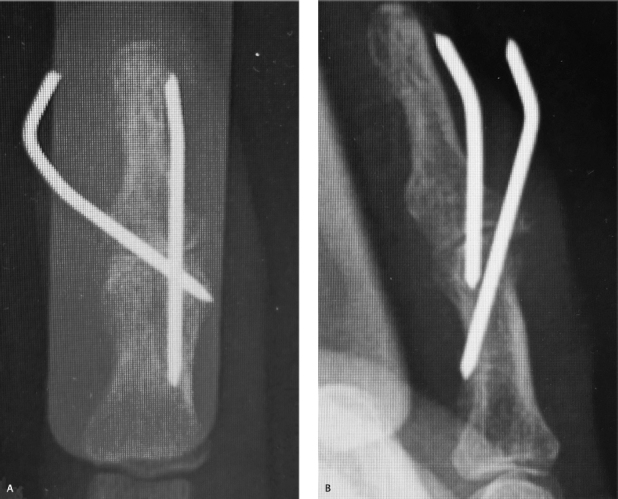
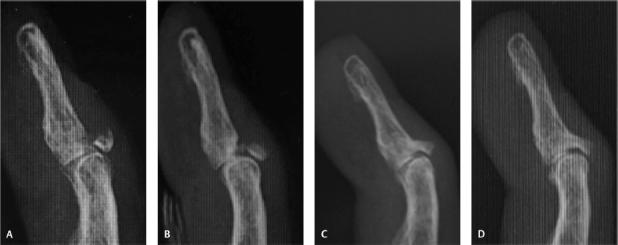
This retrospective study evaluated procedural failures of closed reductions using an extension-block Kirschner wire (K-wire) for bony mallet finger. A total of 132 patients who underwent a closed reduction for bony mallet finger in a procedure using an extension-block K-wire were radiographically assessed. Radiographs were used to evaluate (1) postoperative displacement of the reduction before or after K-wire removal and (2) inaccurate reduction of the fragment immediately after surgery. The causes of procedural failure and bone union were evaluated using radiographs and medical records of the intraoperative findings. Out of 132 patients, 17 with procedural failure were enrolled. Displacement of the reduction before and after K-wire removal occurred in seven and six cases, respectively. Inaccurate reduction immediately after surgery occurred in four cases. The most common cause of procedural failure was inaccurate insertion of the K-wire to fix the distal interphalangeal joint (eight cases) followed by inaccurate insertion of the extension-block pin (five cases). All patients had bone union regardless of the displacement of the reduction or inaccurate reduction of the fragment. Caution should be exercised during the reduction and fixation when an extension-block K-wire is used in a closed reduction procedure.
Keywords: bony mallet finger; displacement of the reduction; mallet finger; postoperative displacement; procedural failure.
Society of Indian Hand & Microsurgeons. All rights reserved. Thieme Medical and Scientific Publishers Pvt. Ltd., A-12, 2nd Floor, Sector 2, Noida-201301 UP, India.
Conflict of interest statement
Conflict of Interest None declared.
Figures


References
-
- Lin J S, Samora J B. Surgical and nonsurgical management of mallet finger: a systematic review. J Hand Surg Am. 2018;43(02):146–163. - PubMed
-
- Ishiguro T, Itoh Y, Yabe Y, Hashizume N. Extension block with Kirschner wire for fracture dislocation of the distal interphalangeal joint. Tech Hand Up Extrem Surg. 1997;1(02):95–102. - PubMed
-
- Hiwatari R, Saito S, Shibayama M. The ‘chased method’ of mini screw fixation: a percutaneous surgical approach to treating mallet fractures. J Hand Surg Eur Vol. 2014;39(07):784–786. - PubMed
-
- Bischoff R, Buechler U, De Roche R, Jupiter J. Clinical results of tension band fixation of avulsion fractures of the hand. J Hand Surg Am. 1994;19(06):1019–1026. - PubMed
-
- King H J, Shin S J, Kang E S. Complications of operative treatment for mallet fractures of the distal phalanx. J Hand Surg [Br] 2001;26(01):28–31. - PubMed
LinkOut - more resources
Full Text Sources
