. 2021 Feb 3;71(4):370-382.
doi: 10.1093/biosci/biaa170. eCollection 2021 Apr.

Nothing in Evolution Makes Sense Except in the Light of Biology

Affiliations

Nothing in Evolution Makes Sense Except in the Light of Biology

Martha O Burford Reiskind et al. Bioscience. .

Abstract

A key question in biology is the predictability of the evolutionary process. If we can correctly predict the outcome of evolution, we may be better equipped to anticipate and manage species' adaptation to climate change, habitat loss, invasive species, or emerging infectious diseases, as well as improve our basic understanding of the history of life on Earth. In the present article, we ask the questions when, why, and if the outcome of future evolution is predictable. We first define predictable and then discuss two conflicting views: that evolution is inherently unpredictable and that evolution is predictable given the ability to collect the right data. We identify factors that generate unpredictability, the data that might be required to make predictions at some level of precision or at a specific timescale, and the intellectual and translational value of understanding when prediction is or is not possible.

Keywords: adaptive evolution; evolution; population genetics; predictability; quantitative genetics; reintegrating biology.


Figures

Figure 1.
Figure 1.
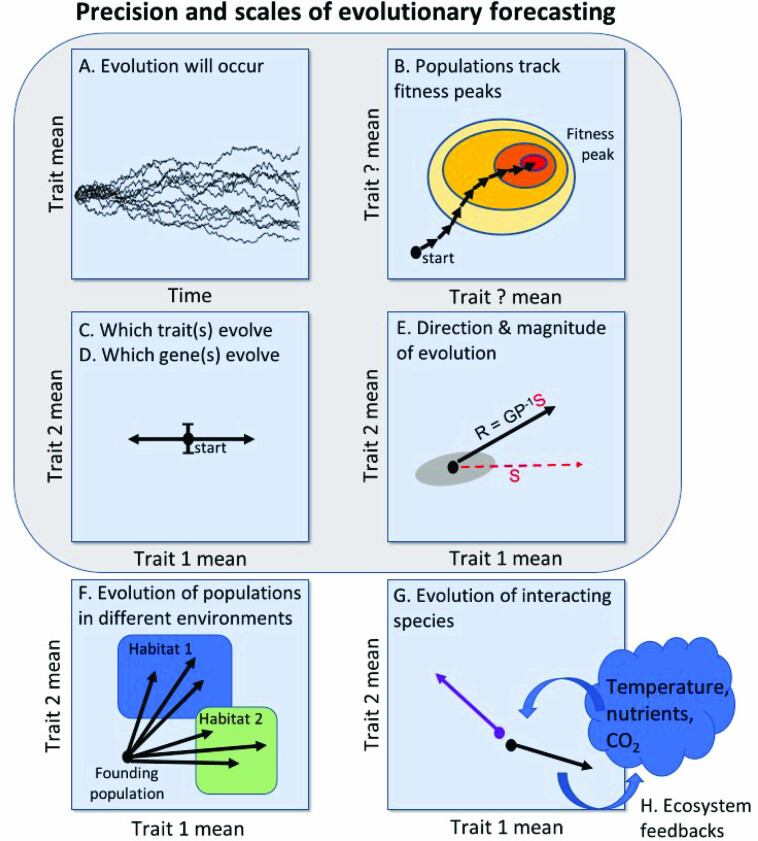
Precision and scales of evolutionary forecasting. As was described in the text, there are varying degrees of precision and scale at which evolution may be forecast. (a) Nearly all traits and genes are subject to evolutionary change, making this the most reliable but least precise prediction. (b) In a constant environment, populations with sufficient genetic variation will evolve toward fitness peaks that increase mean fitness (Fisher's fundamental theorem of natural selection). We can therefore forecast that adaptation will occur even if we are uncertain of the specific traits or genes driving this adaptation. A more precise prediction would specify the traits (c) or genes (d) that will drive evolutionary change. (e) Even greater precision comes from forecasting the magnitude and direction of trait evolution (the black line) using quantitative methods such as the breeder's equation, which requires information on genetic and phenotypic covariances (G, P, represented by the grey oval) and selection strength (red dashed line). (f) Forecasting requires information on environmental settings, which may allow us to make predictions for numerous populations spanning a range of environmental settings: To what extent will these evolve in parallel or diverge? (g) Interacting species (species 1 blue and species 2 black lines, respectively) can drive each other's evolution through ecological interactions, such as character displacement between competitors, which requires community-level forecasting. (h) We may seek to forecast how evolutionary change by species within a community alter ecosystem properties, which can feed back to change interactions among and selection on those communities. The gray box that encompasses the top four panels is the focus of this article, the lower two panels (f) and (g) are not specifically addressed in the present article. Abbreviations: GP–1, heritability; R, response to selection; S, strength of selection.

Comment in

  • Plant Evolutionary Adaptation.
    Rieseberg LH, Gao L. Rieseberg LH, et al. Plant Commun. 2020 Oct 31;1(6):100118. doi: 10.1016/j.xplc.2020.100118. eCollection 2020 Nov 9. Plant Commun. 2020. PMID: 33367271 Free PMC article. No abstract available.

References

    1. Agor J, Ozaltin O. 2018. Models for predicting the evolution of influenza to inform vaccine strain selection. Human Vaccines and Immunotherapeutics 14: 678–683. - PMC - PubMed
    1. Agrawal AA. 2017. Toward a predictive framework for convergent evolution: Integrating natural history, genetic mechanisms, and consequences for the diversity of life. American Naturalist 190: S1–S12. - PubMed
    1. Agrawal AF, Stinchcombe JR. 2009. How much do genetic covariances alter the rate of adaptation? Proceedings of the Royal Society B 276: 1183–1191. - PMC - PubMed
    1. Alfaro MA, Bolnick DI, Wainwright PC. 2004. The evolutionary dynamics of complex biomechanical systems: An example using the four-bar mechanism. Evolution 58: 495–503. - PubMed
    1. Bolnick DI, Barrett RDH, Oke KB, Rennison DJ, Stuart YE. 2018. (Non)parallel evolution. Annual Review of Ecology Evolution and Systematics 49: 303–330.