


Association Between Digoxin Use and Cancer Incidence: A Propensity Score-Matched Cohort Study With Competing Risk Analysis
- PMID: 33867973
- PMCID: PMC8044813
- DOI: 10.3389/fphar.2021.564097
Association Between Digoxin Use and Cancer Incidence: A Propensity Score-Matched Cohort Study With Competing Risk Analysis
Abstract
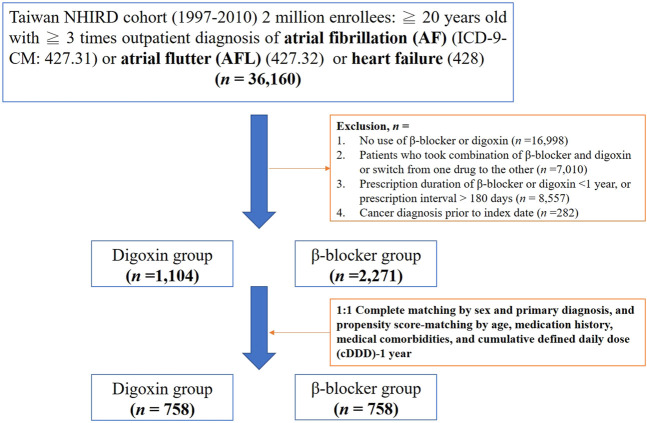
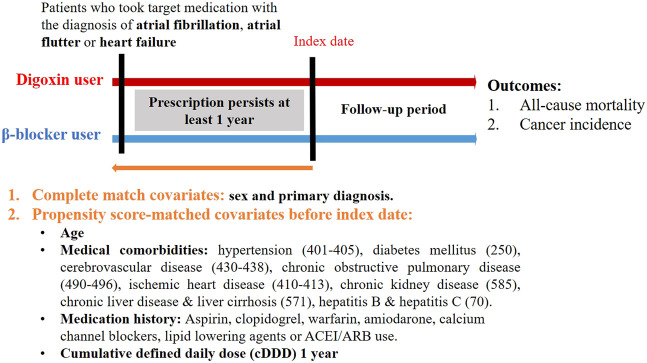
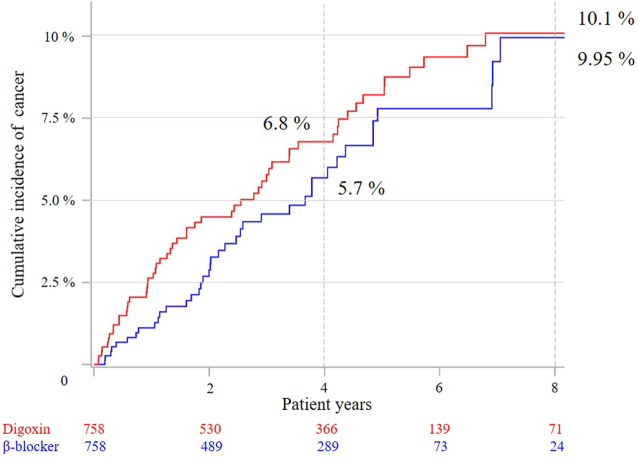
Background: Previous studies neglected death as a critical competing risk while estimating the cancer risk for digoxin users. Therefore, the current study aims to assess the effectiveness of digoxin on cancer prevention by competing risk analysis. Methods: We performed a population-based retrospective cohort study using the Taiwan National Health Insurance Research database between 1998 and 2010. After one-to-one propensity score-matching from 36,160 patients with defined criteria, we enrolled 758 patients both in digoxin and β-blocker group for further analysis. Results: The results showed that the digoxin group had higher all-cause mortality than the β-blocker group in the 4- year (10.4 vs. 4.9%) and 8 years (13.6 vs. 7.0%) follow-up. The subdistribution HR of cancer incidence in the digoxin group compared to the β-blocker group was 1.99 (95% confidence interval [CI]: 1.22-3.01) and 1.46 (95% CI: 1.01-2.15) in the 4 years and 8 years follow-up, respectively. Conclusions: The result of our study showed the usage of digoxin has no benefit in cancer prevention compared with β-blocker. The possibility of β-blocker as a new drug candidate for cancer prevention needs further clinical evaluation. The current study also emphasized the necessity of competing risk analysis applying to similar clinical researches.
Keywords: cancer; competing risk analysis; digoxin; propensity-score matching; β-blocker.
Copyright © 2021 Tai, Yang, Tseng, Chang and Wang.
Conflict of interest statement
The authors declare that the research was conducted in the absence of any commercial or financial relationships that could be construed as a potential conflict of interest.
Figures
References
-
- Bangalore S., Kumar S., Kjeldsen S. E., Makani H., Grossman E., Wetterslev J., et al. (2011). Antihypertensive drugs and risk of cancer: network meta-analyses and trial sequential analyses of 324 168 participants from randomised trials. Lancet Oncol. 12, 65–82. 10.1016/s1470-2045(10)70260-6 - DOI - PubMed
LinkOut - more resources
Full Text Sources
Other Literature Sources
