


Lipid Transport and Metabolism at the Blood-Brain Interface: Implications in Health and Disease
- PMID: 33868013
- PMCID: PMC8044814
- DOI: 10.3389/fphys.2021.645646
Lipid Transport and Metabolism at the Blood-Brain Interface: Implications in Health and Disease
Abstract
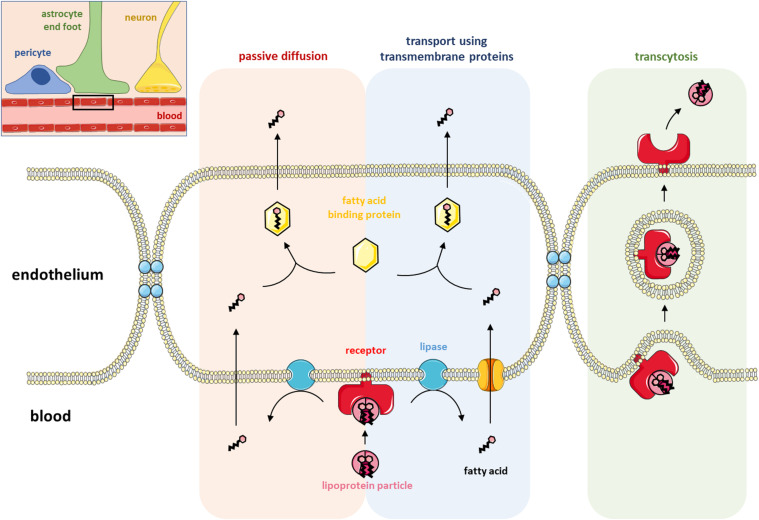
Many prospective studies have shown that a diet enriched in omega-3 polyunsaturated fatty acids (n-3 PUFAs) can improve cognitive function during normal aging and prevent the development of neurocognitive diseases. However, researchers have not elucidated how n-3 PUFAs are transferred from the blood to the brain or how they relate to cognitive scores. Transport into and out of the central nervous system depends on two main sets of barriers: the blood-brain barrier (BBB) between peripheral blood and brain tissue and the blood-cerebrospinal fluid (CSF) barrier (BCSFB) between the blood and the CSF. In this review, the current knowledge of how lipids cross these barriers to reach the CNS is presented and discussed. Implications of these processes in health and disease, particularly during aging and neurodegenerative diseases, are also addressed. An assessment provided here is that the current knowledge of how lipids cross these barriers in humans is limited, which hence potentially restrains our capacity to intervene in and prevent neurodegenerative diseases.
Keywords: blood-brain-barrier; blood-cerebrospinal fluid barrier; cholesterol; lipid transport; n-3 PUFA.
Copyright © 2021 Pifferi, Laurent and Plourde.
Conflict of interest statement
The authors declare that the research was conducted in the absence of any commercial or financial relationships that could be construed as a potential conflict of interest.
Figures

References
Publication types
LinkOut - more resources
Full Text Sources
Other Literature Sources
