


Risk of Stroke in Systemic Necrotizing Vasculitis: A Nationwide Study Using the National Claims Database
- PMID: 33868249
- PMCID: PMC8046646
- DOI: 10.3389/fimmu.2021.629902
Risk of Stroke in Systemic Necrotizing Vasculitis: A Nationwide Study Using the National Claims Database
Abstract
Objective: Evidences indicate that the risk of stroke is increased in autoimmune rheumatic diseases. This study aimed to investigate the incidence of stroke in patients with systemic necrotizing vasculitis (SNV) using the national health database.
Methods: Data were obtained from the Korean National Claims database between 2010 and 2018 to identify incident SNV [anti-neutrophil cytoplasmic antibody-associated vasculitis (AAV) and polyarteritis nodosa (PAN)] cases. The standardized incidence ratio (SIR) and incidence rate ratio (IRR) were calculated to estimate the risk of stroke in patients with SNV compared to the general population and among disease subgroups. Time-dependent Cox's regression analysis was performed to identify risk factors for stroke.
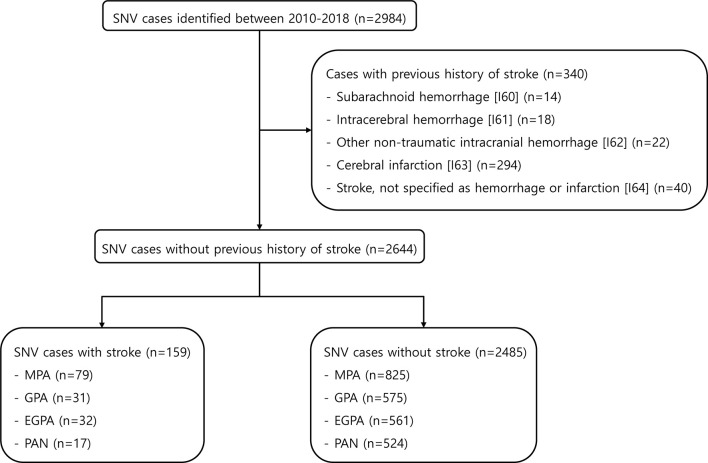
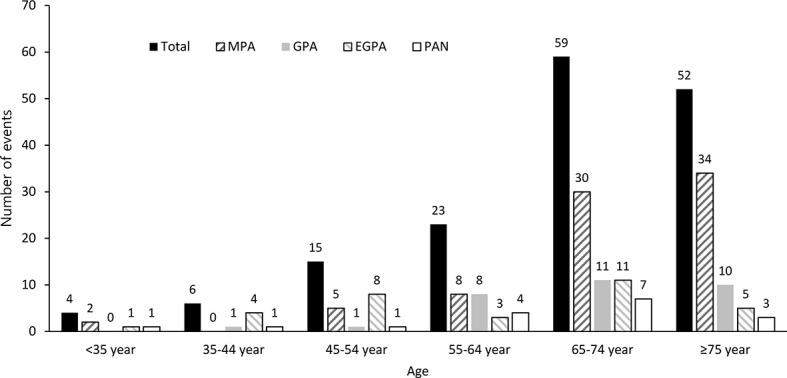
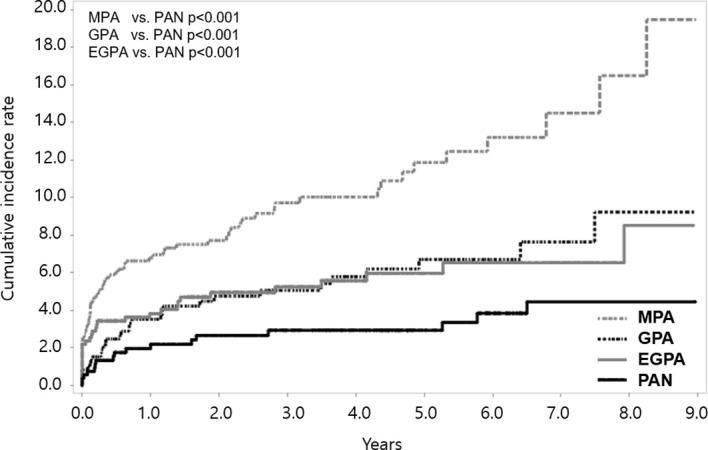
Results: Among 2644 incident SNV cases, 159 patients (6.0%) were affected by stroke. The overall risk of stroke was significantly higher in patients with SNV compared to the general population (SIR 8.42). Stroke event rates were the highest within the first year of SNV diagnosis (67.3%). Among disease subgroups, patients with microscopic polyangiitis (MPA) exhibited higher IRR compared to PAN (adjusted IRR 1.98). In Cox's hazard analysis, older age and MPA were associated with higher risk of stroke [hazard ratio (HR) 1.05 and 1.88], whereas the administration of cyclophosphamide, azathioprine/mizoribine, methotrexate, and statins were protective in stroke (HR 0.26, 0.34, 0.49, and 0.50, respectively).
Conclusion: A considerable number of SNV patients experienced stroke, especially in the early phase of disease. Older age and MPA diagnosis were associated with elevated risk of stroke, while the administration of immunosuppressive agents and statins was beneficial in preventing stroke.
Keywords: anti-neutrophil cytoplasmic antibody-associated vasculitis; incidence; microscopic polyangiitis; polyarteritis nodosa; stroke; systemic necrotizing vasculitis.
Copyright © 2021 Ahn, Han, Yoo, Park, Jung and Lee.
Conflict of interest statement
The authors declare that the research was conducted in the absence of any commercial or financial relationships that could be construed as a potential conflict of interest.
Figures
Similar articles
-
Incidence of Tuberculosis in Systemic Necrotizing Vasculitides: A Population-Based Study From an Intermediate-Burden Country.Front Med (Lausanne). 2020 Oct 22;7:550004. doi: 10.3389/fmed.2020.550004. eCollection 2020. Front Med (Lausanne). 2020. PMID: 33195300 Free PMC article.
-
Ophthalmologic manifestations of systemic necrotizing vasculitides at diagnosis: a retrospective study of 1286 patients and review of the literature.Semin Arthritis Rheum. 2013 Apr;42(5):507-14. doi: 10.1016/j.semarthrit.2012.08.003. Epub 2012 Dec 24. Semin Arthritis Rheum. 2013. PMID: 23270762 Review.
-
Brief Report: Childhood-Onset Systemic Necrotizing Vasculitides: Long-Term Data From the French Vasculitis Study Group Registry.Arthritis Rheumatol. 2015 Jul;67(7):1959-65. doi: 10.1002/art.39122. Arthritis Rheumatol. 2015. PMID: 25808634
-
Risk of acute myocardial infarction, stroke, and venous thromboembolism among patients with anti-neutrophil cytoplasmic antibody-associated vasculitis in South Korea: A nationwide population-based study.Joint Bone Spine. 2023 Mar;90(2):105498. doi: 10.1016/j.jbspin.2022.105498. Epub 2022 Nov 21. Joint Bone Spine. 2023. PMID: 36423779
-
Uncommon presentations of primary systemic necrotizing vasculitides: the Great Masquerades.Int J Rheum Dis. 2014 Jun;17(5):562-72. doi: 10.1111/1756-185X.12223. Epub 2013 Nov 14. Int J Rheum Dis. 2014. PMID: 24237487 Review.
Cited by
-
Cerebrovascular involvement in systemic childhood vasculitides.Clin Rheumatol. 2023 Oct;42(10):2733-2746. doi: 10.1007/s10067-023-06552-5. Epub 2023 Mar 8. Clin Rheumatol. 2023. PMID: 36884156 Review.
-
Granulomatosis With Polyangiitis Complicated by Diffuse Alveolar Hemorrhage, Splenic Infarction and Stroke.Cureus. 2022 Oct 9;14(10):e30102. doi: 10.7759/cureus.30102. eCollection 2022 Oct. Cureus. 2022. PMID: 36381831 Free PMC article.
-
Stroke frequency, associated factors, and clinical features in primary systemic vasculitis: a multicentric observational study.J Neurol. 2024 Jun;271(6):3309-3320. doi: 10.1007/s00415-024-12251-1. Epub 2024 Mar 12. J Neurol. 2024. PMID: 38472397 Free PMC article.
-
Relationship Between Cerebrovascular Diseases and Vasculitis: A Cross-Sectional Nationwide Inpatient Study.Cureus. 2022 Jul 29;14(7):e27435. doi: 10.7759/cureus.27435. eCollection 2022 Jul. Cureus. 2022. PMID: 36053247 Free PMC article.
-
Systematic literature review informing the 2022 update of the EULAR recommendations for the management of ANCA-associated vasculitis (AAV): Part 2 - Treatment of eosinophilic granulomatosis with polyangiitis and diagnosis and general management of AAV.RMD Open. 2023 Jun;9(2):e003083. doi: 10.1136/rmdopen-2023-003083. RMD Open. 2023. PMID: 37349121 Free PMC article.
References
Publication types
MeSH terms
Supplementary concepts
LinkOut - more resources
Full Text Sources
Other Literature Sources
Medical
