


Potential role of mitochondria in gastric cancer detection: Fission and glycolysis
- PMID: 33868477
- PMCID: PMC8045152
- DOI: 10.3892/ol.2021.12700
Potential role of mitochondria in gastric cancer detection: Fission and glycolysis
Abstract
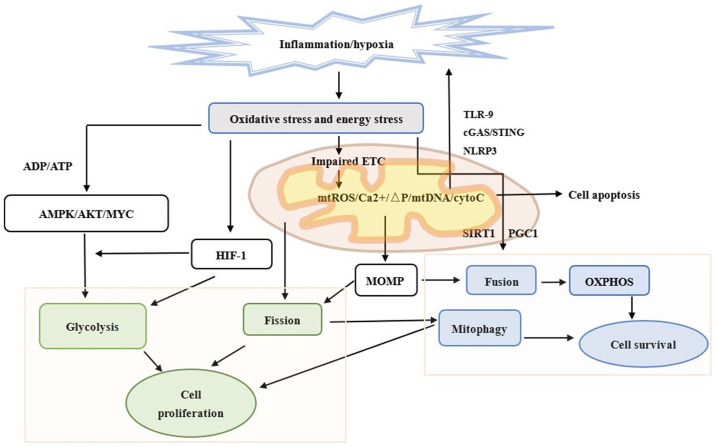
Gastric cancer (GC) is characterized by high morbidity and mortality rates worldwide. Helicobacter pylori infection, high salt intake, smoking, alcohol, low fiber intake, family history of GC, obesity and precancerous lesions, including chronic atrophic gastritis and intestinal metaplasia, are considered general risk factors for GC. Image enhancement endoscopy methods, which improve the visualization of mucosal structures and vascularity, may be used for the early diagnosis of GC, such as narrow band imaging, which can reveal fine details of subtle superficial abnormalities of early gastric cancer (EGC). Mitochondria are well-known for their role in producing ATP via the tricarboxylic acid cycle. In cancer cells, the energetic metabolism can be reprogrammed as anaerobic glycolysis for energy production and anabolic growth. In addition to their dominant metabolic functions, mitochondria participate in several central signaling pathways, such as the apoptotic pathway and NLRP3 inflammasome activation. Conversely, mitochondrial dynamics, including fission/fusion and mitophagy, can also contribute to the pathogenesis of cancer. The dysfunction and dysregulation of mitochondria have been associated with several ageing and degenerative diseases, as well as cancer. The present review focuses on energy metabolism and mitochondrial dynamics, and summarizes the changes in gastric carcinogenesis, the diagnosis of EGC and indicates potential targeted treatments.
Keywords: diagnosis of early gastric cancer; mitochondrial dynamics; reprogrammed energy metabolism.
Copyright: © Yang et al.
Conflict of interest statement
The authors declare that they have no competing interests.
Figures
References
-
- Pimentel-Nunes P, Libânio D, Marcos-Pinto R, Areia M, Leja M, Esposito G, Garrido M, Kikuste I, Megraud F, Matysiak-Budnik T, et al. Management of epithelial precancerous conditions and lesions in the stomach (MAPS II): European Society of Gastrointestinal Endoscopy (ESGE), European Helicobacter and Microbiota Study Group (EHMSG), European Society of Pathology (ESP), and Sociedade Portuguesa de Endoscopia Digestiva (SPED) guideline update 2019. Endoscopy. 2019;51:365–388. - PubMed
-
- Banks M, Graham D, Jansen M, Gotoda T, Coda S, di Pietro M, Uedo N, Bhandari P, Pritchard DM, Kuipers EJ, et al. British Society of Gastroenterology guidelines on the diagnosis and management of patients at risk of gastric adenocarcinoma. Gut. 2019;68:1545–1575. doi: 10.1136/gutjnl-2018-318126. - DOI - PMC - PubMed
Publication types
LinkOut - more resources
Full Text Sources
Other Literature Sources
Miscellaneous