


Outcomes of pulmonary vasodilator use in Veterans with pulmonary hypertension associated with left heart disease and lung disease
- PMID: 33868640
- PMCID: PMC8020250
- DOI: 10.1177/20458940211001714
Outcomes of pulmonary vasodilator use in Veterans with pulmonary hypertension associated with left heart disease and lung disease
Abstract
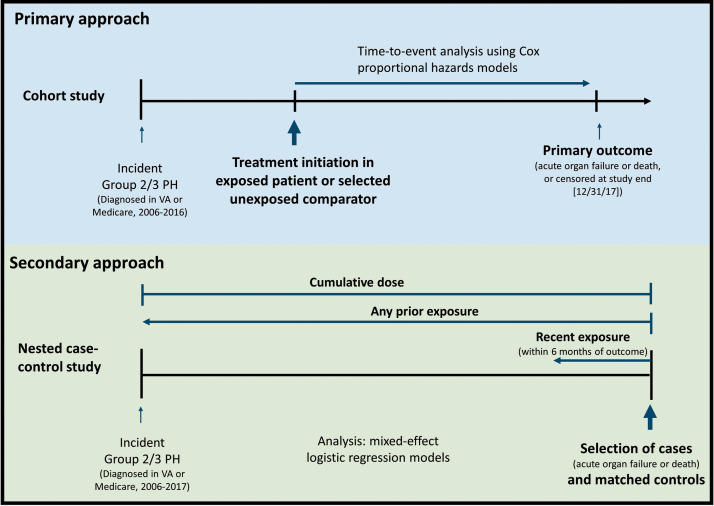
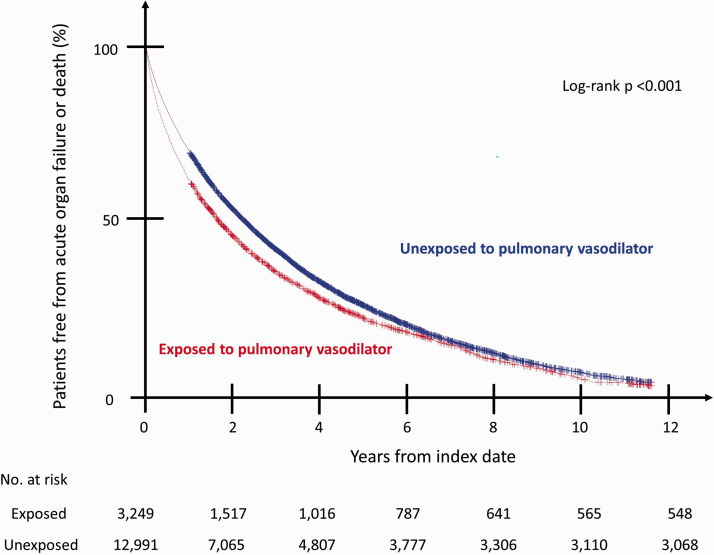
Randomized trials of pulmonary vasodilators in pulmonary hypertension due to left heart disease (Group 2) and lung disease (Group 3) have demonstrated potential for harm. Yet these therapies are commonly used in practice. Little is known of the effects of treatment outside of clinical trials. We aimed to establish outcomes of vasodilator treatment for Groups 2/3 pulmonary hypertension in real-world practice. We conducted a retrospective cohort study of 132,552 Medicare-eligible Veterans with incident Groups 2/3 pulmonary hypertension between 2006 and 2016, and a secondary nested case-control study. Our primary outcome was a composite of death by any cause or selected acute organ failures. In our cohort analysis, we calculated adjusted risks of time to our outcome using Cox proportional hazards models with facility-specific random effects. In our case-control analysis, we used logistic mixed-effects models to estimate the effect of any past, recent, and cumulative exposure on our outcome. From our cohort study, 3249 (2.5%) Veterans were exposed to pulmonary vasodilators. Exposure to vasodilators was associated with increased risk of our primary outcome, in both Group 3 (HR: 1.58 (95% CI: 1.37-1.82)) and Group 2 (HR: 1.26 (95% CI: 1.12-1.41)) pulmonary hypertension patients. The case-control study determined odds of our outcome increased by 11% per year of exposure (OR: 1.11 (95% CI: 1.07-1.16)). Treating Groups 2/3 pulmonary hypertension with vasodilators in clinical practice is associated with increased risk of harm. This extension of trial findings to a real-world setting offers further evidence to limit use of vasodilators in Groups 2/3 pulmonary hypertension outside of clinical trials.
Keywords: comparative effectiveness; evidence-based medicine; pulmonary hypertension.
© The Author(s) 2021.
Figures
References
-
- Thabut G, Dauriat G, Stern JB, et al. Pulmonary hemodynamics in advanced COPD candidates for lung volume reduction surgery or lung transplantation. Chest 2005; 127: 1531–1536. - PubMed
-
- Thenappan T, Shah SJ, Gomberg-Maitland M, et al. Clinical characteristics of pulmonary hypertension in patients with heart failure and preserved ejection fraction. Circ Heart Fail 2011; 4: 257–265. - PubMed
-
- Weitzenblum E, Chaouat A, Canuet M, et al. Pulmonary hypertension in chronic obstructive pulmonary disease and interstitial lung diseases. Semin Respir Crit Care Med 2009; 30: 458–470. - PubMed
-
- Burgess MI, Mogulkoc N, Bright-Thomas RJ, et al. Comparison of echocardiographic markers of right ventricular function in determining prognosis in chronic pulmonary disease. J Am Soc Echocardiogr 2002; 15: 633–639. - PubMed
Grants and funding
LinkOut - more resources
Full Text Sources
Other Literature Sources
Miscellaneous
