SARS-CoV-2 seroprevalence study in Lambayeque, Peru. June-July 2020
- PMID: 33868828
- PMCID: PMC8034367
- DOI: 10.7717/peerj.11210
SARS-CoV-2 seroprevalence study in Lambayeque, Peru. June-July 2020
Abstract
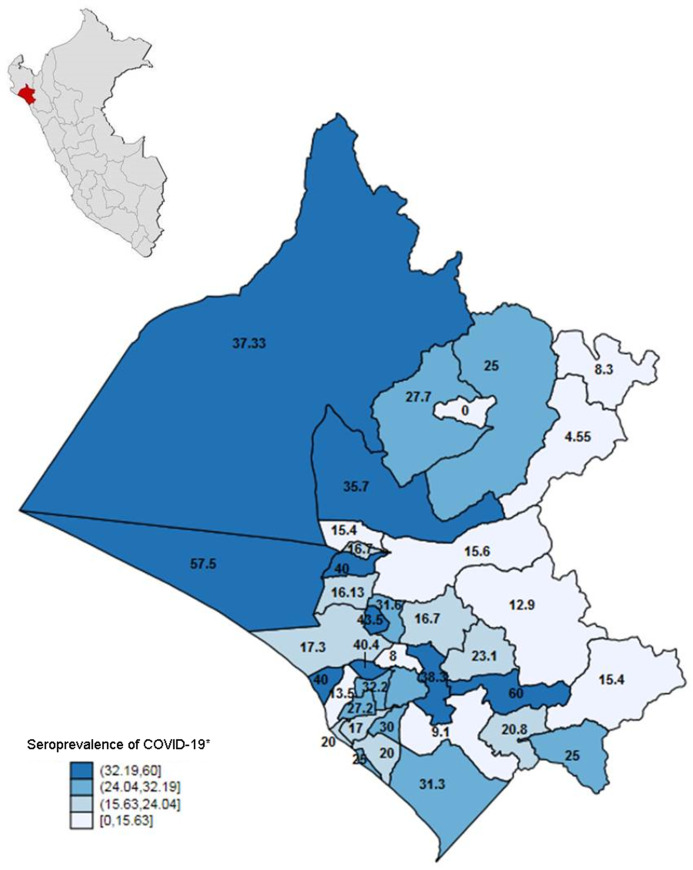
Background: Estimating the cumulative prevalence of SARS-COV-2 will help to understand the epidemic, contagion, and immunity to COVID-19 in vulnerable populations. The objective is to determine the extent of infection in the general population and the cumulative incidence by age group.
Methods: It was carried out with a longitudinal analytical study, in the population of the Lambayeque region, located in the north of Peru. The selection was carried out in multistages (districts, area, household, and finally choosing the interviewee within the house). Seroprevalence was estimated as a positive result of the rapid test whether it was positive IgM or positive IgG. An adjustment was made for the sampling weights used.
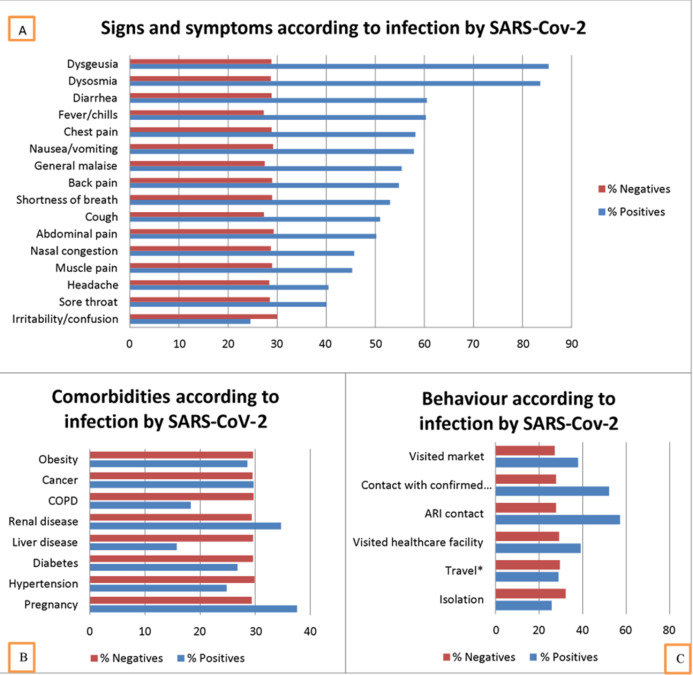
Results: The seroprevalence found in the region was 29.5%. Young people between 21 and 50 years old presented the highest seroprevalence frequencies. A total of 25.4% were asymptomatic. The most frequent complaint was dysgeusia and dysosmia (85.3% and 83.6%). Dysosmia (PR = 1.69), chest pain (PR = 1.49), back pain (PR = 1.45), cough (PR = 1.44), fever (PR = 1.41), general malaise (PR = 1.27) were associated factors with the higher the frequency of seropositivity for SARS-CoV-2. Reporting of complete isolation at home decreased the frequency of positivity (PR = 0.80), however, reporting having ARI contact (PR = 1.60), having contact with a confirmed case (PR = 1.51), and going to market (PR = 1.26) increased the frequency of positivity for SARS-CoV-2.
Conclusion: These results suggest that Lambayeque is the region with the highest seroprevalence in the world, well above Spain, the United States and similar to a study in India.
Keywords: COVID-19; Peru; SARS-CoV-2; Seroepidemiology; Seroprevalence.
© 2021 Díaz-Vélez et al.
Conflict of interest statement
The authors declare that they have no competing interests.
Figures
References
-
- Bi Q, Wu Y, Mei S, Ye C, Zou X, Zhang Z, Liu X, Wei L, Truelove SA, Zhang T. Epidemiology and transmission of COVID-19 in 391 cases and 1286 of their close contacts in Shenzhen, China: a retrospective cohort study. Lancet Infectious Diseases. 2020;20(8):911–919. doi: 10.1016/S1473-3099(20)30287-5. - DOI - PMC - PubMed
-
- Biggs HM, Harris JB, Breakwell L, Dahlgren FS, Abedi GR, Szablewski CM, Drobeniuc J, Bustamante ND, Almendares O, Schnall AH, Gilani Z, Smith T, Gieraltowski L, Johnson JA, Bajema KL, McDavid K, Schafer IJ, Sullivan V, Punkova L, Tejada-Strop A, Amiling R, Mattison CP, Cortese MM, Ford SE, Paxton LA, Drenzek C, Tate JE. Estimated Community Seroprevalence of SARS-CoV-2 Antibodies - Two Georgia Counties. Morbidity and Mortality Weekly Report. 2020;69:965–970. doi: 10.15585/mmwr.mm6929e2. - DOI - PMC - PubMed
-
- Chu DK, Akl EA, Duda S, Solo K, Yaacoub S, Schünemann HJ. Physical distancing, face masks, and eye protection to prevent person-to-person transmission of SARS-CoV-2 and COVID-19: a systematic review and meta-analysis. Lancet. 2020;395(10242):1973–1987. doi: 10.1016/S0140-6736(20)31142-9. - DOI - PMC - PubMed
-
- Clapham H, Hay J, Routledge I, Takahashi S, Choisy M, Cummings D, Grenfell B, Metcalf CJE, Mina M, Barraquer IR, Salje H, Tam CC. Seroepidemiologic study designs for determining SARS-COV-2 transmission and immunity. Emerging Infectious Diseases. 2020;26(9):1978–1986. doi: 10.3201/eid2609.201840. - DOI - PMC - PubMed
-
- Havers FP, Reed C, Lim T, Montgomery JM, Klena JD, Hall AJ, Fry AM, Cannon DL, Chiang CF, Gibbons A, Krapiunaya I, Morales-Betoulle M, Roguski K, Rasheed MAU, Freeman B, Lester S, Mills L, Carroll DS, Owen SM, Johnson JA, Semenova V, Blackmore C, Blog D, Chai SJ, Dunn A, Hand J, Jain S, Lindquist S, Lynfield R, Pritchard S, Sokol T, Sosa L, Turabelidze G, Watkins SM, Wiesman J, Williams RW, Yendell S, Schiffer J, Thornburg NJ. Seroprevalence of antibodies to SARS-CoV-2 in 10 Sites in the United States. JAMA Internal Medicine. 2020;180(12):1576. doi: 10.1001/jamainternmed.2020.4130. - DOI - PMC - PubMed
LinkOut - more resources
Full Text Sources
Other Literature Sources
Research Materials
Miscellaneous