Review
. 2021 Mar 25:8:635245.
doi: 10.3389/fmolb.2021.635245. eCollection 2021.

Perspectives on RNA Vaccine Candidates for COVID-19

Affiliations
Review

Perspectives on RNA Vaccine Candidates for COVID-19

Pobitra Borah et al. Front Mol Biosci. .

Abstract

With the current outbreak caused by SARS-CoV-2, vaccination is acclaimed as a public health care priority. Rapid genetic sequencing of SARS-CoV-2 has triggered the scientific community to search for effective vaccines. Collaborative approaches from research institutes and biotech companies have acknowledged the use of viral proteins as potential vaccine candidates against COVID-19. Nucleic acid (DNA or RNA) vaccines are considered the next generation vaccines as they can be rapidly designed to encode any desirable viral sequence including the highly conserved antigen sequences. RNA vaccines being less prone to host genome integration (cons of DNA vaccines) and anti-vector immunity (a compromising factor of viral vectors) offer great potential as front-runners for universal COVID-19 vaccine. The proof of concept for RNA-based vaccines has already been proven in humans, and the prospects for commercialization are very encouraging as well. With the emergence of COVID-19, mRNA-1273, an mRNA vaccine developed by Moderna, Inc. was the first to enter human trials, with the first volunteer receiving the dose within 10 weeks after SARS-CoV-2 genetic sequencing. The recent interest in mRNA vaccines has been fueled by the state of the art technologies that enhance mRNA stability and improve vaccine delivery. Interestingly, as per the "Draft landscape of COVID-19 candidate vaccines" published by the World Health Organization (WHO) on December 29, 2020, seven potential RNA based COVID-19 vaccines are in different stages of clinical trials; of them, two candidates already received emergency use authorization, and another 22 potential candidates are undergoing pre-clinical investigations. This review will shed light on the rationality of RNA as a platform for vaccine development against COVID-19, highlighting the possible pros and cons, lessons learned from the past, and the future prospects.

Keywords: COVID-19; SARS-CoV-2; conventional RNA; mRNA; mRNA-1273; replicons; self-amplifying RNA; vaccine.


Conflict of interest statement

The authors declare that the review article was written in the absence of any commercial or financial relationships that could be construed as a potential conflict of interest.

Figures
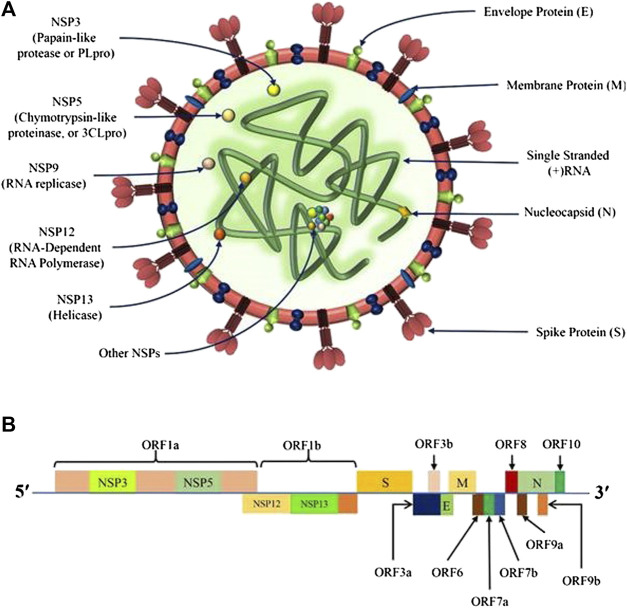
FIGURE 1
FIGURE 1
Genomic organization of SARS-CoV-2; (A) The structure of SARS-CoV-2 containing spherical crown-like lipid envelope showing structural proteins, namely Spike (S), Envelope (E), Nucleocapsid (N), and Membrane (M) proteins surrounding the non-segmented (+)-sense single stranded RNA encoding for several non-structural proteins (NSPs); (B) The SARS-CoV-2 genome representing the arrangement of - 5′ untranslated region (5′-UTR) caps, ORF1ab (replicase), S, E, M, N, and other genes encoding for the NSPs like ORF 3, 6, 7a, 7b, 8, and 9b; and 3′-UTR (poly-A tails).
FIGURE 2
FIGURE 2
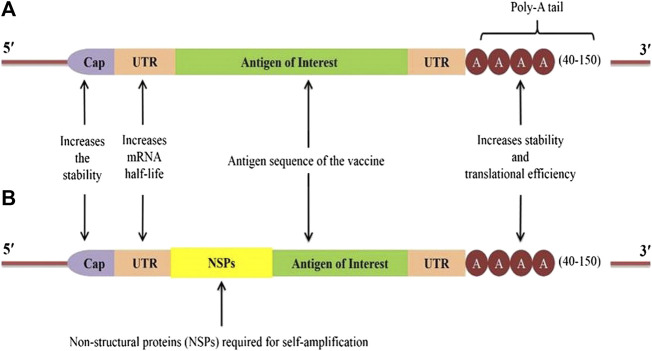
Construct of two types of RNA vaccines: (A) A typical conventional mRNA construct with Cap, untranslated regions (UTRs), antigen of interest, and poly-A tail; (B) self-amplifying mRNA or Replicons construct with the sequences of non-structural proteins (NSPs) derived from another virus (e.g. Alpha virus) introduced between the 5ʹ-UTR and the antigen of interest.
FIGURE 3
FIGURE 3
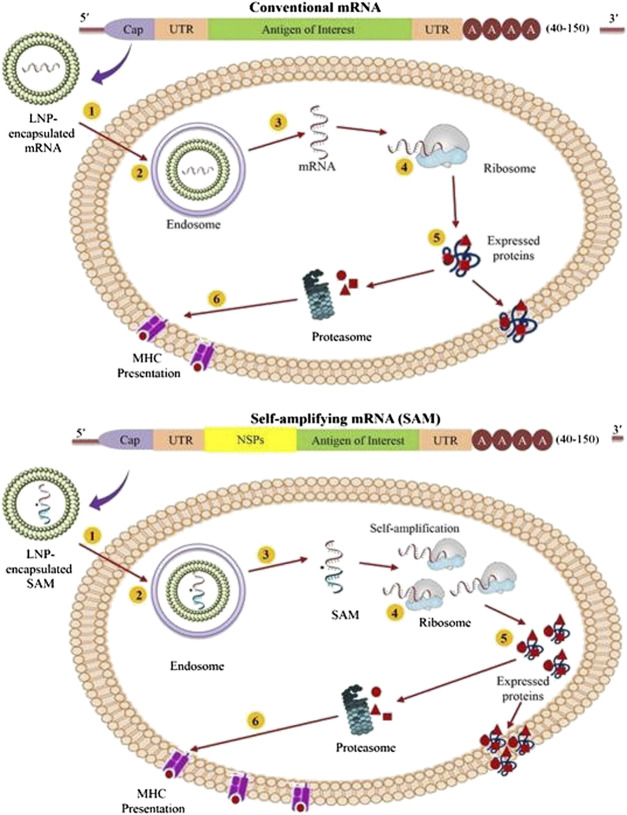
Diagrammatic representation of mechanism of antigen expression by the conventional mRNA (Top) and self-amplifying mRNA (SAM) vaccines (Bottom). (1) In this illustration, both conventional mRNA and SAM are shown to be formulated in lipid-derived nanoparticles (LNPs) to provide better stability; (2) The LNP formulated mRNA enters the cell through membrane-derived endocytosis processes; (3) The mRNA content shows endosomal escape to reach the cytosol; (4) In case of conventional type, the escaped mRNAs are immediately translated by the ribosomes to generate the protein of interest (Top), while SAM constructs undergoes translation to produce the replicase complex to exhibit self-amplification of the encoded mRNA, followed by translation of the antigen of interest to express the desired protein (Bottom); (5) Then the expressed proteins undergoes subsequent post-translational modification to appear as trans-membrane, intracellular or secreted protein; and (6) The expressed proteins are then broken down to peptides by the proteasome, and the peptide formed are presented to the immune system by the major histocompatibility complex (MHC).

References

    1. Ahammad I., Lira S. S. (2020). Designing a novel mRNA vaccine against SARS-CoV-2: an immunoinformatics approach. Int. J. Biol. Macromol. 162, 820–837. 10.1016/j.ijbiomac.2020.06.213 - DOI - PMC - PubMed
    1. Alanagreh L., Alzoughool F., Atoum M. (2020). The human coronavirus disease COVID-19: its origin, characteristics, and insights into potential drugs and its mechanisms. Pathogens 9, 331. 10.3390/pathogens9050331 - DOI - PMC - PubMed
    1. Alberer M., Gnad-Vogt U., Hong H. S., Mehr K. T., Backert L., Finak G., et al. (2017). Safety and immunogenicity of a mRNA rabies vaccine in healthy adults: an open-label, non-randomised, prospective, first-in-human phase 1 clinical trial. Lancet 390, 1511–1520. 10.1016/S0140-6736(17)31665-3 - DOI - PubMed
    1. Alwis R. d., Gan E. S., Chen S., Leong Y. S., Tan H. C., Zhang S. L., et al. (2020). A single dose of self-transcribing and replicating RNA based SARS-CoV-2 vaccine produces protective adaptive immunity in mice. BioRxiv. 10.1101/2020.09.03.280446 - DOI - PMC - PubMed
    1. Anderluzzi G., Lou G., Gallorini S., Brazzoli M., Johnson R., O’Hagan D. T., et al. (2020). Investigating the impact of delivery system design on the efficacy of self-amplifying RNA vaccines. Vaccines 8, 212. 10.3390/vaccines8020212 - DOI - PMC - PubMed

LinkOut - more resources