


Effect of suspension training on neuromuscular function, postural control, and knee kinematics in anterior cruciate ligament reconstruction patients
- PMID: 33869600
- PMCID: PMC8026838
- DOI: 10.12998/wjcc.v9.i10.2247
Effect of suspension training on neuromuscular function, postural control, and knee kinematics in anterior cruciate ligament reconstruction patients
Abstract
Background: Suspension training (SET) is a method of neuromuscular training that enables the body to carry out active training under unstable support through a suspension therapy system. However, there have been few reports in the literature on the application of SET to anterior cruciate ligament reconstruction (ACLR) patients. It is not clear what aspects of the patient's function are improved after SET.
Aim: To investigate the effect of SET on the neuromuscular function, postural control, and knee kinematics of patients after ACLR surgery.
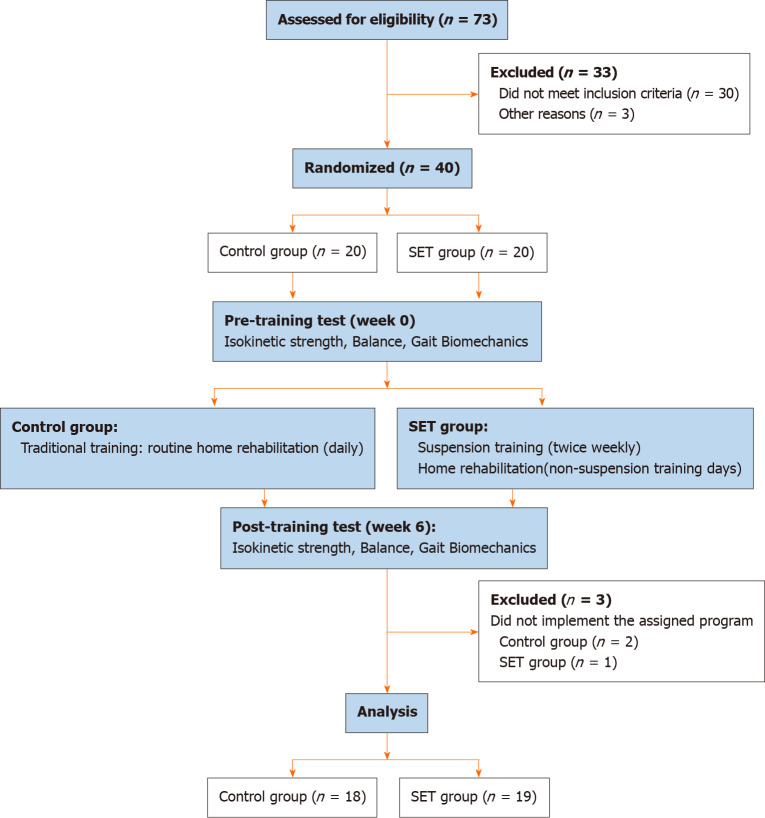
Methods: Forty participants were randomized to an SET group or a control group. The SET group subjects participated in a SET protocol over 6 wk. The control group subjects participated in a traditional training protocol over 6 wk. Isokinetic muscle strength of the quadriceps and hamstrings, static and dynamic posture stability test, and relative translation of the injured knee were assessed before and after training.
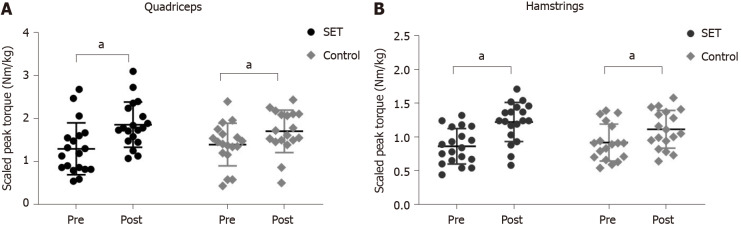
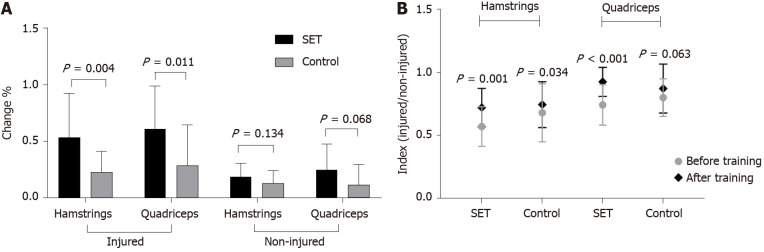
Results: The relative peak torque of the quadriceps and hamstrings in both groups increased significantly (P < 0.001), and the SET group increased by a higher percentage than those in the control group (quadriceps: P = 0.004; hamstrings: P = 0.011). After training, both groups showed significant improvements in static and dynamic posture stability (P < 0.01), and the SET group had a greater change than the control group (P < 0.05). No significant improvement on the relative translation of the injured knee was observed after training in either group (P > 0.05).
Conclusion: Our findings show that SET promotes great responses in quadriceps and hamstring muscle strength and balance function in ACLR patients.
Keywords: Anterior cruciate ligament reconstruction; Knee kinematics; Neuro-muscular function; Postural control; Rehabilitation; Suspension training.
©The Author(s) 2021. Published by Baishideng Publishing Group Inc. All rights reserved.
Conflict of interest statement
Conflict-of-interest statement: We have no conflicts of interest to report.
Figures

References
-
- Musahl V, Becker R, Fu FH, Karlsson J. New trends in ACL research. Knee Surg Sports Traumatol Arthrosc. 2011;19 Suppl 1:S1–S3. - PubMed
-
- Perraton L, Clark R, Crossley K, Pua YH, Whitehead T, Morris H, Telianidis S, Bryant A. Impaired voluntary quadriceps force control following anterior cruciate ligament reconstruction: relationship with knee function. Knee Surg Sports Traumatol Arthrosc. 2017;25:1424–1431. - PubMed
-
- Andriacchi TP, Dyrby CO. Interactions between kinematics and loading during walking for the normal and ACL deficient knee. J Biomech. 2005;38:293–298. - PubMed
LinkOut - more resources
Full Text Sources
Other Literature Sources
Medical
