


Coexistence of osteoporosis, sarcopenia and obesity in community-dwelling adults - The Yishun Study
- PMID: 33869801
- PMCID: PMC8044590
- DOI: 10.1016/j.afos.2020.12.002
Coexistence of osteoporosis, sarcopenia and obesity in community-dwelling adults - The Yishun Study
Abstract
Objectives: To 1) report prevalence of 'osteosarcopenia' (OS) and osteosarcopenic obesity (OSO) entities using evidence-based diagnostic techniques and definitions, 2) examine if OSO offers additional predictive value of functional decline over its components, and 3) identify associated factors in a multi-racial Southeast Asian population.
Methods: We performed a cross-sectional study of a representative sample of 542 community-dwelling adults (21-90 years old), and assessed anthropometry, cognition, functional performance, and self-report sociodemographic, health and lifestyle questionnaires. Low muscle mass, and the Asian Working Group for Sarcopenia (AWGS) 2019 criteria, were used to assess sarcopenia. Obesity was defined using percentage body fat and fat mass index. Osteopenia/osteoporosis was determined using lumbar spinal bone mineral density. Associated factors were examined using logistic regression, and OSO's value investigated using linear regressions with functional performance.
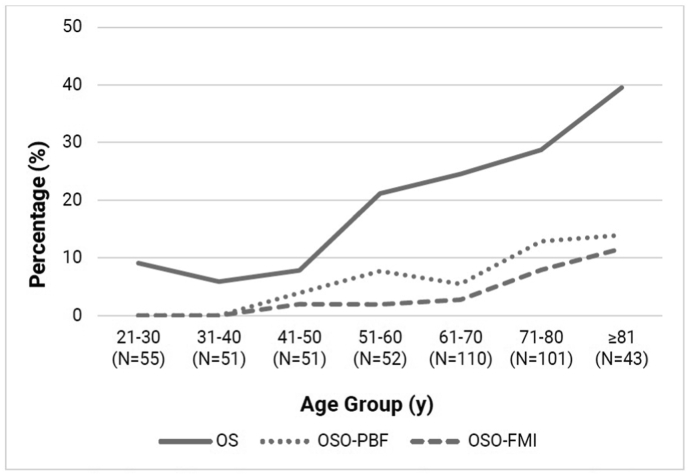
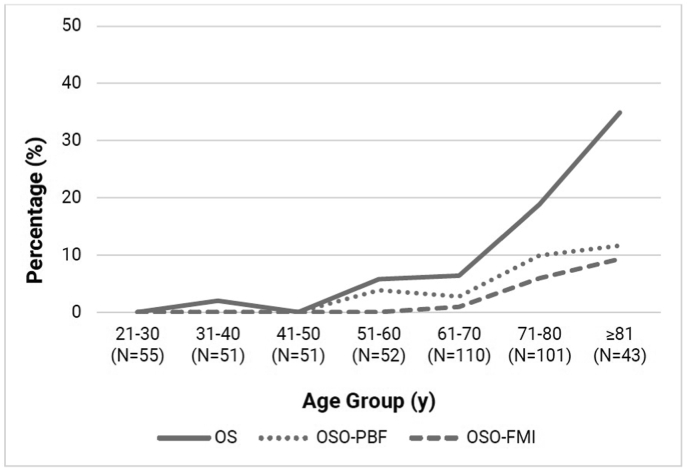
Results: OS and OSO prevalence were 1.8% and 0% (21-59 years), 12.9% and 2.8% (≥ 60 years), 17.3% and 4.1% (≥ 65 years), and 25.5% and 7.0% (≥75 years), respectively. OSO entity as defined was not a significant predictor (P > 0.05) and did not improve explanations for functional decline over sarcopenia or sarcopenic obesity. Age, sex, race and body mass index (BMI) were associated with OS, while age, sex, race and alcoholism were associated with OSO.
Conclusions: Our results do not support OSO as a distinct entity in relation to functional decline. Aside from biological age, sex, and race, amenable lifestyle factors such as BMI and alcohol intake are important variables that can influence the co-existence of osteopenia/osteoporosis, sarcopenia and obesity.
Keywords: Obesity; Osteopenia; Osteosarcopenic obesity; Prevalence; Sarcopenia.
© 2020 The Korean Society of Osteoporosis. Publishing services by Elsevier B.V.
Conflict of interest statement
The authors declare no competing interests.
Figures
References
-
- United Nations DoEaSA, Population Division World population prospects 2019: highlights. New York: United Nations. 2019. https://population.un.org/wpp/Publications/Files/WPP2019_Highlights.pdf Available from:
-
- Chen L.-K., Woo J., Assantachai P., Auyeung T.-W., Chou M.-Y., Iijima K. Asian working group for sarcopenia: 2019 consensus update on sarcopenia diagnosis and treatment. J Am Med Dir Assoc. 2020;21 300-7.e2. - PubMed
-
- Kalinkovich A., Livshits G. Sarcopenic obesity or obese sarcopenia: a cross talk between age-associated adipose tissue and skeletal muscle inflammation as a main mechanism of the pathogenesis. Ageing Res Rev. 2017;35:200–221. - PubMed
-
- Drey M., Sieber C.C., Bertsch T., Bauer J.M., Schmidmaier R. The FiAT ig. Osteosarcopenia is more than sarcopenia and osteopenia alone. Aging Clin Exp Res. 2016;28:895–899. - PubMed
LinkOut - more resources
Full Text Sources
Other Literature Sources
