


Oxidative stability of high oleic sunflower oil during deep-frying process of purple potato Purple Majesty
- PMID: 33869817
- PMCID: PMC8035487
- DOI: 10.1016/j.heliyon.2021.e06294
Oxidative stability of high oleic sunflower oil during deep-frying process of purple potato Purple Majesty
Abstract
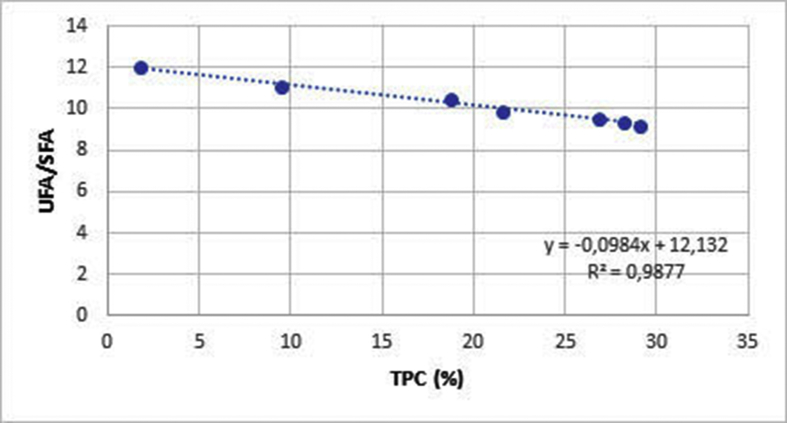
The behaviour of high oleic sunflower oil in deep frying process of purple potato Purple Majesty has been evaluated simulating a fast food cooking process. This oil was used for 8h/day for 6 days, filling up from the 2nd day. A discontinuous and prolonged procedure was tested. Free Fatty Acidity (FFA), Peroxide Value (PV), Total Polar Compounds (TPC), Fatty Acid (FA) composition, Volatile Organic Compounds (VOC) have been determined at different times in thermo-oxidized (T-OX) oil, and in frying oil. The FFA in T-OX oil samples showed values in the range 0.09%-0.24%, whereas in the frying oil values varied in a range between 0.09% and 0.16%. TPCs values varied from 1.76% to 38.24% in T-OX oils, whereas in frying oil used for frying purple potatoes (FOPP) showed values in the range from 1.76 to 29.13%. The peroxides values did not follow a regular pattern, both during thermo-oxidation and during frying. Among the Long Chain Fatty Acids (LCFAs), oleic acid was the most represented (84.13%). Short chain fatty acids (SCFAs) amount was 0.34% (octanoic acid). Medium chain fatty acids (MCFA) amount was 4.45% (palmitic acid). During the thermo-oxidation, the poly-unsaturated fatty acids (PUFA) amount decreased during the 48 h of heat treatment, reaching an amount of 6.21%. This determined the increase in short chain fatty acids (SCFA). Trans fatty acids increased with the frying time. Unsaturated fatty acids (UFA) reached the value of 90.19%; SFA was 9.79%, and octanoic acid was 0.20%. A correlation between TPC vs UFA/SFA and TPC vs C18:2/C16:0 was observed in the frying oil. The most abundant volatile compounds in frying oil (from 0 to 48 h) were the aldehydes produced by decomposition of hydroperoxides of oleic and linoleic acids.
Keywords: Deep frying; High oleic sunflower oil; Oxidative stability; Purple potato “Purple Majesty”; Thermo-oxidation.
© 2021 Published by Elsevier Ltd.
Conflict of interest statement
The authors declare the following conflict of interests: Antonello Santini; [is an Associate Editor for the Food Science and Nutrition section of Heliyon.]
Figures


References
-
- Abdulkarim S.M., Ghazali H.M. Fatty acid ratios and their relative amounts as indicators of oil stability and extent of oil deterioration during frying. J. Food Agric. Environ. 2012;10(2):33–38.
-
- Aladedunye F., Przybylski R. Performance of palm olein and modified rapeseed, sunflower, and soybean oils in intermittent deep-frying. Eur. J. Lipid Sci. 2013;116:144–152.
-
- Bou R., Navas J.A., Tres A., Codony R., Guardiola F. Quality assessment of frying fats and fried snacks during continuous deep-fat frying at different large scale producers. Food Contr. 2012;27(1):254–267.
-
- Chang C., Wu G., Zhang H., Jin Q., Wang X. Deep-fried flavor: characteristics, formation mechanisms, and influencing factors. Crit. Rev. Food Sci. Nutr. 2019;11:1–19. - PubMed
-
- Cheng S., Tu M., Liu H., Zhao G., Du M. Food-derived antithrombotic peptides: preparation, identification, and interactions with thrombin. Crit. Rev. Food Sci. Nutr. 2019:1–15. - PubMed
LinkOut - more resources
Full Text Sources
Other Literature Sources
