


Comparative Analysis of the Bibliographic Data Sources Dimensions and Scopus: An Approach at the Country and Institutional Levels
- PMID: 33870055
- PMCID: PMC8025979
- DOI: 10.3389/frma.2020.593494
Comparative Analysis of the Bibliographic Data Sources Dimensions and Scopus: An Approach at the Country and Institutional Levels
Abstract
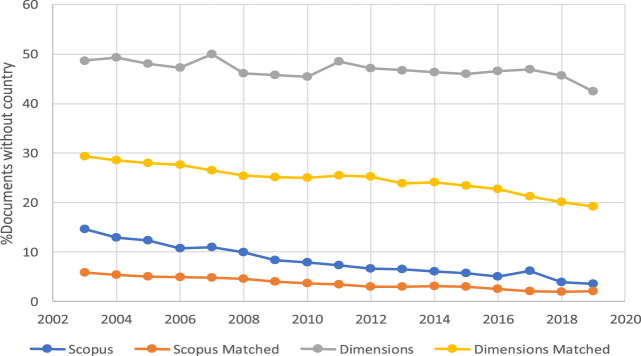
This paper presents a large-scale document-level comparison of two major bibliographic data sources: Scopus and Dimensions. The focus is on the differences in their coverage of documents at two levels of aggregation: by country and by institution. The main goal is to analyze whether Dimensions offers as good new opportunities for bibliometric analysis at the country and institutional levels as it does at the global level. Differences in the completeness and accuracy of citation links are also studied. The results allow a profile of Dimensions to be drawn in terms of its coverage by country and institution. Dimensions' coverage is more than 25% greater than Scopus which is consistent with previous studies. However, the main finding of this study is the lack of affiliation data in a large fraction of Dimensions documents. We found that close to half of all documents in Dimensions are not associated with any country of affiliation while the proportion of documents without this data in Scopus is much lower. This situation mainly affects the possibilities that Dimensions can offer as instruments for carrying out bibliometric analyses at the country and institutional level. Both of these aspects are highly pragmatic considerations for information retrieval and the design of policies for the use of scientific databases in research evaluation.
Keywords: Dimensions; Scopus; bibliographic data sources; database coverage; research evaluation; scientometrics, bibliometrics.
Copyright © 2021 Guerrero-Bote, Chinchilla-Rodríguez, Mendoza and de Moya-Anegón.
Conflict of interest statement
The authors declare that the research was conducted in the absence of any commercial or financial relationships that could be construed as a potential conflict of interest.
Figures
References
-
- Adams J., Jones P., Porter S., Szomszor M., Draux H., Osipov I. (2018). Dimensions–A collaborative approach to enhancing research discovery. Technical report. Digital Science. 10.6084/m9.figshare.5783160.v1 - DOI
-
- Archambault É., Campbell D., Gingras Y., Larivière V. (2009). Comparing bibliometric statistics obtained from the Web of Science and Scopus. J. Am. Soc. Inf. Sci. 60 (7), 1320–1326. 10.1002/asi.21062 - DOI
-
- Baas J., Schotten M., Plume A., Côté G., Karimi R. (2020). Scopus as a curated, high-quality bibliometric data source for academic research in quantitative science studies. Quant. Sci. Stud. 1 (1), 377–386. 10.1162/qss_a_00019 - DOI
-
- Bode C., Herzog C., Hook D., McGrath R. (2019). A guide to the dimensions data approach. Technical report. Digital Science. 10.6084/m9.figshare.5783094.v5 - DOI
LinkOut - more resources
Full Text Sources
Other Literature Sources
