


Intestinal function is impaired in patients with Chronic Obstructive Pulmonary Disease
- PMID: 33873268
- PMCID: PMC8058450
- DOI: 10.1016/j.clnu.2020.10.010
Intestinal function is impaired in patients with Chronic Obstructive Pulmonary Disease
Abstract
Background & aims: Gastrointestinal symptoms are prevalent extrapulmonary systemic manifestations of Chronic Obstructive Pulmonary Disease (COPD), but have been rarely studied. We dissected the perturbations in intestinal function in human patients with COPD using comprehensive metabolic and physiological approaches.
Methods: In this observational study, small intestinal membrane integrity and active carrier-mediated glucose transport were quantified by sugar permeability test in 21 clinically stable patients with moderate to severe COPD (mean FEV1, 41.2 (3.2) % of predicted) and 16 healthy control subjects. Protein digestion and absorption was analyzed using stable tracer kinetic methods. Plasma acetate, propionate, and butyrate concentrations were measured as markers of intestinal microbial metabolism.
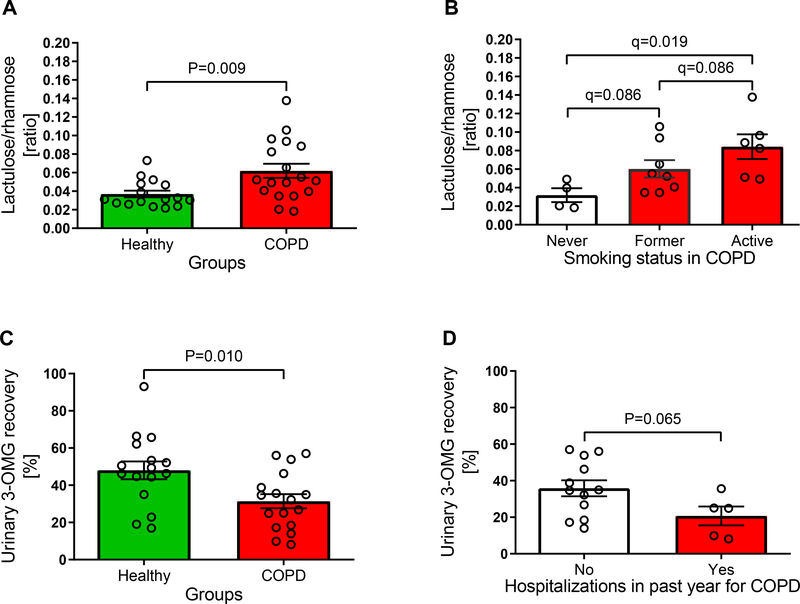
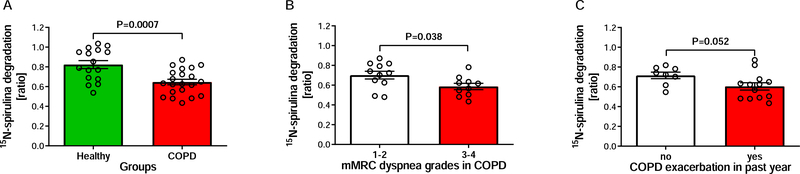
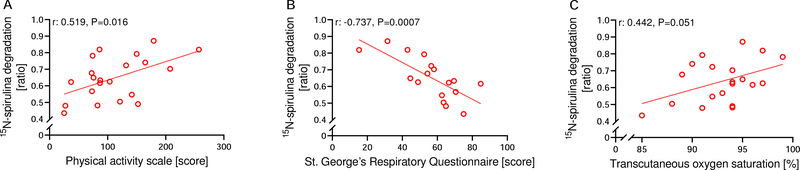
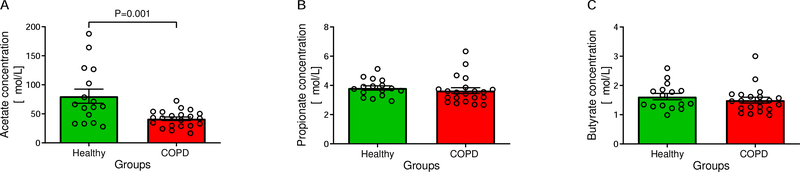
Results: Compared with healthy controls, non carrier-mediated permeability was higher (0.062 (95% CI [0.046, 0.078]) vs. 0.037 (95% CI [0.029, 0.045]), P = 0.009) and active glucose transport lower in COPD (31.4 (95% CI [23.4, 39.4])% vs. 48.0 (95% CI [37.8, 58.3])%, P = 0.010). Protein digestion and absorption was lower in COPD (0.647 (95% CI [0.588, 0.705]) vs. 0.823 (95% CI [0.737, 0.909]), P = 0007), and impairment greater in patients with dyspnea (P = 0.038), exacerbations in preceding year (P = 0.052), and reduced transcutaneous oxygen saturation (P = 0.051), and was associated with reduced physical activity score (P = 0.016) and lower quality of life (P = 0.0007). Plasma acetate concentration was reduced in COPD (41.54 (95% CI [35.17, 47.91]) vs. 80.44 (95% CI [54.59, 106.30]) μmol/L, P = 0.001) suggesting perturbed intestinal microbial metabolism.
Conclusions: We conclude that intestinal dysfunction is present in COPD, worsens with increasing disease severity, and is associated with reduced quality of life.
Keywords: Comorbidity; Gut dysfunction; Oral sugar tests; Protein digestion and absorption; Short-chain fatty acids; Stable tracer kinetics.
Copyright © 2020 Elsevier Ltd and European Society for Clinical Nutrition and Metabolism. All rights reserved.
Conflict of interest statement
Conflict of interest The authors have no competing interests to declare.
Figures
References
-
- Nielsen HM, Rodsgaard PA, Weinreich UM. Chronic obstructive pulmonary disease as comorbidity in patients admitted to a university hospital: a cross-sectional study. The clinical respiratory journal. 2014;8(3):274–80. - PubMed
-
- Ekbom A, Brandt L, Granath F, Lofdahl CG, Egesten A. Increased risk of both ulcerative colitis and Crohn’s disease in a population suffering from COPD. Lung. 2008;186(3):167–72. - PubMed
-
- Niklasson A, Strid H, Simren M, Engstrom CP, Bjornsson E. Prevalence of gastrointestinal symptoms in patients with chronic obstructive pulmonary disease. European journal of gastroenterology & hepatology. 2008;20(4):335–41. - PubMed
-
- Rutten EP, Spruit MA, Franssen FM, Buurman WA, Wouters EF, Lenaerts K. GI symptoms in patients with COPD. Chest. 2014;145(6):1437–8. - PubMed
-
- Rutten EPA, Lenaerts K, Buurman WA, Wouters EFM. Disturbed intestinal integrity in patients with COPD: effects of activities of daily living. Chest. 2014;145(2):245–52. - PubMed
Publication types
MeSH terms
Substances
Grants and funding
LinkOut - more resources
Full Text Sources
Other Literature Sources
Medical
