


Prevalence of Rhesus D negativity among reproductive age women in Southern Ethiopia: a cross-sectional study
- PMID: 33874938
- PMCID: PMC8054355
- DOI: 10.1186/s12905-021-01315-3
Prevalence of Rhesus D negativity among reproductive age women in Southern Ethiopia: a cross-sectional study
Abstract
Background: The Rhesus (Rh) blood group system is the next most clinically significant blood group system following the ABO blood group. Rh D-negative women are at risk of alloimmunization following exposure to Rh D-positive blood. The exposure of Rh D-negative women to Rh D-positive fetal blood may cause hemolytic disease of the fetus or new-born due to Rh incompatibility. Knowing Rh blood phenotype has paramount importance to prevent the risk of sensitization and bad obstetric outcome in Rh D-negative women. Despite the aforementioned fact, the distribution of Rh D-negative phenotype of women was not explored in Arba Minch Zuria district, southern Ethiopia. This study was aimed to assess the prevalence of Rh D-negative blood phenotype among reproductive-age women in Arba Minch Zuria district, southern Ethiopia.
Methods and materials: A community-based cross-sectional study was conducted among reproductive-age women in Arba Minch Zuria district, Southern Ethiopia from March to April 2019. Socio-demographic data were collected using an interviewer-administered semi-structured questionnaire and blood phenotype determination was done by laboratory technicians using the slide method principle aseptically and Statistical Package for Social Science (SPSS) version 21 was used for analysis.
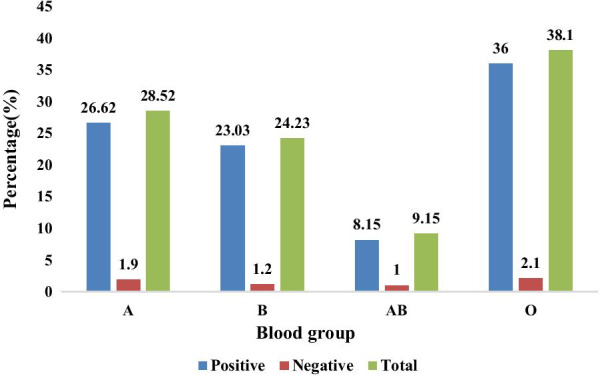
Result: The data were collected from 417 study participants with a 98.8% response rate. This study revealed that 2.1%, 1.9%, 1.2%, and 1% of study participants with blood group O, A, B, and AB were Rh D negative, respectively. In this study, the overall prevalence of Rh D negative phenotype was found 6.2% among reproductive-age women in Arba Minch Zuria district, Southern Ethiopia.
Conclusions: This study showed a high prevalence of Rh D negative factor among reproductive-age women in Arba Minch Zuria district. Therefore, counseling of reproductive age women on the importance of Rh D factor status determination would be worthy to avoid the potential risk of sensitization among Rh D negative women in order to prevent hemolytic disease of the fetus and new-born.
Keywords: Blood phenotype; Reproductive women; Rh negative; Rhesus D factor.
Conflict of interest statement
The authors report no conflict of interest in this work.
Figures
References
-
- Contreras M, Daniels G. Antigens in human blood. In: Hoffbrand AV, Catovsky D (eds) Postgraduate haematology, 6 ed. Wiley, West Sussex. 2011; 244–267.
-
- Landsteiner K, Weiner AS. An agglutinable factor in human blood recognized by immune serum for rhesus blood. Proc Soc Exp Biol Med. 1940;43:223–4. doi: 10.3181/00379727-43-11151. - DOI
-
- Hunshikatti KB. PR Pranita A study on the prevalence of rhesus factor among at tertiary care center in North Karnataka. Int J Curr Res. 2015;7(01):11556–8.
-
- Reid ME, Lomas Francis C. The blood group antigen facts book. Elsevier Academic Press, London, 2005.
MeSH terms
LinkOut - more resources
Full Text Sources
Other Literature Sources
Research Materials
Miscellaneous
