. 2021 Jun 17;65(7):e0027521.
doi: 10.1128/AAC.00275-21. Epub 2021 Jun 17.

Pharmacogene Sequencing of a Gabonese Population with Severe Plasmodium falciparum Malaria Reveals Multiple Novel Variants with Putative Relevance for Antimalarial Treatment

Affiliations

Pharmacogene Sequencing of a Gabonese Population with Severe Plasmodium falciparum Malaria Reveals Multiple Novel Variants with Putative Relevance for Antimalarial Treatment

Leyre Pernaute-Lau et al. Antimicrob Agents Chemother. .

Abstract

Malaria remains one of the deadliest diseases in Africa, particularly for children. While successful in reducing morbidity and mortality, antimalarial treatments are also a major cause of adverse drug reactions (ADRs). Host genetic variation in genes involved in drug disposition or toxicity constitutes an important determinant of ADR risk and can prime for parasite drug resistance. Importantly, however, the genetic diversity in Africa is substantial, and thus, genetic profiles in one population cannot be reliably extrapolated to other ethnogeographic groups. Gabon is considered a high-transmission country, with more than 460,000 malaria cases per year. Yet the pharmacogenetic landscape of the Gabonese population or its neighboring countries has not been analyzed. Using targeted sequencing, here, we profiled 21 pharmacogenes with importance for antimalarial treatment in 48 Gabonese pediatric patients with severe Plasmodium falciparum malaria. Overall, we identified 347 genetic variants, of which 18 were novel, and each individual was found to carry 87.3 ± 9.2 (standard deviation [SD]) variants across all analyzed genes. Importantly, 16.7% of these variants were population specific, highlighting the need for high-resolution pharmacogenomic profiling. Between one in three and one in six individuals harbored reduced-activity alleles of CYP2A6, CYP2B6, CYP2D6, and CYP2C8 with important implications for artemisinin, chloroquine, and amodiaquine therapy. Furthermore, one in three patients harbored at least one G6PD-deficient allele, suggesting a considerably increased risk of hemolytic anemia upon exposure to aminoquinolines. Combined, our results reveal the unique genetic landscape of the Gabonese population and pinpoint the genetic basis for interindividual differences in antimalarial drug responses and toxicity.

Keywords: Gabon; malaria; population pharmacogenetics; precision medicine; public health.


Figures
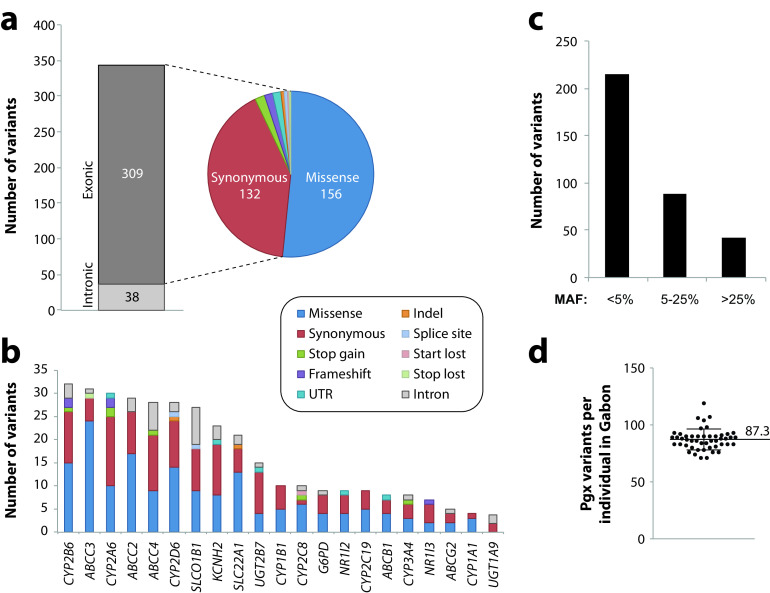
FIG 1
FIG 1
Overview of the pharmacogenetic landscape in the Gabonese population. (a) Across the 21 pharmacogenes analyzed, a total of 347 different variants were identified, of which 309 were exonic. The majority of exonic variants resulted in amino acid exchanges (missense) or were synonymous. (b) Stacked column plot showing the number of variants per variant class per gene. Note that variant numbers differed >10-fold between genes. (c) The majority of variants were rare, with minor allele frequencies (MAFs) of <5%. (d) On average, each individual in the Gabonese cohort harbored between 71 and 119 variants in the analyzed pharmacogenes combined (mean ± standard deviation [SD], 87.3 ± 9.2). Pgx, pharmacogenetic.
FIG 2
FIG 2
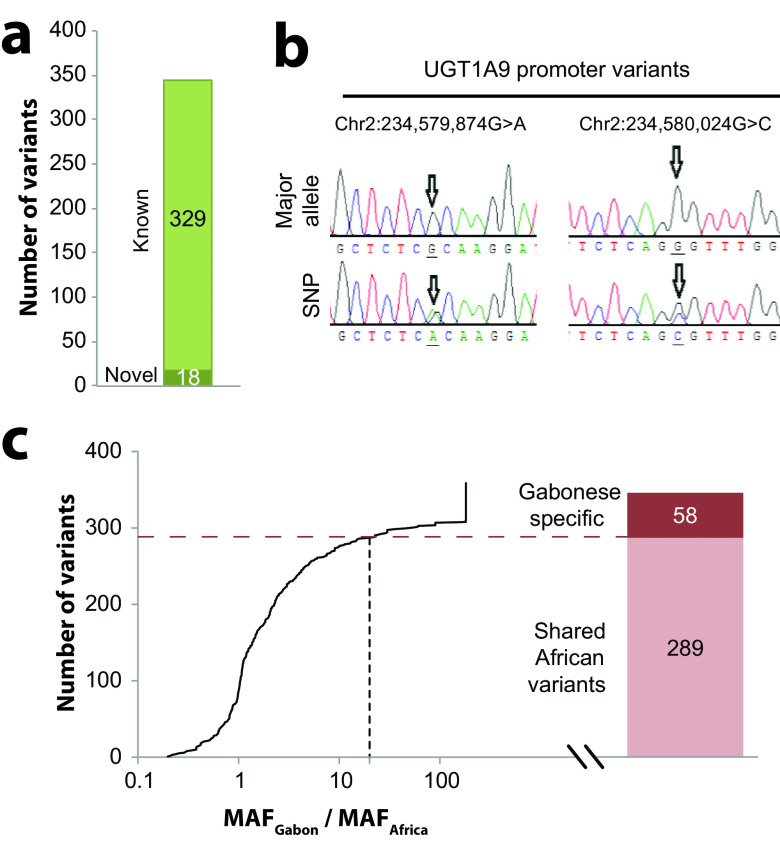
The pharmacogenetic variability in Gabon is highly population specific. (a) Across all genes, 18 novel variations were identified, accounting for 4.6% of all variants. (b) Sanger sequencing data showing the nucleotide sequences (sense strands) in the promoter of UGT1A9. Major alleles are shown in the top row, while the bottom rows show the heterozygous variants. Arrows indicate the variant positions. SNP, single-nucleotide polymorphism. (c) Of all 347 detected variants, 16.7% (n = 58) were specific to the Gabonese population, as defined by a ≥20-fold increased minor allele frequency in Gabon (MAFGabon) compared to African reference populations (MAFAfrica), and each individual carried on average 2.2 population-specific pharmacogenetic variants.
FIG 3
FIG 3
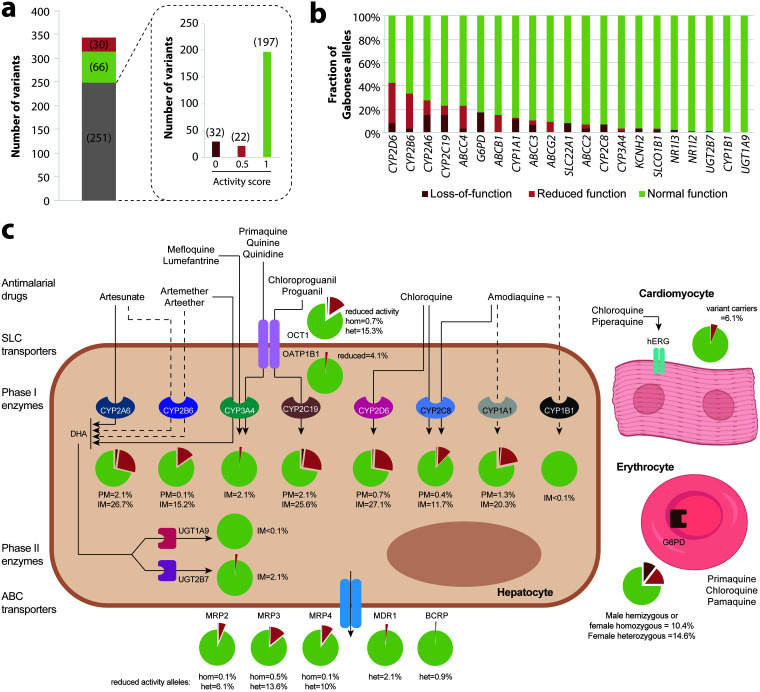
Estimated functional consequences and clinical implications of pharmacogenetic variation in Gabon. (a) Of all 347 variants, 66 were annotated as functionally neutral (green), whereas 30 had known functional consequences on the drug response (red). The remaining 251 variants (gray) with unclear functions were analyzed using a computational prediction framework specifically developed for pharmacogenetic interpretations. Predicted outcomes of gene activity of these variants are shown in the dashed inset. Activity scores of 0, 0.5, and 1 correspond to loss-of-function variants, decreased-function variants, and neutral variants, respectively. (b) Fractions of loss-of-function alleles, reduced-function alleles, and normal-function alleles in the Gabonese population plotted for each of the 21 analyzed genes. (c) Schematic simplified depiction of the metabolic routes of antimalarials and the transporters and drug-metabolizing enzymes involved. The fractions of poor metabolizers (PM) (defined as a diplotype activity score of 0) (dark red), intermediate metabolizers (IM) (defined as a diplotype activity score of 0.5 or 1) (light red), and normal metabolizers (defined as a diplotype activity score of ≥1.5) (green) are shown as pie charts for each enzyme. For transporters, the fractions of heterozygous (het) and homozygous (hom) carriers of reduced-function alleles are shown analogously. Solid and dashed arrows indicate major and minor metabolic routes, respectively. DHA, dihydroartemisinin.

Similar articles

Cited by

References

    1. World Health Organization. 2019. WHO malaria report 2019. World Health Organization, Geneva, Switzerland.
    1. Cowman AF, Healer J, Marapana D, Marsh K. 2016. Malaria: biology and disease. Cell 167:610–624. 10.1016/j.cell.2016.07.055. - DOI - PubMed
    1. Ashley EA, Pyae Phyo A, Woodrow CJ. 2018. Malaria. Lancet 391:1608–1621. 10.1016/S0140-6736(18)30324-6. - DOI - PubMed
    1. Wicht KJ, Mok S, Fidock DA. 2020. Molecular mechanisms of drug resistance in Plasmodium falciparum malaria. Annu Rev Microbiol 74:431–454. 10.1146/annurev-micro-020518-115546. - DOI - PMC - PubMed
    1. Paganotti GM, Gallo BC, Verra F, Sirima BS, Nebié I, Diarra A, Coluzzi M, Modiano D. 2011. Human genetic variation is associated with Plasmodium falciparum drug resistance. J Infect Dis 204:1772–1778. 10.1093/infdis/jir629. - DOI - PubMed

Publication types