Review
. 2021 Oct;22(5-6):289-303.
doi: 10.1038/s41435-021-00126-8. Epub 2021 Apr 19.

The aging gut microbiome and its impact on host immunity

Affiliations
Review

The aging gut microbiome and its impact on host immunity

Nabil Bosco et al. Genes Immun. 2021 Oct.

Abstract

The microbiome plays a fundamental role in the maturation, function, and regulation of the host-immune system from birth to old age. In return, the immune system has co-evolved a mutualistic relationship with trillions of beneficial microbes residing our bodies while mounting efficient responses to fight invading pathogens. As we age, both the immune system and the gut microbiome undergo significant changes in composition and function that correlate with increased susceptibility to infectious diseases and reduced vaccination responses. Emerging studies suggest that targeting age-related dysbiosis can improve health- and lifespan, in part through reducing systemic low-grade inflammation and immunosenescence-two hallmarks of the aging process. However-a cause and effect relationship of age-related dysbiosis and associated functional declines in immune cell functioning have yet to be demonstrated in clinical settings. This review aims to (i) give an overview on hallmarks of the aging immune system and gut microbiome, (ii) discuss the impact of age-related changes in the gut commensal community structure (introduced as microb-aging) on host-immune fitness and health, and (iii) summarize prebiotic- and probiotic clinical intervention trials aiming to reinforce age-related declines in immune cell functioning through microbiome modulation or rejuvenation.


Conflict of interest statement

BN and NM are employees of Société des Produits Nestlé S.A.

Figures
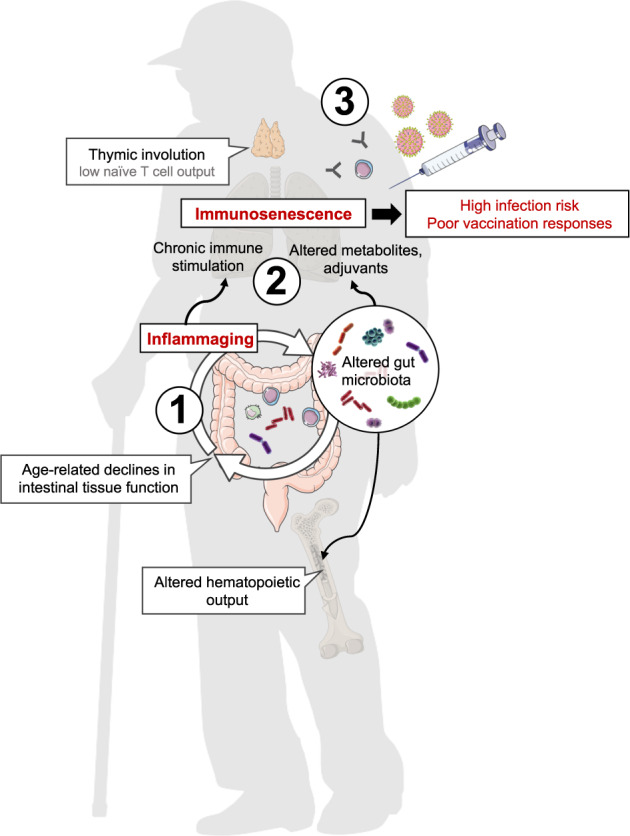
Fig. 1
Fig. 1. Microb-aging and related consequences for host immunity—a hypothetical model.
Age-related changes in gut-microbial communities and associated declines in intestinal tissue function may fuel inflammaging, creating a vicious cycle further impacting host-microbiome interactions (1). Chronic immune stimulation as a consequence of systemic low-grade inflammation and changes in the metabolome and microbial stimuli contribute to immunosenescence (2) that together with impaired immune repopulation (e.g., thymic involution, altered hematopoiesis) result in increased infection risk, and poor vaccination responses in the elderly (3).
Fig. 2
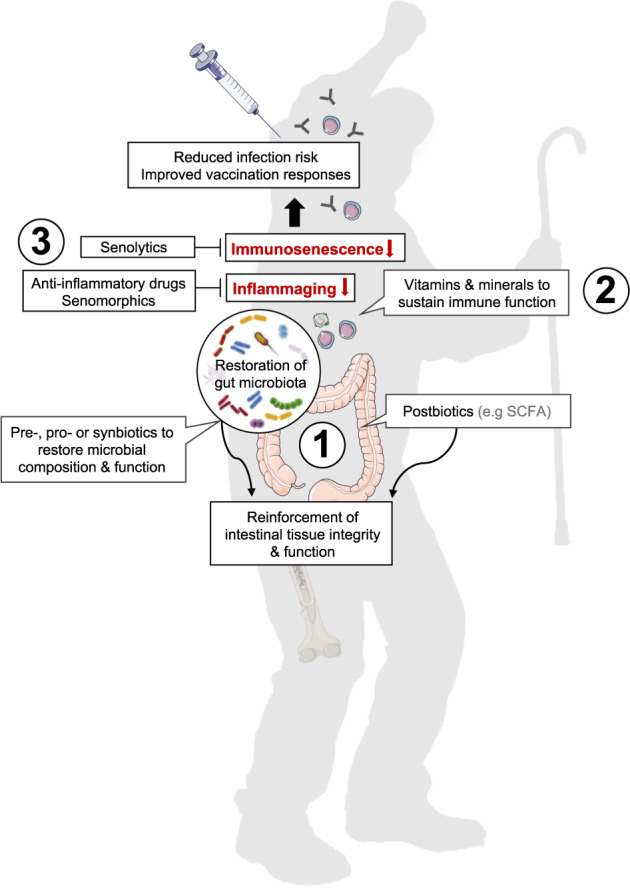
Fig. 2. Approaches to restore gut-microbial homeostasis, reduce inflammaging, and immunosenescence to support immunity in the elderly.
Nutritional intervention with pre- pro- or synbiotics as well as metabolites thereof (e.g., SCFAs) may help to restore age-related declines in gut-microbial composition and function, reinforce intestinal integrity and reduce systemic low-grade inflammation (1). Supplementation with vitamins and minerals contributes to normal immune cell functioning (2). Anti-inflammatory drugs or senomorphics may help to reduce inflammaging while senolytics directly eliminate senescent cells that fuel inflammaging (3). These approaches, as stand alone or in combination may help to reinforce host immunity to better control infections and mount appropriate vaccination responses as we age.

References

    1. Nikolich-Žugich J. The twilight of immunity: emerging concepts in aging of the immune system. Nat Immunol. 2018;19:10–9. doi: 10.1038/s41590-017-0006-x. - DOI - PubMed
    1. Crooke SN, Ovsyannikova IG, Poland GA, Kennedy RB. Immunosenescence and human vaccine immune responses. Immun Ageing. 2019;16:25–16. doi: 10.1186/s12979-019-0164-9. - DOI - PMC - PubMed
    1. Hägg S, Jylhävä J, Wang Y, Xu H, Metzner C, Annetorp M, et al. Age, frailty, and comorbidity as prognostic factors for short-term outcomes in patients with coronavirus disease 2019 in geriatric care. J Am Med Dir Assoc. 2020;21:1555–9.e2. doi: 10.1016/j.jamda.2020.08.014. - DOI - PMC - PubMed
    1. Tehrani S, Killander A, Åstrand P, Jakobsson J, Gille-Johnson P. Risk factors for death in adult COVID-19 patients: frailty predicts fatal outcome in older patients. Int J Infect Dis. 2021;102:415–21. doi: 10.1016/j.ijid.2020.10.071. - DOI - PMC - PubMed
    1. Badal VD, Vaccariello ED, Murray ER, Yu KE, Knight R, Jeste DV, et al. The gut microbiome, aging, and longevity: a systematic review. Nutrients. 2020;12:3759. doi: 10.3390/nu12123759. - DOI - PMC - PubMed

LinkOut - more resources