. 2021 Aug;36(4):395-409.
doi: 10.1177/07487304211006073. Epub 2021 Apr 20.

Chronotype-specific Sleep in Two Versus Four Consecutive Shifts

Affiliations

Chronotype-specific Sleep in Two Versus Four Consecutive Shifts

Dorothee Fischer et al. J Biol Rhythms. 2021 Aug.

Abstract

The study aimed to explore chronotype-specific effects of two versus four consecutive morning or night shifts on sleep-wake behavior. Sleep debt and social jetlag (a behavioral proxy of circadian misalignment) were estimated from sleep diary data collected for 5 weeks in a within-subject field study of 30 rotating night shift workers (29.9 ± 7.3 years, 60% female). Mixed models were used to examine whether effects of shift sequence length on sleep are dependent on chronotype, testing the interaction between sequence length (two vs. four) and chronotype (determined from sleep diaries). Analyses of two versus four morning shifts showed no significant interaction effects with chronotype. In contrast, increasing the number of night shifts from two to four increased sleep debt in early chronotypes, but decreased sleep debt in late types, with no change in intermediate ones. In early types, the higher sleep debt was due to accumulated sleep loss over four night shifts. In late types, sleep duration did not increase over the course of four night shifts, so that adaptation is unlikely to explain the observed lower sleep debt. Late types instead had increased sleep debt after two night shifts, which was carried over from two preceding morning shifts in this schedule. Including naps did not change the findings. Social jetlag was unaffected by the number of consecutive night shifts. Our results suggest that consecutive night shifts should be limited in early types. For other chronotypes, working four night shifts might be a beneficial alternative to working two morning and two night shifts. Studies should record shift sequences in rotating schedules.

Keywords: night work; rotation speed; shift rotation; shift scheduling; sleep deprivation; sleep regularity; social jetlag.


Conflict of interest statement

Conflict of Interest Statement: The author(s) declared the following potential conflicts of interest with respect to the research, authorship, and/or publication of this article: D.F. and T.R. declare no conflicts of interest. C.V., during the part of this work, received research support from the NIH, the Colorado Clinical and Translational Sciences Institute, and the University of Colorado Boulder; was an unpaid scientific advisory board member of Circadian Light Therapy Inc. and Chronosulting; and served as a paid consultant to the U.S. Department of Energy and NIOSH outside of the submitted work. Study design, data processing and analysis, and result presentation and interpretation were independent from third parties.

Figures

Figure 1.
Figure 1.
Chronotype-specific sleep debt for two versus four consecutive night shifts: (a) Sleep debt, calculated such that negative values indicate shorter sleep on workdays than first day off. (b) Average sleep duration after night shifts. (c) Average sleep duration on first day off after night shifts. (d) and (e) Sleep duration by order of consecutive night shifts. (f) Sleep onsets and offsets after night shifts. Abbreviations: ΔSleep duration = proxy for sleep debt; 2N = two consecutive night shifts; 4N = four consecutive night shifts. Note that chronotype was used as a continuous variable in regression models and cut-offs are used for illustration purposes only. *Significant (p ≤ 0.002) interaction effect “chronotype × number of consecutive shifts.”
Figure 2.
Figure 2.
Alternate approaches to calculating sleep debt. Different ways of calculating sleep debt were compared: the difference in sleep duration between (a) the average on workdays and the first day off (primary outcome of this study); (b) the average on workdays and the average across the first, second, and third day off; (c) the average on free days and the first day off; and (d) the average on workdays and the average on free days. Panels a-c show robust results for the effect of chronotype and shift sequences (2N vs. 4N) on sleep debt. While the more typical calculation of sleep debt as illustrated in panel d shows the known chronotype-dependency in sleep debt, it does not capture the otherwise observed interaction between chronotype and shift sequence. This calculation shows similar patterns for 2N and 4N, even though sleep loss accumulates over consecutive workdays. The similar patterns are due to the fact that average sleep duration across all free days is used as the reference, being the same for 2N and 4N. Abbreviations: 2N = two consecutive night shifts; 4N = four consecutive night shifts.
Figure 3.
Figure 3.
Chronotype-specific cumulative sleep loss (SLc): (a) and (b) 28-day shift schedule with morning shifts (light gray boxes), evening shifts (gray boxes), night shifts (dark gray boxes), and work-free days (white boxes). Striped boxes indicate first days off following a given shift sequence. Panel a shows 2-and 4-day blocks of consecutive night shifts (2N, 4N). Panel b shows 5-day blocks, including four workdays and one free day (2M + 2N, 4N). (c) Chronotype-specific SLc for shift sequences 2N versus 4N. (d) Sleep duration on first day off after 2N versus 4N. (e) Chronotype-specific SLc for 5-day shift sequences 2M + 2N versus 4N. (f) Sleep duration on first day off after 5-day shift sequences 2M + 2N versus 4N. Abbreviations: 4N = four consecutive night shifts; 2N = two consecutive night shifts; Seq2: 4N = shift sequence including one work-free day and four night shifts; Seq1: 2M + 2N = shift sequence including two morning shifts, one work-free day, and two night shifts. Note that chronotype was used as a continuous variable in regression models and cut-offs are used for illustration purposes only. *Significant (p ≤ 0.002) and #marginally significant (p < 0.10) interaction effect “chronotype × number of consecutive shifts.”
Figure 4.
Figure 4.
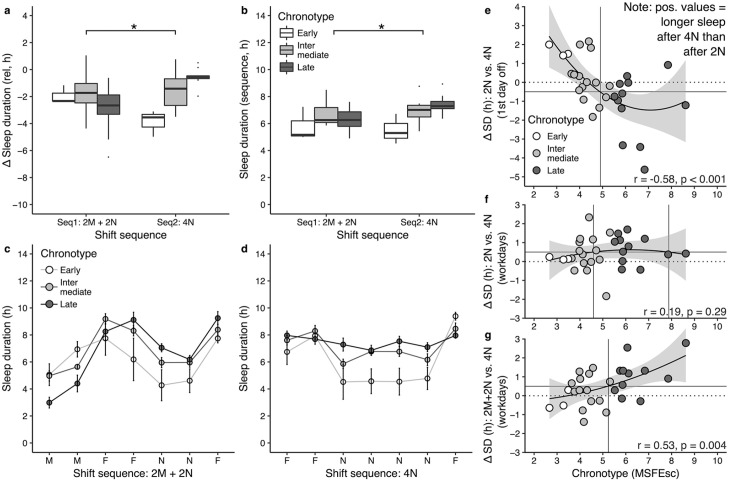
Chronotype-specific sleep in shift sequences including preceding morning shifts: (a) Sleep debt, calculated such that negative values indicate shorter sleep on workdays than first day off. (b) Average sleep duration in 5-day shift sequences: “Seq1: 2M + 2N” includes two morning shifts, one work-free day, and two night shifts; “Seq2: 4N” includes one work-free day and four night shifts. (c) and (d) Sleep duration by sleep episode in the shift sequence. Note that five workdays equal six associated sleep episodes, due to the night shift, for example, for the 3-day sequence “morning shift—work-free day—night shift,” there are four sleep episodes: one before the morning shift, a second after the morning shift and onto the work-free day, a third after the work-free day onto the first night shift, and a fourth the next day after the first night shift. (e) Difference in sleep duration on the first day off for 2N versus 4N. (f) Difference in sleep duration on workdays for 2N versus 4N. (g) Difference in sleep duration for 2M + 2N versus 4N. Positive values in panels e-g indicate more sleep for sequences with four night shifts than for sequences with two night shifts (2N, 2M + 2N). Abbreviations: Seq1: 2M + 2N = shift sequence including two morning shifts, one work-free day, and two night shifts; Seq2: 4N = shift sequence including one work-free day and four night shifts; 2N = two consecutive night shifts; 4N = four consecutive night shifts; MSFEsc = chronotype proxy. Note that chronotype was used as a continuous variable in regression models and cut-offs are used for illustration purposes only. *Significant (p ≤ 0.002) interaction effect “chronotype × number of consecutive shifts.”

References

    1. Åkerstedt T, Kecklund G, Ingre M, Lekander M, Axelsson J. (2009) Sleep homeostasis during repeated sleep restriction and recovery: support from EEG dynamics. Sleep 32:217-222. - PMC - PubMed
    1. Axelsson J, Kecklund G, Åkerstedt T, Donofrio P, Lekander M, Ingre M. (2008) Sleepiness and performance in response to repeated sleep restriction and subsequent recovery during semi-laboratory conditions. Chronobiol Int 25:297-308. - PubMed
    1. Behrens T, Burek K, Pallapies D, Kösters L, Lehnert M, Beine A, Wichert K, Kantermann T, Vetter C, Brüning T, et al. (2019) Decreased psychomotor vigilance of female shift workers after working night shifts. PLoS ONE 14:e0219087. - PMC - PubMed
    1. Boivin DB, Boudreau P. (2014) Impacts of shift work on sleep and circadian rhythms. Pathol Biol 62:292-301. - PubMed
    1. Braun R, Kath WL, Iwanaszko M, Kula-Eversole E, Abbott SM, Reid KJ, Zee PC, Allada R. (2018) Universal method for robust detection of circadian state from gene expression. Proc Natl Acad Sci U S A 115:E9247-E9256. - PMC - PubMed

Publication types

LinkOut - more resources