. 2021 May;100(5):542-548.
doi: 10.1177/0022034520979150.

A Novel Competence Pathway in the Oral Pathogen Streptococcus sobrinus

Affiliations

A Novel Competence Pathway in the Oral Pathogen Streptococcus sobrinus

J W Li et al. J Dent Res. 2021 May.

Abstract

Streptococcus sobrinus is an etiologic cause of dental caries (tooth decay) in humans. Our knowledge of S. sobrinus is scant despite the organism's important role in oral health. It is widely believed that S. sobrinus lacks the natural competence pathways that are used by other streptococci to regulate growth, virulence, and quorum sensing. The lack of natural competence has also prevented genetic manipulation of S. sobrinus, limiting our knowledge of its pathogenicity. We discovered that most strains of S. sobrinus contain a new class of the ComRS competence system. Although S. sobrinus is typically placed among the mutans group streptococci, the S. sobrinus ComRS system is most similar to the competence pathways in the salivarius group. Unlike all other ComRS systems, the S. sobrinus pathway contains 2 copies of the transcriptional regulator ComR and has a peptide pheromone (XIP) that lacks any aromatic amino acids. Synthetic XIP enables transformation of S. sobrinus with plasmid or linear DNA, and we leverage this newfound genetic tractability to confirm that only 1 of the ComR homologs is required for induced competence while the other appears to suppress competence. Exogenous XIP increases the expression of bacteriocin gene clusters and produces an antimicrobial response that inhibits growth of S. mutans. We also identified 2 strains of S. sobrinus that appear to be "cheaters" by either not responding to or not producing XIP. We show how a recombination event in the nonresponsive strain could restore function of the ComRS pathway but delete the gene encoding XIP. Thus, the S. sobrinus ComRS pathway provides new tools for studying this pathogen and offers a lens into the evolution of ecological cheaters.

Keywords: dental caries; genetics; microbiology; pheromones; quorum sensing; streptococcus.


Conflict of interest statement

Declaration of Conflicting Interests: The authors declared no potential conflicts of interest with respect to the research, authorship, and/or publication of this article.

Figures

Figure 1.
Figure 1.
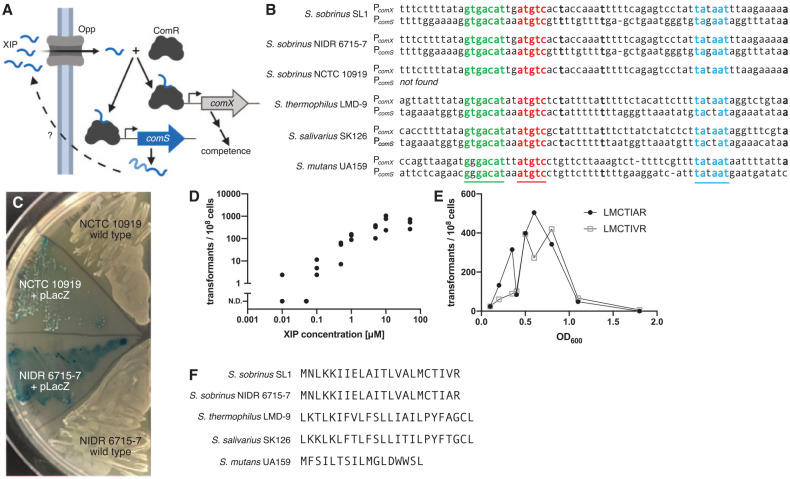
The peptide XIP induces competence in Streptococcus sobrinus. (A) The ComRS competence pathway in Streptococcus mutans forms an autocrine signaling loop. An unknown protein cleaves the leader peptide from ComS and exports the XIP precursor. Activated XIP is imported, where it facilitates dimerization of the transcriptional regulator ComR. The ComR/XIP complex binds a DNA motif to promote transcription of comX and comS. (B) The ComR/XIP binding motif appears upstream of the sigma factor comX. Using this sequence, we identified a comS gene in 2 strains of S. sobrinus. The comS gene appears downstream of a homolog of the regulator comR. (C) S. sobrinus strains NIDR 6715-7 and NCTC 10919 can be transformed with exogenous XIP. Both strains were transformed with a plasmid expressing LacZ. When plated with X-gal, the plasmid-carrying strains produce a blue color, but the wild type strains do not. (D) The transformation efficiency of S. sobrinus strain NCTC 10919 increases with XIP concentration. Transformation assays used linear DNA with homology to regions flanking comR. No transformants were observed without XIP. (E) Transformation efficiency peaks in the midexponential phase. Transformation assays were performed with strain NCTC 10919 and the pLacZ plasmid (Appendix Fig. 1) by using the predicted XIP for strains SL1 (LMCTIVR) and NIDR 6715-7 (LMCTIAR). No XIP precursor gene (comS) is found in the NCTC 10919 genome. (F) The S. sobrinus ComS peptides differ from sequences in S. mutans, Streptococcus salivarius, and Streptococcus thermophilus. In particular, all previously known XIP sequences in streptococci contain 2 aromatic amino acids; the XIP in S. sobrinus has none.
Figure 2.
Figure 2.
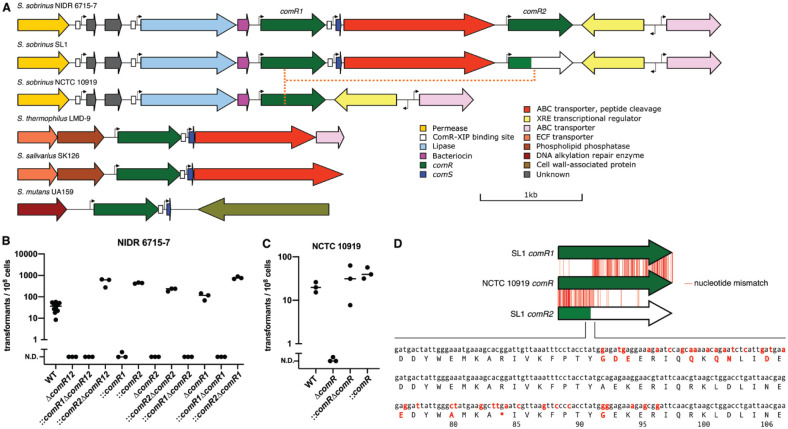
The Streptococcus sobrinus ComRS gene cluster is distinct from other streptococci. (A) The ComRS gene cluster in strains NIDR 6715-7 and SL1 contain 2 homologs of comR that we call comR1 and comR2. The type strain SL1 contains a truncated comR2 gene (green/white) and cannot be transformed. Strain NCTC 10919 has a single homolog of comR and no comS gene or a ComS export/cleavage gene. (B) Strain NIDR 6715-7 cannot be transformed if comR2 or the region from comR1 to comR2 is deleted. An additional copy of comR1 on a plasmid does not rescue transformation, but strains complemented with extra comR2 can be transformed. The horizontal bars represent the mean of the biological replicates (black dots). (C) The single comR homolog in strain NCTC 10919 is required for transformation. (D) The comR gene in strain NCTC 10919 appears to be a fusion of comR1 and comR2. A recombination event that produced comR would have removed the premature stop codon found in the comR2 gene of strain SL1.
Figure 3.
Figure 3.
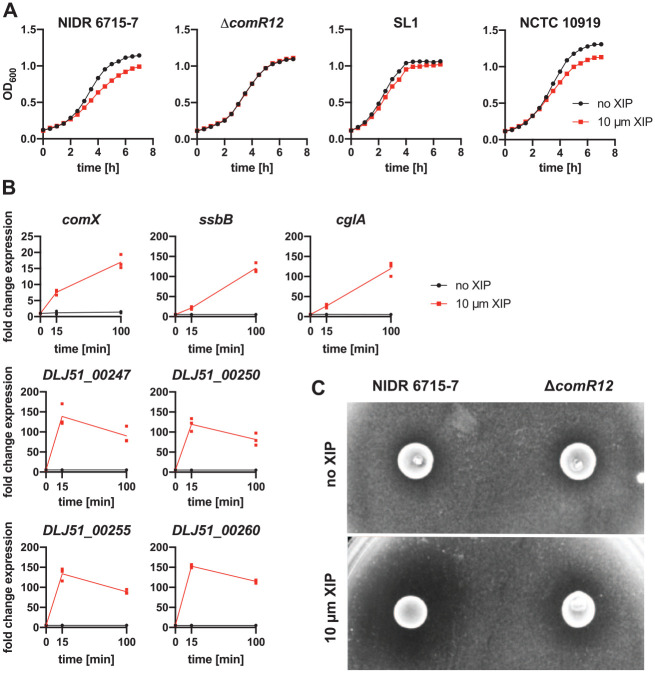
The ComRS pathway controls phenotypic changes in Streptococcus sobrinus. (A) Adding XIP to cultures of strain NIDR 6715-7 causes a growth defect. An NIDR 6715-7 deletion strain lacking the ComRS pathway (comR1, comS, the ComS exporter, and comR2) does not show a growth defect after XIP is added. The SL1 wild type strain cannot be transformed with XIP and does not show a growth defect, but the NCTC 10919 strain is transformable and grows slower in the presence of XIP. (B) XIP increases the expression of the comX, ssbB, and cglA genes in strain NIDR 6715-7. The ComR/XIP binding motif appears upstream of 4 genes in a bacteriocin gene cluster (DLJ51_00247, DLJ51_00250, DLJ51_00255, and DLJ51_00260). All 4 genes are upregulated after XIP is added. Each point is a biological replicate, and fold change is relative to the expression at time zero. (C) S. sobrinus inhibits the growth of S. mutans when XIP is added to cultures on solid agarose. A base layer of agarose containing XIP is topped with a second layer of agarose with embedded S. mutans UA159. Spotting S. sobrinus 6715-7 on top of the agarose inhibits the growth of Streptococcus mutans on plates containing XIP. The inhibition is reduced when the ComRS pathway is deleted from S. sobrinus.

References

    1. Avery OT, Macleod CM, McCarty M. 1944. Studies on the chemical nature of the substance inducing transformation of pneumococcal types : induction of transformation by a desoxyribonucleic acid fraction isolated from Pneumococcus type III. J Exp Med. 79(2):137–158. - PMC - PubMed
    1. Camacho C, Coulouris G, Avagyan V, Ma N, Papadopoulos J, Bealer K, Madden TL. 2009. BLAST+: architecture and applications. BMC Bioinform. 10:421. - PMC - PubMed
    1. Chang JC, LaSarre B, Jimenez JC, Aggarwal C, Federle MJ. 2011. Two group A streptococcal peptide pheromones act through opposing Rgg regulators to control biofilm development. PLoS Pathog. 7(8):e1002190. - PMC - PubMed
    1. Conrads G, de Soet JJ, Song L, Henne K, Sztajer H, Wagner-Döbler I, Zeng AP. 2014. Comparing the cariogenic species Streptococcus sobrinus and S. mutans on whole genome level. J Oral Microbiol. 6:26189. - PMC - PubMed
    1. Desai K, Mashburn-Warren L, Federle MJ, Morrison DA. 2012. Development of competence for genetic transformation of Streptococcus mutans in a chemically defined medium. J Bacteriol. 194(15):3774–3780. - PMC - PubMed

Publication types

Substances

LinkOut - more resources