Review
. 2021 Jun:61:91-98.
doi: 10.1016/j.mib.2021.03.005. Epub 2021 Apr 18.

Roles of liquid-liquid phase separation in bacterial RNA metabolism

Affiliations
Review

Roles of liquid-liquid phase separation in bacterial RNA metabolism

Vidhyadhar Nandana et al. Curr Opin Microbiol. 2021 Jun.

Abstract

While bacteria typically lack membrane bound organelles, the mechanisms of subcellular organization have been unclear. Bacteria have recently been found to harbor membraneless organelles containing enzymes of many biochemical pathways. These organelles, called biomolecular condensates, have been found to commonly form through the process of liquid-liquid phase separation and are typically enriched in nucleic acid binding proteins. Interestingly, eukaryote and bacterial transcription and RNA decay machinery have been found to form biomolecular condensates. Additionally, DEAD Box ATPases from eukaryotes and bacteria have also been found to modulate biomolecular condensates. The shared ability of RNA metabolic enzymes to assemble into biomolecular condensates across domains suggests that this mode of subcellular organization aids in the control of RNA metabolism.


Conflict of interest statement

Declaration of interests

The authors declare that they have no known competing financial interests or personal relationships that could have appeared to influence the work reported in this paper.

Figures
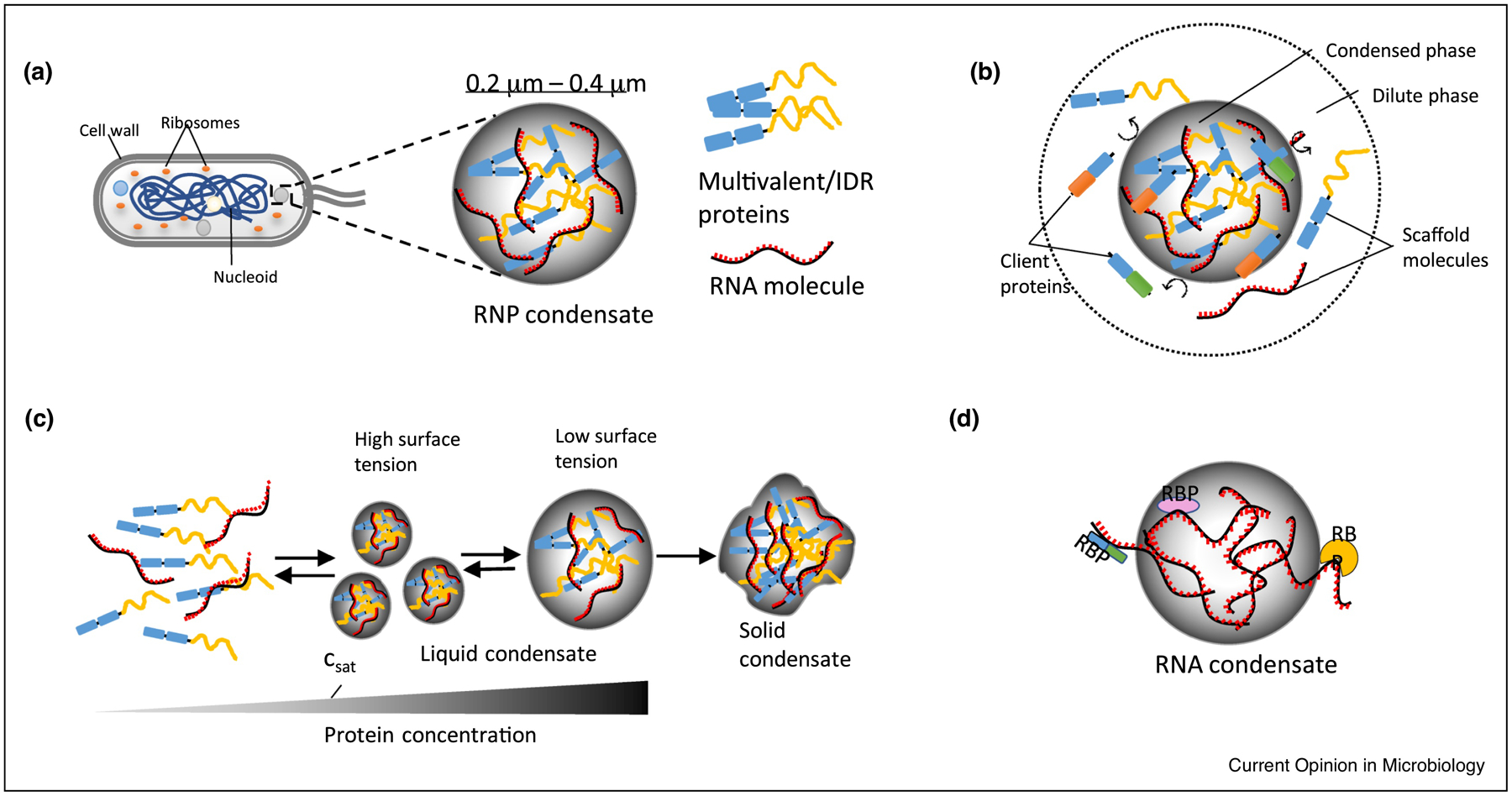
Figure 1.
Figure 1.
Basic properties of liquid-liquid phase separated condensates. (a) Bacterial cell showing condensates in the cytoplasm with one ribonucleoprotein (RNP) condensate enlarged. RNP condensates are formed by weak multivalent interactions between multivalent/intrinsically disordered proteins (IDPs) and RNA. Multivalency refers to the number of specific intra and as well inter molecular interactions. Multivalent domains can be present on both folded and intrinsically disordered regions (IDRs) of a protein. IDRs lack a defined structure and are enriched in disorder promoting amino acids (Arg, Pro, Gly, Glu, Ser, Ala and Lys). (b) Condensed phase is rich in macromolecules and the dilute phase sparse in macromolecules, nevertheless the system is in thermodynamic equilibrium because of the gain in net free energy (ΔG) in the condensed phase. Condensates are selective in recruiting protein and RNA molecules that may have promoting or inhibitory effect on the condensates. Multivalent/IDR proteins and RNA molecules acts as scaffold molecules in recruiting client protein and RNA molecules into the condensate. (c) The formation of liquid condensates is reversible. At concentrations above the critical saturation concentration (csat), the proteins or RNA molecules condense into droplets, and the smaller droplets can fuse to become bigger droplets as this process lowers the surface tension of smaller droplets. Intracellular or extracellular stimulation may lead to the dissolution of condensates. Liquid condensates can turn into solid condensates by accumulating large number of macromolecules and this process is often irreversible. (d) RNA alone has the intrinsic property to undergo phase separation and RNA molecules can in turn recruit specific RNA binding proteins (RBPs) ultimately forming an RNP granule.
Figure 2.
Figure 2.
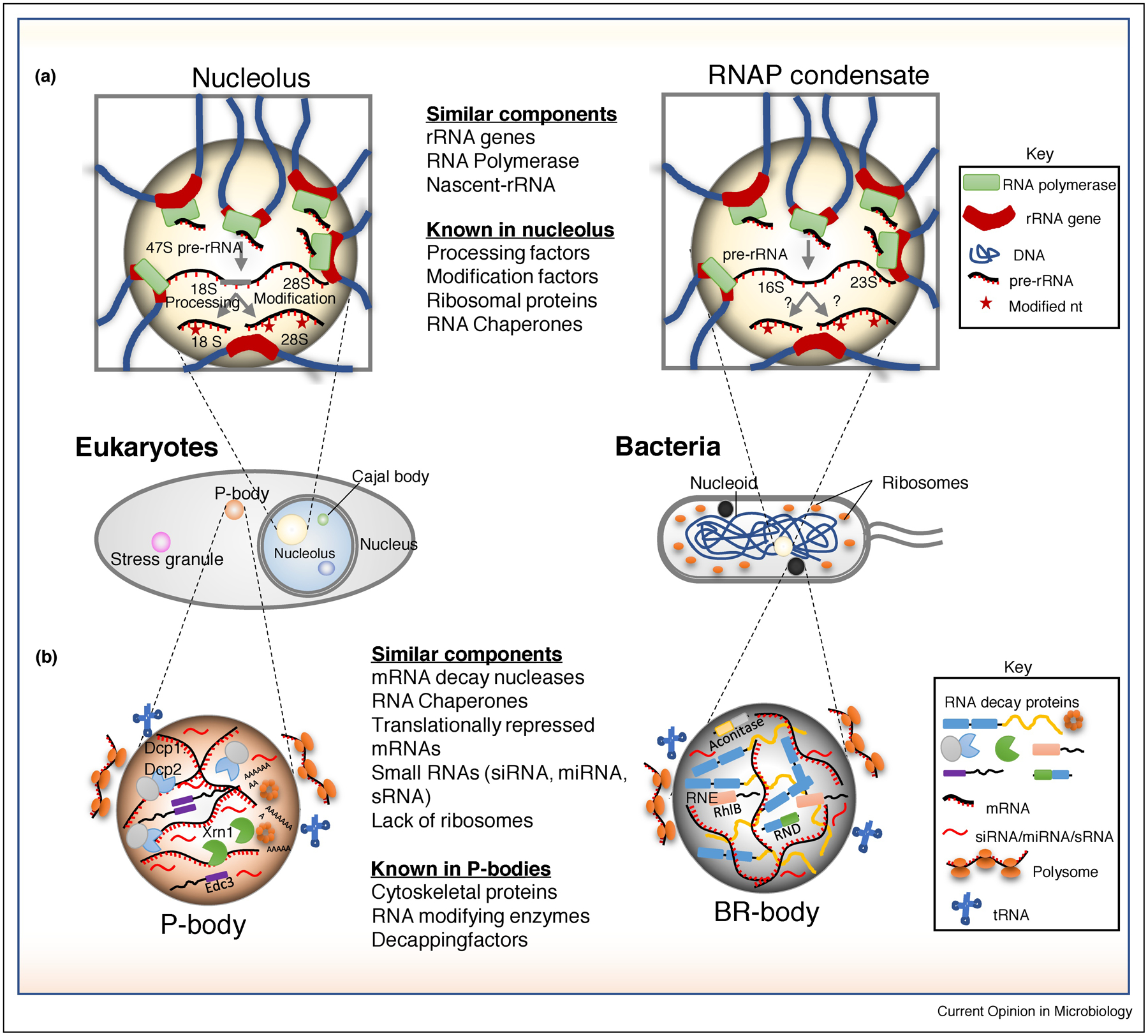
Prokaryotic and eukaryotic RNP granules involved in RNA synthesis and degradation. (a) Left: In eukaryotes, clusters of ribosomal RNA (rRNA) genes are transcribed by RNA polymerase I (RNAP I) and processed in a liquid condensate called nucleolus situated in the nucleus. The processed 18 S and 12 S rRNA are exported into the cytoplasm for the subsequent assembly of ribosomes and translation. Right: In E. coli RNA polymerase (RNAP) foci are shown to colocalize with rRNA operons (In E. coli 6 out of 7 rRNA operons - rrnE, rrnG, rrnD, rrnA, rrnH and rrnB are colocalized). This arrangement of rRNA operons and RNAP in bacteria mimics the nucleolus like compartmentalization seen in eukaryotes, though the transcription and processing of rRNAs in bacterial condensates need to be demonstrated. (b) Processing bodies (P-bodies) in eukaryotes (left) can be compared to the bacterial ribonucleoprotein bodies (BR-bodies) in bacteria (right). There are lot of similarities between these condensates in terms of the presence or absence of functionally equivalent proteins and RNA molecules. While it is agreed that BR-bodies mainly act as RNA decay compartments, there is no consensus whether P-bodies act as RNA decay or storage compartments.
Figure 3.
Figure 3.
RNA decay in bacterial ribonucleoprotein bodies (BR-bodies). The existence of various functional enzymes hints their probable coordination in BR-bodies. RNase E, the core component cleaves long RNAs into short RNAs by its endonucleolytic activity. DEAD box ATPase and RNase D (3’−5’ exonuclease) coordinate with RNase E to further degrade RNA. This leads to RNA fragmentation and reduced multivalent interactions between proteins and RNA molecules resulting in the dissolution of BR-body.
Figure 4.
Figure 4.
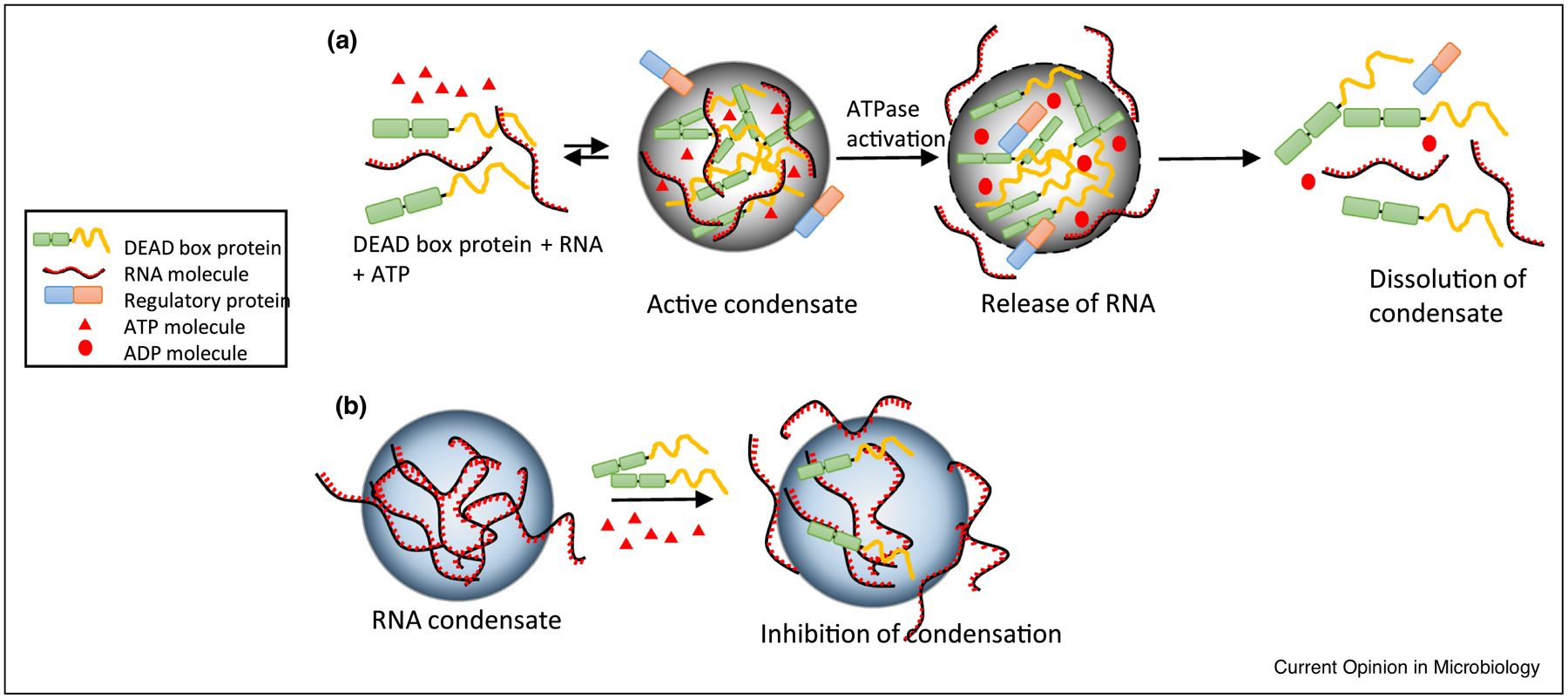
DEAD box proteins regulate the assembly and turnover of condensates. (a) DEAD box proteins undergo oligomerization in the presence of RNA and ATP forming RNP condensates. These RNP condensates may organize various RNA processing reactions depending on the function of a DEAD box ATPase. Upon the stimulation of ATPase activity by a regulatory protein, RNA is released leading to the dissolution of condensate [55]. (b) DEAD box proteins can act as chaperones by reducing the multivalent interactions between RNA molecules in the condensate by means of its ATPase activity. This activity of DEAD box proteins potentially reduces RNA/RNP condensation in the cytoplasm of cells [56].

References

    1. Walter H, Brooks DE: Phase separation in cytoplasm, due to macromolecular crowding, is the basis for microcompartmentation. FEBS Letters 1995, 361:135–139. - PubMed
    1. Banani SF, Lee HO, Hyman AA, Rosen MK: Biomolecular condensates: organizers of cellular biochemistry. Nature Reviews Molecular Cell Biology 2017, 18:285–298. - PMC - PubMed
    1. Hyman AA, Weber CA, Jülicher F: Liquid-Liquid Phase Separation in Biology. Annual Review of Cell and Developmental Biology 2014, 30:39–58. - PubMed
    1. Al-Husini N, Tomares DT, Bitar O, Childers WS, Schrader JM: α-Proteobacterial RNA Degradosomes Assemble Liquid-Liquid Phase-Separated RNP Bodies. Molecular Cell 2018, 71:1027–1039.e14. - PMC - PubMed
    2. (** This study shows RNase E undergoing LLPS to form BR bodies. This is the first in vivo and in vitro demonstration of LLPS in bacteria)

    1. Lasker K, von Diezmann L, Zhou X, Ahrens DG, Mann TH, Moerner WE, Shapiro L: Selective sequestration of signalling proteins in a membraneless organelle reinforces the spatial regulation of asymmetry in Caulobacter crescentus. Nature Microbiology 2020, 5:418–429. - PMC - PubMed

Publication types

LinkOut - more resources