


Predictors of kidney function recovery among incident ESRD patients
- PMID: 33879082
- PMCID: PMC8059163
- DOI: 10.1186/s12882-021-02345-7
Predictors of kidney function recovery among incident ESRD patients
Abstract
Background: ESRD is considered an irreversible loss of renal function, yet some patients will recover kidney function sufficiently to come off dialysis. Potentially modifiable predictors of kidney recovery, such as dialysis prescription, have not been fully examined.
Methods: Retrospective cohort study using United States Renal Data System (USRDS) data to identify incident hemodialysis (HD) patients between 2012 and 2016, the first 4 years for which dialysis treatment data is available. The primary outcome was kidney recovery within 1 year of ESRD and HD initiation, defined by a specific recovery code and survival off dialysis for at least 30 days. Patient and treatment characteristics were compared between those that recovered versus those that remained dialysis-dependent. A time-dependent survival model was used to identify independent predictors of kidney recovery.
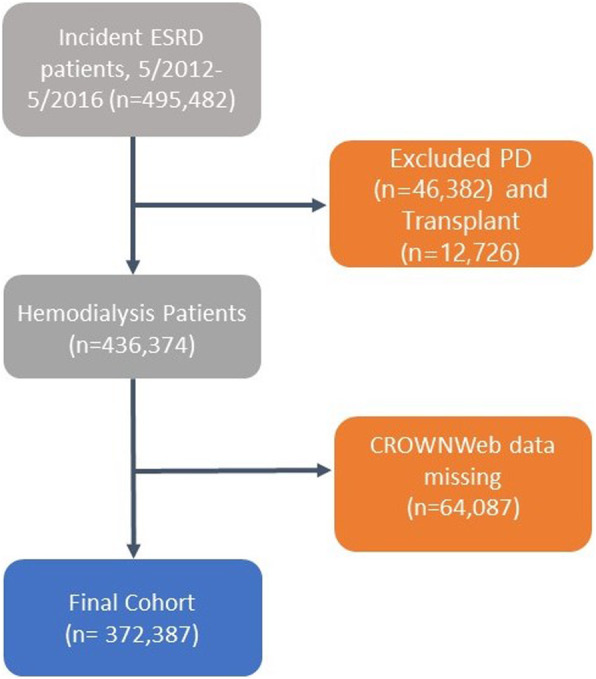
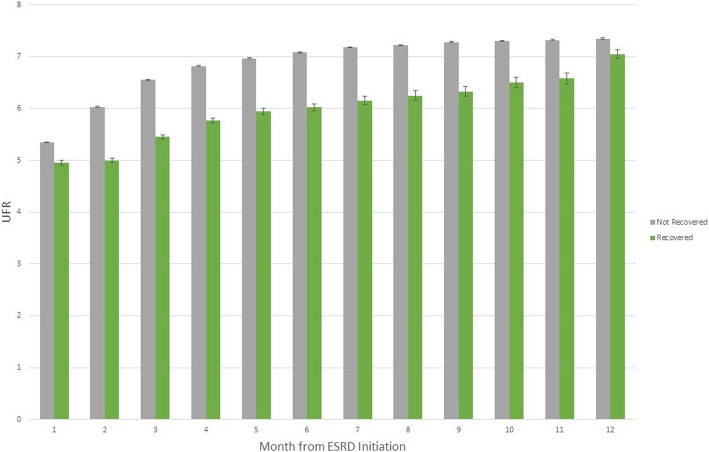
Results: During the study period, there were 372,387 incident HD patients with available data, among whom 16,930 (4.5%) recovered to dialysis-independence. Compared to non-recovery, a higher proportion of patients with kidney recovery were of white race, and non-Hispanic ethnicity. Both groups had a similar age distribution. Patients with an acute kidney injury diagnosis as primary cause of ESRD were most likely to recover, but the most common ESRD diagnosis among recovering patients was type 2 diabetes (29.8% of recovery cases). Higher eGFR and lower albumin at ESRD initiation were associated with increased likelihood of recovery. When examining HD ultrafiltration rate (UFR), each quintile above the first quintile was associated with a progressively lower likelihood of recovery (HR 0.45, 95% CI 0.43-0.48 for highest versus lowest quintile, p < 0.001).
Conclusions: We identified non-modifiable and potentially modifiable factors associated with kidney recovery which may assist clinicians in counseling and monitoring incident ESRD patients with a greater chance to gain dialysis-independence. Clinical trials are warranted to examine the impact of dialysis prescription on subsequent kidney function recovery.
Keywords: Acute kidney injury; End-stage renal disease; Kidney recovery; Risk factors.
Conflict of interest statement
The authors declare that they have no competing interests.
Figures
References
-
- Saran R, Robinson B, Abbott KC, Agodoa LYC, Bragg-Gresham J, Balkrishnan R, Bhave N, Dietrich X, Ding Z, Eggers PW, Gaipov A, Gillen D, Gipson D, Gu H, Guro P, Haggerty D, Han Y, He K, Herman W, Heung M, Hirth RA, Hsiung JT, Hutton D, Inoue A, Jacobsen SJ, Jin Y, Kalantar-Zadeh K, Kapke A, Kleine CE, Kovesdy CP, Krueter W, Kurtz V, Li Y, Liu S, Marroquin MV, McCullough K, Molnar MZ, Modi Z, Montez-Rath M, Moradi H, Morgenstern H, Mukhopadhyay P, Nallamothu B, Nguyen DV, Norris KC, O’Hare AM, Obi Y, Park C, Pearson J, Pisoni R, Potukuchi PK, Repeck K, Rhee CM, Schaubel DE, Schrager J, Selewski DT, Shamraj R, Shaw SF, Shi JM, Shieu M, Sim JJ, Soohoo M, Steffick D, Streja E, Sumida K, Kurella Tamura M, Tilea A, Turf M, Wang D, Weng W, Woodside KJ, Wyncott A, Xiang J, Xin X, Yin M, You AS, Zhang X, Zhou H, Shahinian V. US renal data system 2018 annual data report: epidemiology of kidney disease in the United States. Am J Kidney Dis. 2019;73(3 Suppl 1):A7–A8. doi: 10.1053/j.ajkd.2019.01.001. - DOI - PMC - PubMed
Publication types
MeSH terms
Substances
LinkOut - more resources
Full Text Sources
Other Literature Sources
Medical
Research Materials
Miscellaneous
