


A study of the sequential treatment of acute heart failure with sacubitril/valsartan by recombinant human brain natriuretic peptide: A randomized controlled trial
- PMID: 33879733
- PMCID: PMC8078236
- DOI: 10.1097/MD.0000000000025621
A study of the sequential treatment of acute heart failure with sacubitril/valsartan by recombinant human brain natriuretic peptide: A randomized controlled trial
Abstract
This study aimed to investigate the effects of the basic treatment for heart failure and sequential treatment with rh-brain natriuretic peptide (rhBNP) alone or the combination of rhBNP and sacubitril/valsartan. Cardiac structure, pulmonary artery pressure, inflammation and oxidative stress in patients with acute heart failure were evaluated.Three hundred patients with acute heart failure were included. According to the random number table method, the patients were divided into 3 groups of 100 patients per group: the standard treatment group (treated with an angiotensin-converting enzyme inhibitor, β receptor blocker, and corticosteroid antagonist), rhBNP group (basic treatment combined with rhBNP) and sequential treatment group (basic treatment for heart failure combined with rhBNP followed by sacubitril/valsartan). The changes in NT-probrain natriuretic peptide (BNP) levels, cardiac troponin T (cTnT) levels, cardiac structure, pulmonary artery pressure, and the levels inflammatory factors and oxidative stress factors were compared among the 3 groups at 1, 4, 12, and 36 weeks after treatment.The sequential treatment group displayed superior outcomes than the standard treatment group and the rhBNP group in terms of left atrium diameter, left ventricular end diastolic volume, left ventricular ejection fraction, pulmonary artery pressure, NT-proBNP levels, and cTnT levels, which respond to damage to the heart structure and myocardium. This result may be related to the decreased levels of inflammatory factors and the correction of oxidative stress imbalance.Sacubitril/valsartan significantly reduce the serum levels of inflammatory factors in patients with acute heart failure while decreasing the levels of oxidizing factors and increasing the levels of antioxidant factors. These changes may be one of the explanations for the better cardiac structure and better pulmonary artery pressure observed in the sequential treatment group.
Copyright © 2021 the Author(s). Published by Wolters Kluwer Health, Inc.
Conflict of interest statement
The authors have no conflicts of interests to disclose.
Figures
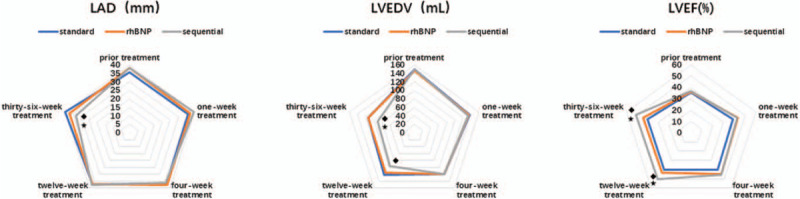
 Compared with the standard treatment group, the rhBNP group exhibited a significant difference (P < .05).
  The sequential treatment group exhibited significant differences compared with the standard treatment group (P < .05).
  The sequential treatment group presented significant differences compared with the rhBNP group (P < .05). LAD = left atrial diameters, LVEDV = left ventricular end-diastolic volume, LVEF = left ventricular ejection fraction, rhBNP = recombinant human brain natriuretic peptide.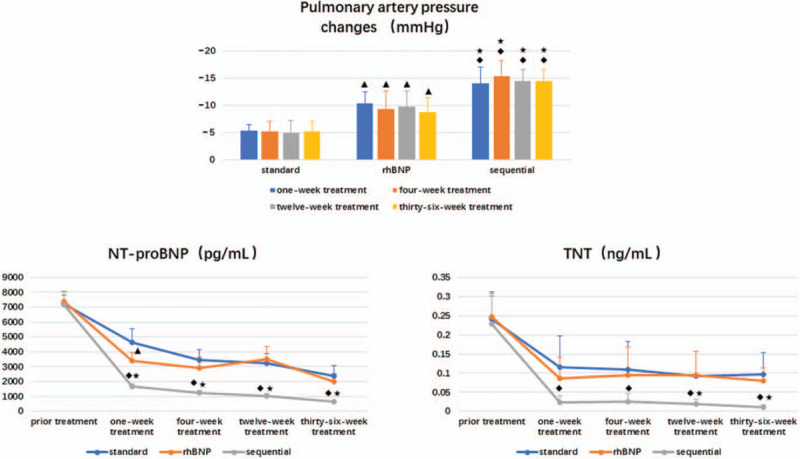
 Compared with the standard treatment group, the rhBNP group presented a significant difference in these parameters (P < .05).
  The sequential treatment group exhibited significant differences compared with the standard treatment group (P < .05).
  The sequential treatment group presented significant differences compared with the rhBNP group (P < .05). cTnT = cardiac troponin T, NT-proBNP = N-terminal B-type natriuretic peptide, rhBNP = recombinant human brain natriuretic peptide.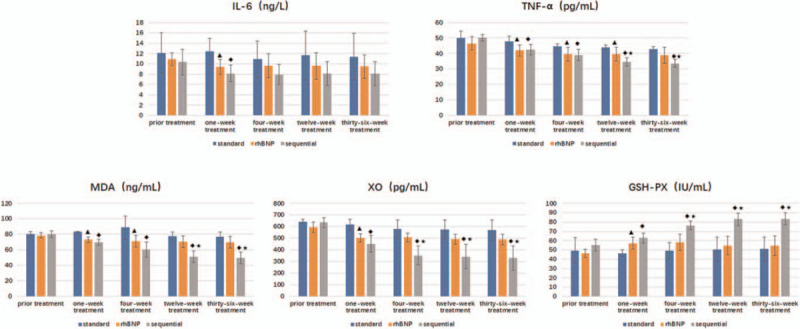
 Compared with the standard treatment group, the rhBNP group exhibited significant differences in these parameters (P < .05).
  The sequential treatment group displayed significant differences compared with the standard treatment group (P < .05).
  The sequential treatment group presented significant differences compared with the rhBNP group (P < .05). GSH-PX = glutathione-peroxidase, IL-6 = interleukin-6, MDA = serum malondialdehyde, rhBNP = recombinant human brain natriuretic peptide, TNF-α = tumor necrosis factor α, XO = xanthine oxidase.
References
-
- Writing Group M, Mozaffarian D, Benjamin EJ, et al. Executive summary: heart disease and stroke statistics--2016 update: a report from the American Heart Association. Circulation 2016;133:447–54. - PubMed
-
- Ambrosy AP, Fonarow GC, Butler J, et al. The global health and economic burden of hospitalizations for heart failure: lessons learned from hospitalized heart failure registries. J Am Coll Cardiol 2014;63:1123–33. - PubMed
-
- Parati G, Esler M. The human sympathetic nervous system: its relevance in hypertension and heart failure. Eur Heart J 2012;33:1058–66. - PubMed
Publication types
MeSH terms
Substances
LinkOut - more resources
Full Text Sources
Other Literature Sources
Medical
Research Materials
Miscellaneous
