. 2021 Jun:150:416-432.
doi: 10.1016/j.psep.2021.04.014. Epub 2021 Apr 15.

Pandemic risk management using engineering safety principles

Affiliations

Pandemic risk management using engineering safety principles

Md Alauddin et al. Process Saf Environ Prot. 2021 Jun.

Abstract

The containment of infectious diseases is challenging due to complex transmutation in the biological system, intricate global interactions, intense mobility, and multiple transmission modes. An emergent disease has the potential to turn into a pandemic impacting millions of people with loss of life, mental health, and severe economic impairment. Multifarious approaches to risk management have been explored for combating an epidemic spread. This work presents the implementation of engineering safety principles to pandemic risk management. We have assessed the pandemic risk using Paté-Cornell's six levels of uncertainty. The susceptible, exposed, infected, quarantined, recovered, deceased (SEIQRD), an advanced mechanistic model, along with the Monte Carlo simulation, has been used to estimate the fatality risk. The risk minimization strategies have been categorized into hierarchical safety measures. We have developed an event tree model of pandemic risk management for distinct risk-reducing strategies realized due to natural evolution, government interventions, societal responses, and individual practices. The roles of distinct interventions have also been investigated for an infected individual's survivability with the existing healthcare facilities. We have studied the Corona Virus Disease of 2019 (COVID-19) for pandemic risk management using the proposed framework. The results highlight effectiveness of the proposed strategies in containing a pandemic.

Keywords: ALARP; COVID-19; Non-pharmaceutical interventions; Pandemic; Precautionary principle; Risk analysis.


Conflict of interest statement

The authors report no declarations of interest.

Figures

Fig. 1
Fig. 1
Schematic representation of the SEIQRD model for infectious disease transmission (T0: incubation period T1: infection period, T2: duration between case detection and quarantined/hospitalization, T3: recovery period).
Fig. 2
Fig. 2
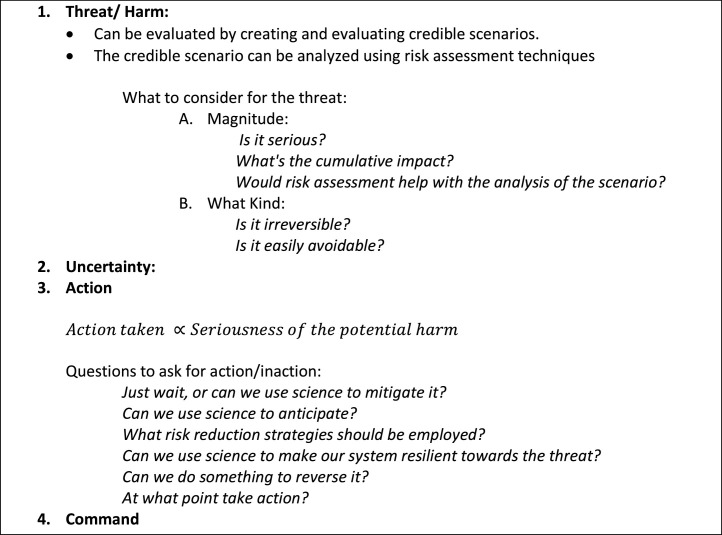
Dimensions of Precautionary principles (Sandin, 1999).
Fig. 3
Fig. 3
Mechanistic models for pandemic risk management.
Fig. 4
Fig. 4
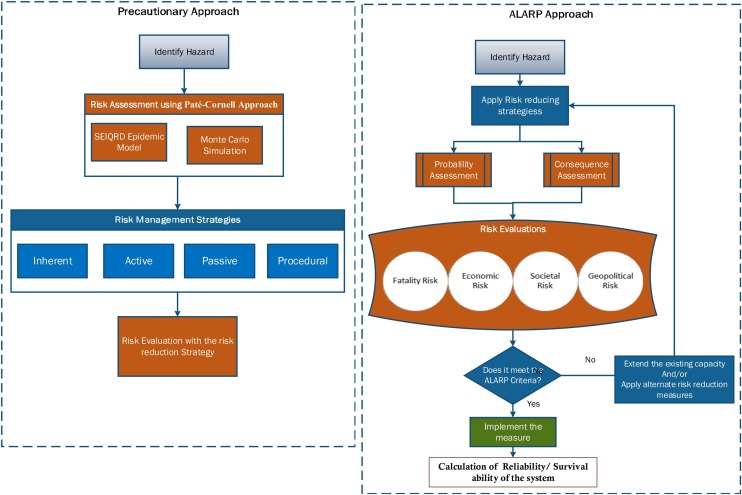
Schematic representation of the precautionary principles for managing a pandemic risk.
Fig. 5
Fig. 5
Infection cases (Mode 1, 2, and 3) due to COVID-19 pandemic if no measures have taken.
Fig. 6
Fig. 6
Risk of infection (Mode 4) due to COVID-19 pandemic if no measures taken.
Fig. 7
Fig. 7
Uncertainty in the fatality risk (Mode 5) due to COVID-19 pandemic if no measures taken.
Fig. 8
Fig. 8
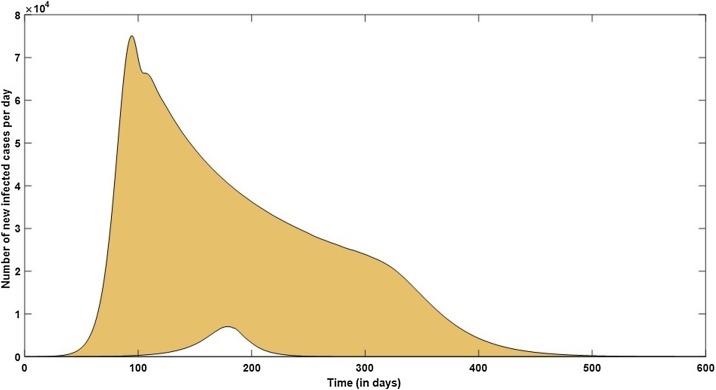
New infection cases of COVID-19 pandemic under the lockdown.
Fig. 9
Fig. 9
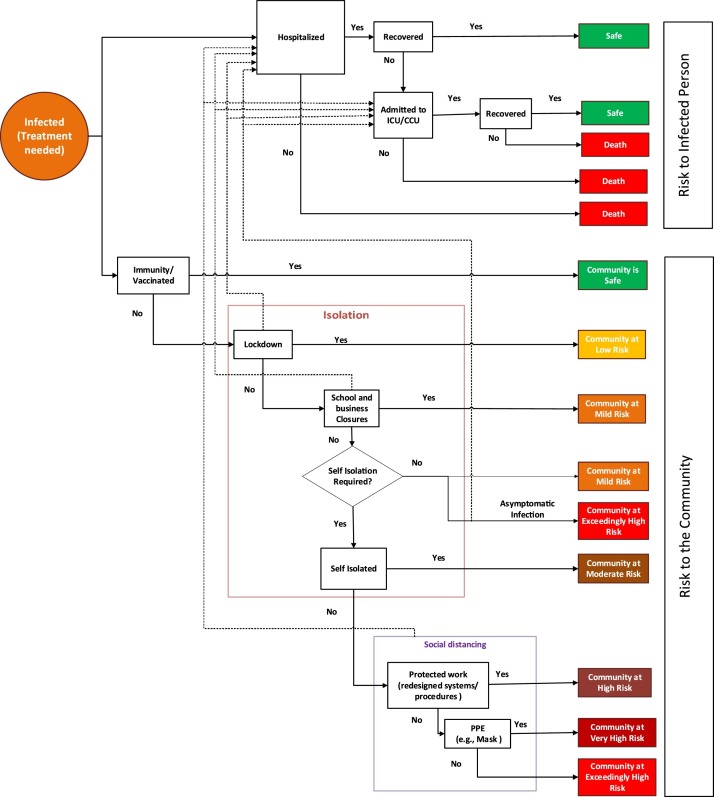
Impact on the infected person and the community due to the infection.
Fig. 10
Fig. 10
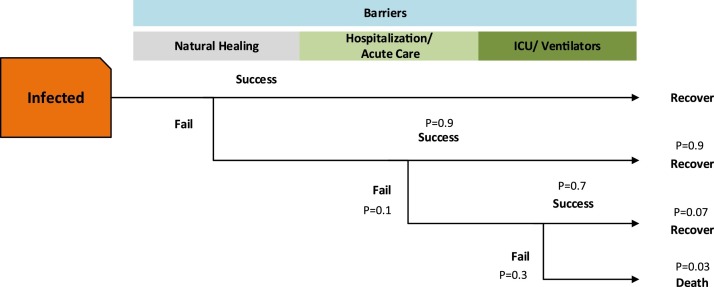
Event Tree model of distinct risk reduction strategies of a pandemic.
Fig. 11
Fig. 11
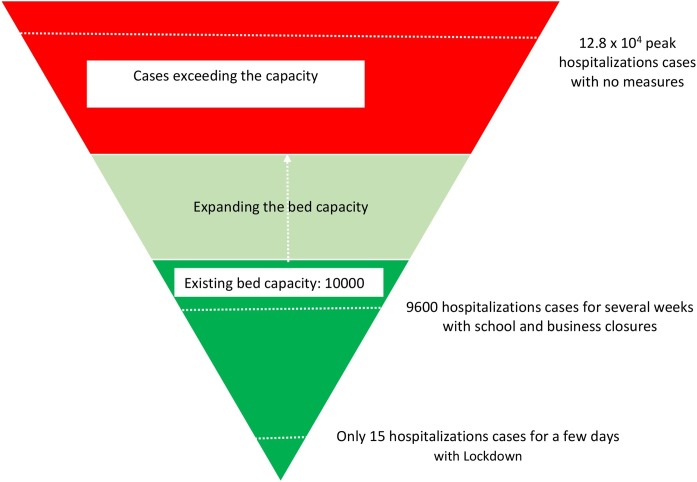
The calculation of the availability of acute and critical care beds during the pandemic.
Fig. 12
Fig. 12
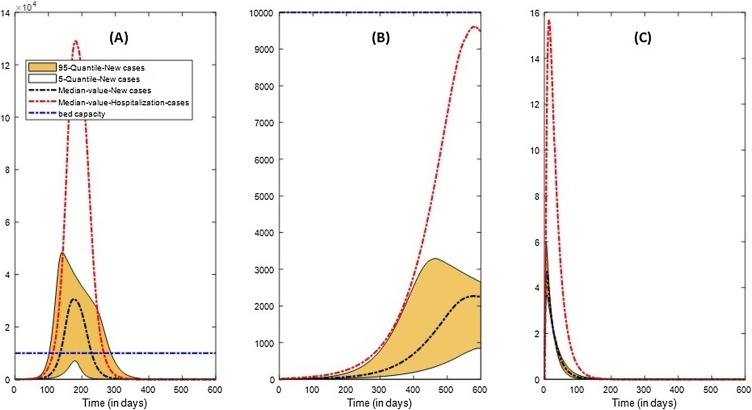
The number of infected cases due to COVID-19 pandemic under distinct measures. A. No measures, B. School and business closures, C. Lockdown.
Fig. 13
Fig. 13
Event tree analysis for risk to an infected person at T = 200th day of the outbreak with schools and business closures in effect.
Fig. 14
Fig. 14
The outcome for the ALARP based implementation for the risk management in COVID-19.
Fig. 15
Fig. 15
Reliability analysis with the existing healthcare facilities with no measures enforced to restrict the COVID-19 pandemic.
Fig. 16
Fig. 16
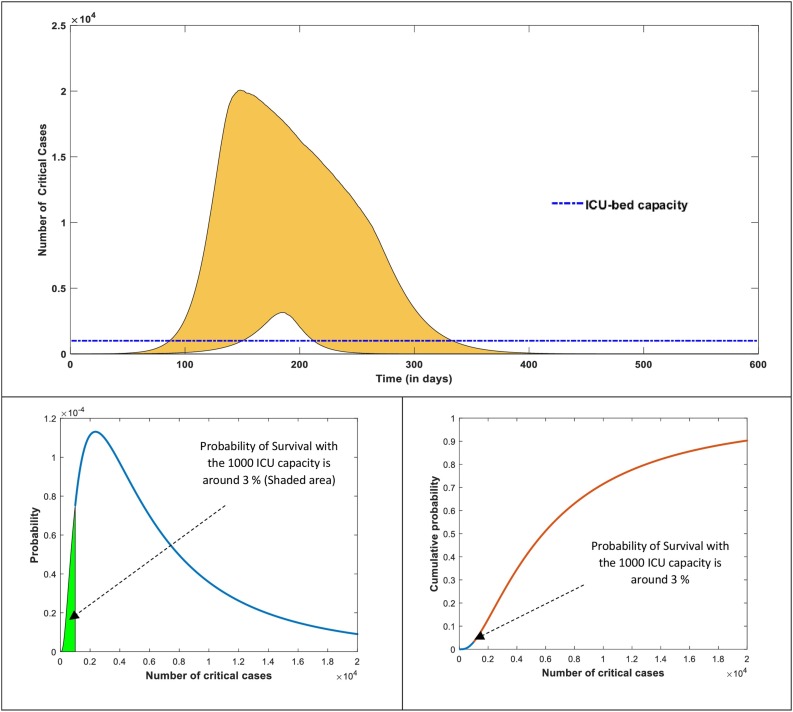
Reliability analysis with the existing healthcare facilities with School/business closures enforced to restrict the COVID-19 pandemic.
Fig. 17
Fig. 17
Reliability analysis with the existing healthcare facilities with lockdown to restrict COVID-19.

References

    1. Abate S.M., Ali S.A., Mantfardo B., Basu B. Rate of intensive care unit admission and outcomes among patients with coronavirus: a systematic review and Meta-analysis. PLoS One. 2020;15(7 July) doi: 10.1371/journal.pone.0235653. - DOI - PMC - PubMed
    1. Alauddin M., Islam Khan M.A., Khan F., Imtiaz S., Ahmed S., Amyotte P. How can process safety and a risk management approach guide pandemic risk management? J. Loss Prev. Process Ind. 2020;68 doi: 10.1016/j.jlp.2020.104310. - DOI - PMC - PubMed
    1. Alvarado A., Vedantam S., Goethals P., Nopens I. A compartmental model to describe hydraulics in a full-scale waste stabilization pond. Water Res. 2012;46(2):521–530. doi: 10.1016/j.watres.2011.11.038. - DOI - PubMed
    1. Amyotte P., Irvine Y., Khan F. Chemical safety board investigation reports and the hierarchy of controls: round 2. Process. Saf. Prog. 2018;37(4):459–466. doi: 10.1002/prs.12009. - DOI
    1. Anderson R.M., May R.M. Population biology of infectious diseases: part I. Nature. 1979;280(5721):361–367. doi: 10.1038/280361a0. - DOI - PubMed

LinkOut - more resources