


Ultrasound-Guided Wireless Tubular Robotic Anchoring System
- PMID: 33880401
- PMCID: PMC7610639
- DOI: 10.1109/LRA.2020.3003868
Ultrasound-Guided Wireless Tubular Robotic Anchoring System
Abstract
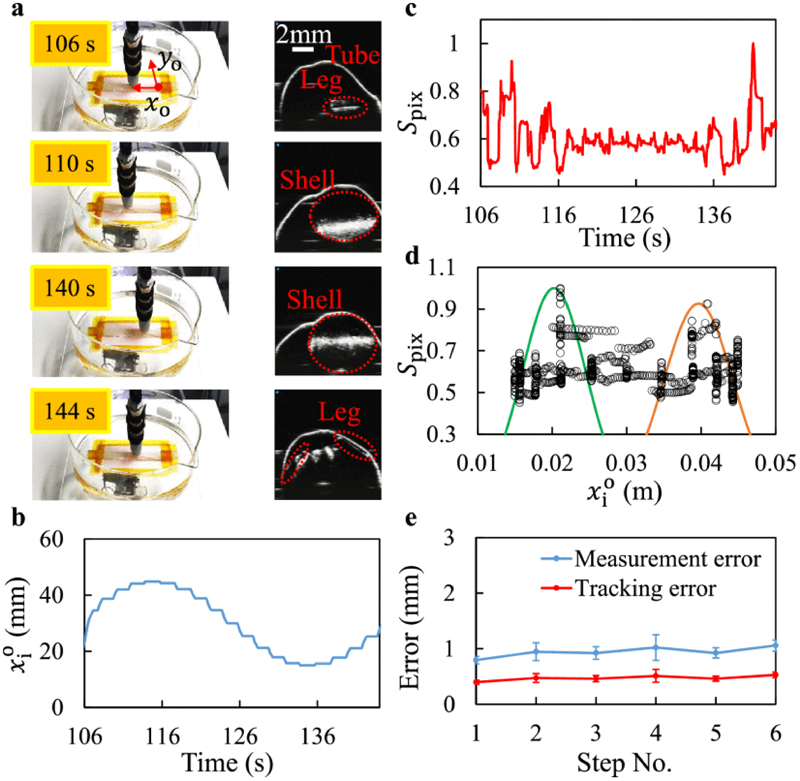
Untethered miniature robots have significant poten-tial and promise in diverse minimally invasive medical applications inside the human body. For drug delivery and physical contra-ception applications inside tubular structures, it is desirable to have a miniature anchoring robot with self-locking mechanism at a target tubular region. Moreover, the behavior of this robot should be tracked and feedback-controlled by a medical imaging-based system. While such a system is unavailable, we report a reversible untethered anchoring robot design based on remote magnetic actuation. The current robot prototype's dimension is 7.5 mm in diameter, 17.8 mm in length, and made of soft polyurethane elastomer, photopolymer, and two tiny permanent magnets. Its relaxation and anchoring states can be maintained in a stable manner without supplying any control and actuation input. To control the robot's locomotion, we implement a two-dimensional (2D) ultrasound imaging-based tracking and control system, which automatically sweeps locally and updates the robot's position. With such a system, we demonstrate that the robot can be controlled to follow a pre-defined 1D path with the maximal position error of 0.53 ± 0.05 mm inside a tubular phantom, where the reversible anchoring could be achieved under the monitoring of ultrasound imaging.
Keywords: Medical robots and systems; computer vision for medical robotics; mechanism design; soft robotics; ultrasound imaging-based control.
Figures




References
-
- Sitti M. Miniature soft robotsroad to the clinic. Nature Rev Mater. 2018;3(6):74.
-
- Sitti M. Mobile Microrobotics. MIT Press; Cambridge, MA, USA: 2017.
-
- Nelson BJ, Kaliakatsos IK, Abbott JJ. Microrobots for minimally invasive medicine. Annu Rev Biomed Eng. 2010;12:55–85. - PubMed
-
- Sitti M. Miniature devices: Voyage of the microrobots. Nature. 2009;458(7242):1121–1122. - PubMed
Grants and funding
LinkOut - more resources
Full Text Sources
Other Literature Sources