Review
. 2021 Apr;7(4):e06841.
doi: 10.1016/j.heliyon.2021.e06841. Epub 2021 Apr 15.

The role of nanotechnology in current COVID-19 outbreak

Affiliations
Review

The role of nanotechnology in current COVID-19 outbreak

Shima Tavakol et al. Heliyon. 2021 Apr.

Abstract

COVID-19 has recently become one of the most challenging pandemics of the last century with deadly outcomes and a high rate of reproduction number. It emphasizes the critical need for the designing of efficient vaccines to prevent virus infection, early and fast diagnosis by the high sensitivity and selectivity diagnostic kits, and effective antiviral and protective therapeutics to decline and eliminate the viral load and side effects derived from tissue damages. Therefore, non-toxic antiviral nanoparticles (NPs) have been under development for clinical application to prevent and treat COVID-19. NPs showed great promise to provide nano vaccines against viral infections. Here, we discuss the potentials of NPs that may be applied as a drug itself or as a platform for the aim of drug and vaccine repurposing and development. Meanwhile, the advanced strategies based on NPs to detect viruses will be described with the goal of encouraging scientists to design effective and cost-benefit nanoplatforms for prevention, diagnosis, and treatment.

Keywords: COVID-19; Cells; Clinical; Coronavirus; Drug delivery; Drug repurposing; Nanocarrier; Nanomaterials; Nanoparticle; Nanotechnology; Preclinical; Vaccine.


Figures

Figure 1
Figure 1
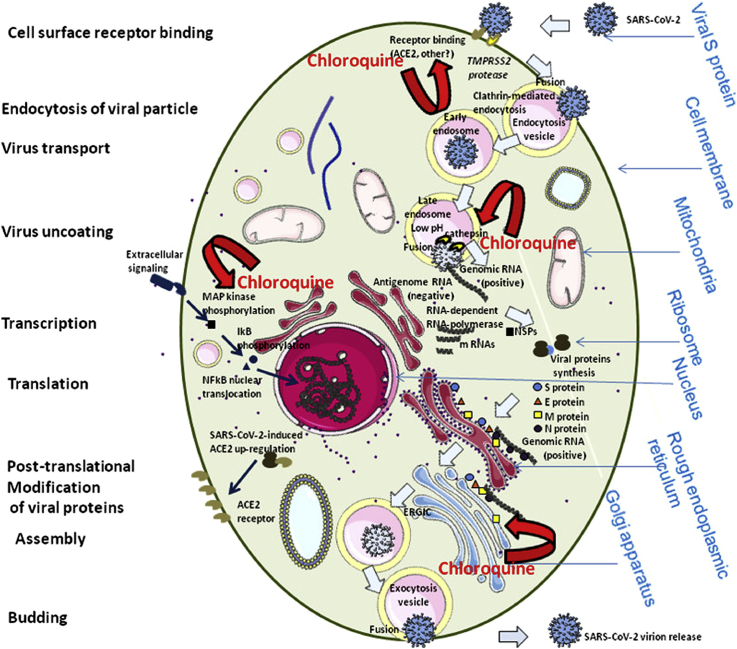
Schematic representation of the life cycle of SARS-CoV-2 in the face to the host cells and in interaction with chloroquine. SARS-CoV-2 binds to ACE2 using its spike and then the spike undergoes cleavage by TMPRSS2 protease resulting in inhibition of antibody neutralization. S protein further cleaves by the cathepsin L resulting in a fusion of endosomal membrane with the viral envelope to lead the release of the viral genome into the cell cytoplasm, transcription and translation of positive RNA and proteins. The packed final virion is released from the host cells. Chloroquine influences on the life cycle of SARS-CoV-2 through the disturbance in ACE2 receptor glycosylation, the biosynthesis of sialic acids, autophagosome formation, virus replication and immune system. Rights and permissions obtained from [100].
Figure 2
Figure 2
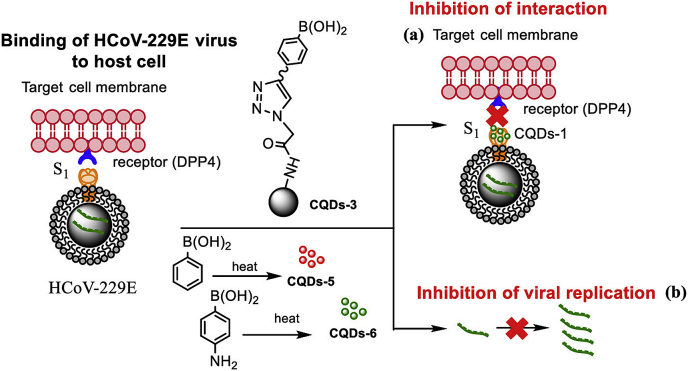
Binding of HCoV-229E virus to host cell. The virus binds to DPP4 cell surface receptors via spike glycoprotein while carbon quantum dot, prepared by hydrothermal carbonization, inhibits its interaction with cell surface receptor and viral replication. Rights and permissions obtained from [50].
Figure 3
Figure 3
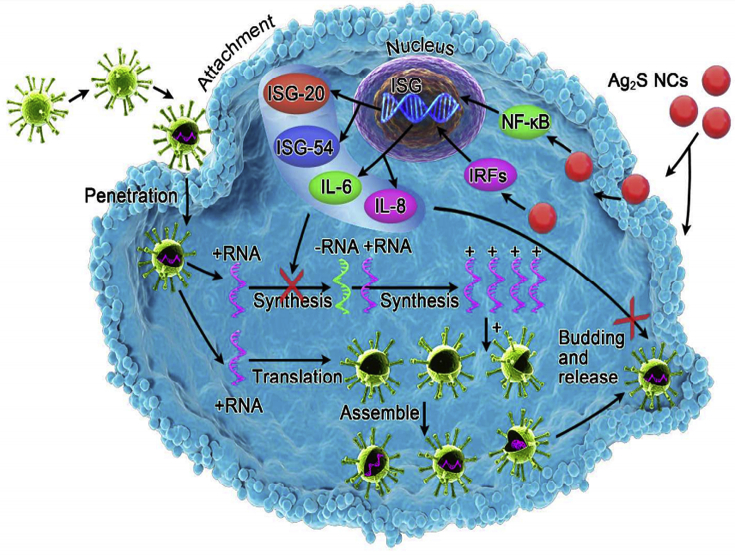
The anti-viral effect of Ag2S nanoclusters. They inhibit the replication of the viral genome and budding. However, they upregulate the INF-stimulating genes (ISGs) expression. Rights and permissions obtained from [62].

References

    1. Sexton N.R., Smith E.C., Blanc H., Vignuzzi M., Peersen O.B., Denison M.R. Homology-based identification of a mutation in the coronavirus RNA-dependent RNA polymerase that confers resistance to multiple mutagens. J. Virol. 2016;90(16):7415–7428. - PMC - PubMed
    1. Ulrich H., Pillat M.M. CD147 as a target for COVID-19 treatment: suggested effects of azithromycin and stem cell engagement. Stem Cell Rev. Rep. 2020:1–7. - PMC - PubMed
    1. Liu P., Jiang J.-Z., Hua Y., Wang X., Hou F., Wan X.-F., Chen J., Zou J., Chen J. bioRxiv; 2020. Are Pangolins the Intermediate Host of the 2019 Novel Coronavirus (2019-nCoV)? - PMC - PubMed
    1. Rodriguez-Teja M., Gronau J.H., Minamidate A., Darby S., Gaughan L., Robson C., Mauri F., Waxman J., Sturge J. Survival outcome and EMT suppression mediated by a lectin domain interaction of Endo180 and CD147. Mol. Canc. Res. 2015;13(3):538–547. - PubMed
    1. Wang K., Chen W., Zhou Y.-S., Lian J.-Q., Zhang Z., Du P., Gong L., Zhang Y., Cui H.-Y., Geng J.-J. BioRxiv; 2020. SARS-CoV-2 invades host cells via a novel route: CD147-spike protein. - PMC - PubMed