[Preprint]. 2021 May 12:2021.04.11.21255153.
doi: 10.1101/2021.04.11.21255153.

Vaccination boosts protective responses and counters SARS-CoV-2-induced pathogenic memory B cells

Affiliations

Vaccination boosts protective responses and counters SARS-CoV-2-induced pathogenic memory B cells

Pankaj Kumar Mishra et al. medRxiv. .

Abstract

Much is to be learned about the interface between immune responses to SARS-CoV-2 infection and vaccination. We monitored immune responses specific to SARS-CoV-2 Spike Receptor-Binding-Domain (RBD) in convalescent individuals for eight months after infection diagnosis and following vaccination. Over time, neutralizing antibody responses, which are predominantly RBD specific, generally decreased, while RBD-specific memory B cells persisted. RBD-specific antibody and B cell responses to vaccination were more vigorous than those elicited by infection in the same subjects or by vaccination in infection-naïve comparators. Notably, the frequencies of double negative B memory cells, which are dysfunctional and potentially pathogenic, increased in the convalescent subjects over time. Unexpectedly, this effect was reversed by vaccination. Our work identifies a novel aspect of immune dysfunction in mild/moderate COVID-19, supports the practice of offering SARS-CoV-2 vaccination regardless of infection history, and provides a potential mechanistic explanation for the vaccination-induced reduction of "Long-COVID" symptoms.


Figures
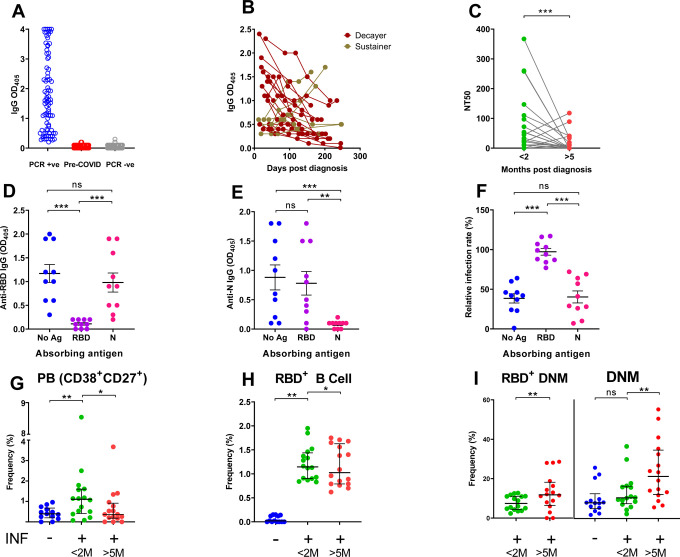
Fig. 1.
Fig. 1.. Temporal trajectories of antibody levels, plasma neutralization activity, and memory B cell responses to SARS-COV-2 infection.
(A,B) Receptor Binding Domain (RBD)-specific antibody binding. (A) Anti-RBD IgG antibody levels in SARS-CoV-2 PCR-positive subjects (n = 83, blue circles); pre-COVID-19 samples (n = 104; red circles); subjects SARS-CoV-2 PCR-negative for at least 16 weeks after blood draw (n = 103 subjects; grey circles). Each circle indicates one subject. (B) Temporal trajectory of IgG antibody levels in SARS-CoV-2-infected subjects. Symbol colors distinguish decayers (n=16) showing downward trajectories (dark red) and sustainers (n=6) showing stable or upward trajectories (dark yellow). (C) Neutralizing titers expressed as NT50 (reciprocal dilution of plasma yielding 50% virus neutralization), as obtained with samples collected <2 months (green circles) or >5 months (red circles) post-SARS-CoV-2 diagnosis from the same 22 subjects as in B. Each pair of circles connected by a line represents one subject. (D-F) Selected plasma samples (n = 10) exhibiting NT50 >80 were depleted of either RBD or N-specific antibodies by pre-incubating them with either recombinant RBD or N (Nucleocapsid) proteins and then performing ELISA for IgG binding to RBD (panel D) or N (panel E) as solid-phase antigen. (F) Neutralization activity of pre-absorbed plasma samples, as in D-E. Relative infection rates were calculated as in Methods and Fig. S1. (G-I) Frequency (%) of selected B cell compartments: plasmablasts (PB) (panel G), RBD-specific (RBD+) B cells (panel H), and double negative memory B cells (DNM) (panel I). <2M and >5M, as in panel C. For the gating strategy, see supplementary Fig. S2A–H. The entire dataset is found in supplementary Table 3. In all panels, the individual circle represents one subject, and the solid black lines represent median with interquartile range. Statistical analysis was performed either with Mann-Whitney U-test for unpaired data or Wilcoxon matched-pairs signed rank test for paired samples (**, p ≤ 0.01; ***, p ≤ 0.001; ns, non-significant, p > 0.05).
Fig. 2.
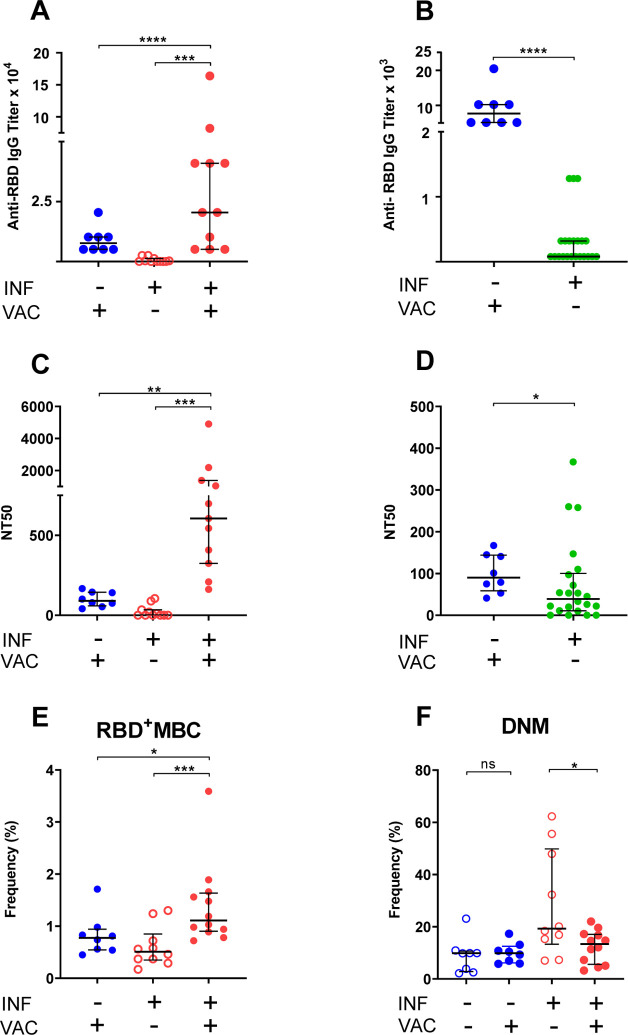
Fig. 2.. Humoral and B cell responses to COVID-19 mRNA vaccination.
Responses to COVID-19 RNA vaccines in previously infected study subjects and infection-naïve comparators were measured. Receptor Binding Domain (RBD)-specific IgG antibody binding, plasma neutralizing activity, and B cell frequencies were assessed as in Fig. 1. Infection (INF) and vaccination (VAC) status are indicated by the corresponding (+) and (−) signs. (A,B) Titers of RBD-specific IgG by ELISA. (C,D) NT50 determinations. Pre-vaccination samples of SARS-CoV-2-infected subjects were either those collected at the last visit before vaccination to determine effect of vaccination (panels A,C) or those collected at the first visit post-diagnosis to compare responses to recent infection and recent vaccination (panels B,D). (E) Frequency of RBD-specific memory B cells (RBD+ MBC). (F) Frequency of total double-negative memory B cells (DNM, CD27 IgD). The entire B cell dataset is found in supplementary Table 4. In all panels, data are shown as scatter plots; each circle represents one study subject; the solid black lines represent the median and interquartile range. Statistical analysis was performed either with Mann-Whitney U-test for unpaired data or Wilcoxon matched-pairs signed rank test for paired samples (*, p ≤ 0.05; **, p ≤ 0.01).

References

    1. Long Q.X., et al. Antibody responses to SARS-CoV-2 in patients with COVID-19. Nat Med 26, 845–848 (2020). - PubMed
    1. Robbiani D.F., et al. Convergent antibody responses to SARS-CoV-2 in convalescent individuals. Nature 584, 437–442 (2020). - PMC - PubMed
    1. Amanat F., et al. A serological assay to detect SARS-CoV-2 seroconversion in humans. Nat Med 26, 1033–1036 (2020). - PMC - PubMed
    1. Rostami A., et al. SARS-CoV-2 seroprevalence worldwide: a systematic review and meta-analysis. Clin Microbiol Infect 27, 331–340 (2021). - PMC - PubMed
    1. Chen L., Xiong J., Bao L. & Shi Y. Convalescent plasma as a potential therapy for COVID-19. Lancet Infect Dis 20, 398–400 (2020). - PMC - PubMed

Publication types

LinkOut - more resources