


Association Between Added Sugars from Infant Formulas and Rapid Weight Gain in US Infants and Toddlers
- PMID: 33880550
- PMCID: PMC8169810
- DOI: 10.1093/jn/nxab044
Association Between Added Sugars from Infant Formulas and Rapid Weight Gain in US Infants and Toddlers
Abstract
Background: Formulas often contain high amounts of added sugars, though little research has studied their connection to obesity.
Objectives: This study assessed the contribution of added sugars from formulas during complementary feeding on total added sugar intakes, and the association between these sugars and upward weight-for-age percentile (WFA%) crossing (i.e., participants crossing a higher threshold percentile were considered to have an upward crossing).
Methods: Data from three 24-hour dietary recalls for infants (n = 97; 9-12 months) and toddlers (n = 44; 13-15 months) were obtained in this cross-sectional analysis. Foods and beverages with added sugars were divided into 17 categories. Pearson's correlations were used to test relations between added sugar intake and upward WFA% crossing, followed by multivariable regressions when significant. ANOVA compared intakes of all, milk-based, and table foods between primarily formula-fed compared with breastfed participants. Multivariable regressions were used to test effects of added sugars and protein from all foods compared with added sugars and protein from milk-based sources on upward WFA% crossing.
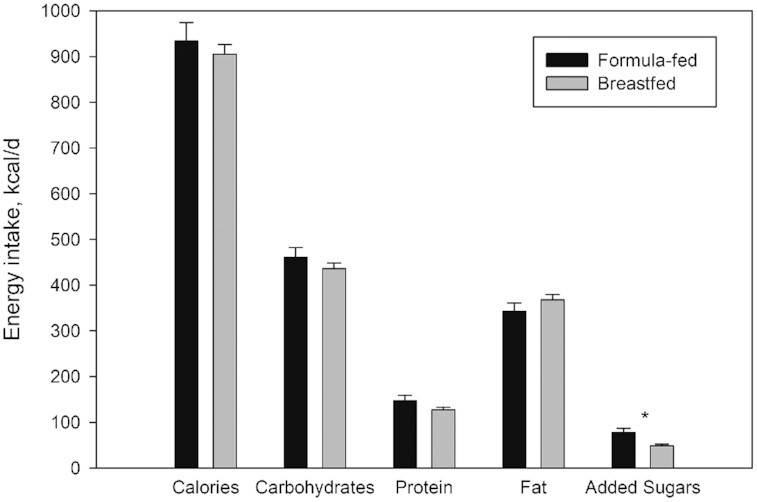
Results: Added sugars from formulas comprised 66% and 7% of added sugars consumed daily by infants and toddlers, respectively. A significant association was observed between upward WFA% crossing and added sugars from milk-based sources after controlling for gestational age, sex, age, introduction to solid foods, mean energy intakes, and maternal pre-pregnancy BMI and education (β = 0.003; 95% CI, 0.000-0.007; P = 0.046). Primarily formula-fed participants consumed nearly twice the energy from added sugars (P = 0.003) and gained weight faster (upward WFA% crossing = 1.1 ± 1.2 compared with 0.3 ± 0.6, respectively; P < 0.001) than their breastfed counterparts.
Conclusions: Added sugars in formulas predict rapid weight gain in infants and toddlers. Educating mothers on lower-sugar options may enhance childhood obesity prevention.
Keywords: added sugars; childhood obesity; complementary feeding; infant formula; infant rapid weight gain.
© The Author(s) 2021. Published by Oxford University Press on behalf of the American Society for Nutrition.
Figures
Comment in
-
Consider the Whole Picture When Discussing Infant Formula and Breast Milk.J Nutr. 2021 Jun 1;151(6):1375-1377. doi: 10.1093/jn/nxab132. J Nutr. 2021. PMID: 34036339 No abstract available.
References
-
- Koletzko B, von Kries R, Closa R, Escribano J, Scaglioni S, Giovannini M, Beyer J, Demmelmair H, Anton B, Gruszfeld Det al. Can infant feeding choices modulate later obesity risk. ? Am J Clin Nutr. 2009;89(5):1502s–8s. - PubMed
-
- Singhal A, Kennedy K, Lanigan J, Fewtrell M, Cole TJ, Stephenson T, Elias-Jones A, Weaver LT, Ibhanesebhor S, MacDonald PDet al. Nutrition in infancy and long-term risk of obesity: Evidence from 2 randomized controlled trials. Am J Clin Nutr. 2010;92(5):1133–44. - PubMed
-
- Roche AF, Guo S, Siervogel RM, Khamis HJ, Chandra RK. Growth comparison of breast-fed and formula-fed infants. Can J Public Health. 1993;84(2):132–5. - PubMed
Publication types
MeSH terms
Substances
Grants and funding
LinkOut - more resources
Full Text Sources
Other Literature Sources
Medical
