


No evidence for enzootic plague within black-tailed prairie dog (Cynomys ludovicianus) populations
- PMID: 33882192
- PMCID: PMC9292313
- DOI: 10.1111/1749-4877.12546
No evidence for enzootic plague within black-tailed prairie dog (Cynomys ludovicianus) populations
Abstract
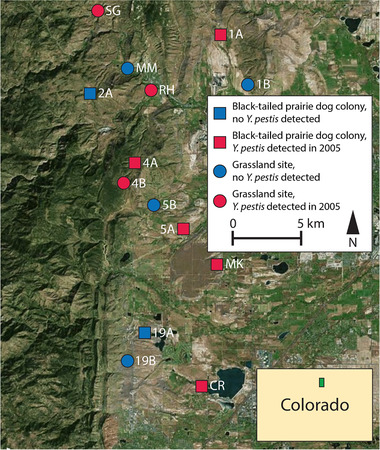
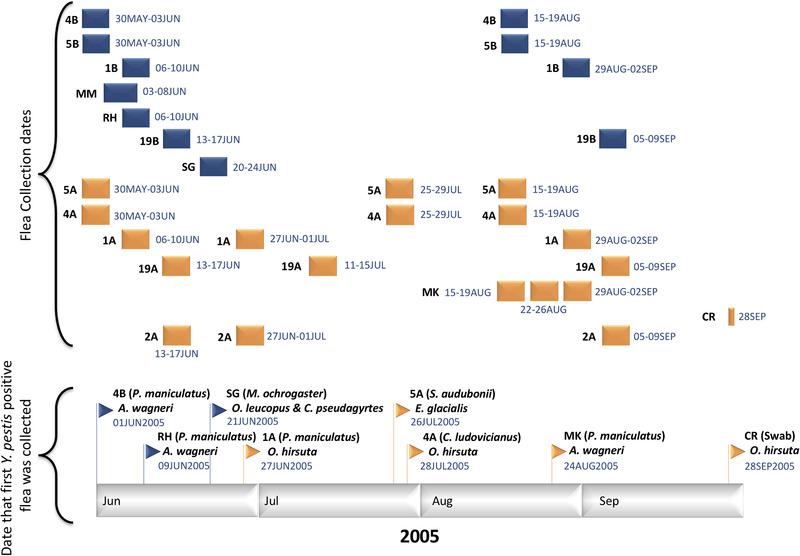
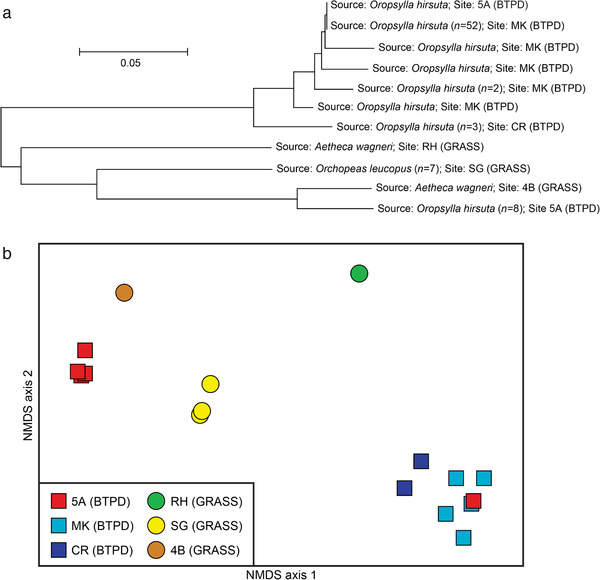
Yersinia pestis, causative agent of plague, occurs throughout the western United States in rodent populations and periodically causes epizootics in susceptible species, including black-tailed prairie dogs (Cynomys ludovicianus). How Y. pestis persists long-term in the environment between these epizootics is poorly understood but multiple mechanisms have been proposed, including, among others, a separate enzootic transmission cycle that maintains Y. pestis without involvement of epizootic hosts and persistence of Y. pestis within epizootic host populations without causing high mortality within those populations. We live-trapped and collected fleas from black-tailed prairie dogs and other mammal species from sites with and without black-tailed prairie dogs in 2004 and 2005 and tested all fleas for presence of Y. pestis. Y. pestis was not detected in 2126 fleas collected in 2004 but was detected in 294 fleas collected from multiple sites in 2005, before and during a widespread epizootic that drastically reduced black-tailed prairie dog populations in the affected colonies. Temporal and spatial patterns of Y. pestis occurrence in fleas and genotyping of Y. pestis present in some infected fleas suggest Y. pestis was introduced multiple times from sources outside the study area and once introduced, was dispersed between several sites. We conclude Y. pestis likely was not present in these black-tailed prairie dog colonies prior to epizootic activity in these colonies. Although we did not identify likely enzootic hosts, we found evidence that deer mice (Peromyscus maniculatus) may serve as bridging hosts for Y. pestis between unknown enzootic hosts and black-tailed prairie dogs.
Keywords: Cynomys ludovicianus; Yersinia pestis; black-tailed prairie dog; plague; prairie dogs.
© 2021 International Society of Zoological Sciences, Institute of Zoology/Chinese Academy of Sciences and John Wiley & Sons Australia, Ltd.
Figures
References
-
- Allender CJ, Easterday WR, Van Ert MN, Wagner DM, Keim P (2004). High‐throughput extraction of arthropod vector and pathogen DNA using bead milling. Biotechniques 37, 730–4. - PubMed
-
- Ayyadurai S, Houhamdi L, Lepidi H, Nappez C, Raoult D, Drancourt M (2008). Long‐term persistence of virulent Yersinia pestis in soil. Microbiology (Reading, England) 154, 2865–71. - PubMed
-
- Bacon M, Drake CH (1958). Comparative susceptibility of various species of mice native to Washington to inoculation with virulent strains of Pasteurella pestis . Journal of Infectious Diseases 102, 14–22. - PubMed
MeSH terms
Grants and funding
- DEB-0224328/NSF/NIH joint program in Ecology of Infectious Diseases
- R15 AI070183/AI/NIAID NIH HHS/United States
- R-82909101-0/National Center for Environmental Research (NCER) STAR program of the US-EPA
- U54 AI065359/AI/NIAID NIH HHS/United States
- AI065359/Pacific-Southwest Regional Center of Excellence
LinkOut - more resources
Full Text Sources
Other Literature Sources
Medical
