


Low suction on digital drainage devices promptly improves post-operative air leaks following lung resection operations: a retrospective study
- PMID: 33882977
- PMCID: PMC8059315
- DOI: 10.1186/s13019-021-01485-z
Low suction on digital drainage devices promptly improves post-operative air leaks following lung resection operations: a retrospective study
Abstract
Background: We investigated the most effective suction pressure for preventing or promptly improving postoperative air leaks on digital drainage devices after lung resection.
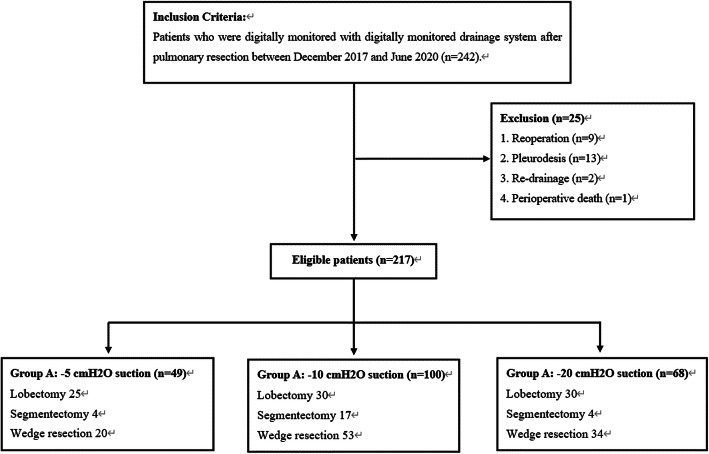
Methods: We retrospectively analyzed the postoperative data of 242 patients who were monitored with a digital drainage system after pulmonary resection in our institution between December 2017 and June 2020. We divided the patients into three groups according to the suction pressure used: A (low-pressure suction group: - 5 cm H2O), B (intermediate-pressure group: - 10 cm H2O), and C (high-pressure suction group: - 20 cm H2O). We evaluated the duration of air leaks, timing of chest tube replacement, the amount of postoperative air leak, volume of fluid drained before chest tube removal, and the total number of air leaks during drainage.
Results: In total, 217 patients were included in this study. The duration of air leaks gradually decreased with significant difference between the groups, the highest decrease in A, the lowest decrease in C (P = 0.019). Timing of chest tube replacement, on the other hand, did not significantly differ between the three groups (P = 0.126). The number of postoperative air leaks just after surgery did not significantly differ between the three groups (P = 0.175), but the number of air leaks on postoperative day 1 were fewest in group A, then B, and greatest in group C (P = 0.033). The maximum amount of air leaks during drainage was lowest in A, then B, and highest in C (P = 0.036). Volume of fluid drained before chest tube removal did not significantly differ between the three groups (P = 0.986).
Conclusion: Low-pressure suction after pulmonary resection seems to avoid or promptly improve postoperative air leaks in digital drainage devices after lung resection.
Trial registration: This is a single-institution, retrospective analysis-based study of data from an electronic database. Study protocol was approved by the Akashi Medical Center Institutional Research Ethics Board (approval number: 2020-9).
Keywords: Chest drain; Digital drainage system; Low-pressure suction; Lung cancer; Prolonged air leaks.
Conflict of interest statement
The authors have declared that they have no conflict of interest.
Figures
References
-
- Gocyk W, Kużdżał J, Włodarczyk J, Grochowski Z, Gil T, Warmus J, Kocoń P, Talar P, Obarski P, Trybalski Ł. Comparison of suction versus nonsuction drainage after lung resections: a prospective randomized trial. Ann Thorac Surg. 2016;102(4):1119–1124. doi: 10.1016/j.athoracsur.2016.04.066. - DOI - PubMed
MeSH terms
LinkOut - more resources
Full Text Sources
Other Literature Sources
