


Introducing two types of psychological resilience with partly unique genetic and environmental sources
- PMID: 33883571
- PMCID: PMC8060303
- DOI: 10.1038/s41598-021-87581-5
Introducing two types of psychological resilience with partly unique genetic and environmental sources
Abstract
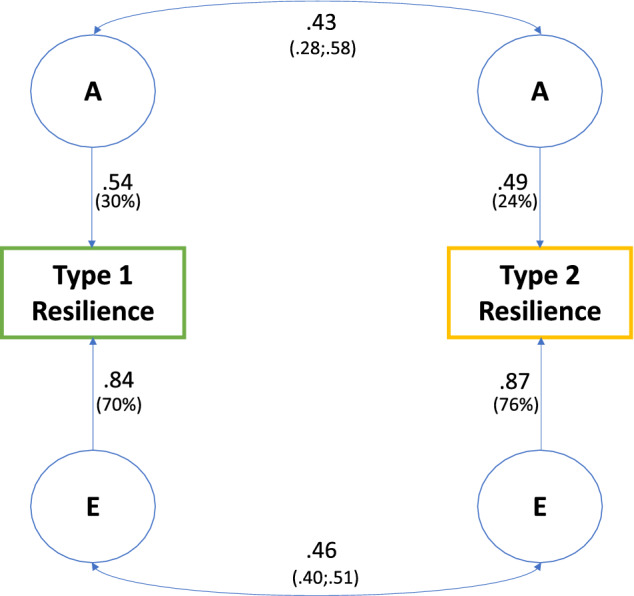
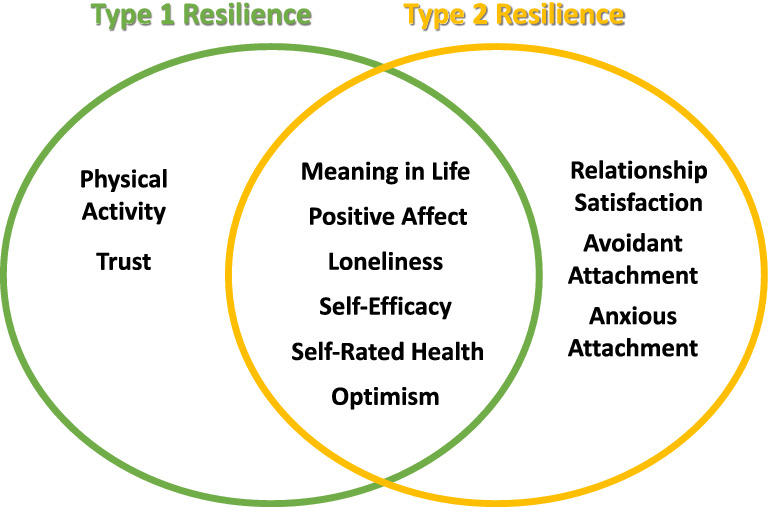
Psychological resilience is indicated when individuals demonstrate good mental health despite exposure to significant stress or adversity. Good mental health may involve low levels of illbeing and/or high levels of wellbeing. There is still very limited knowledge about the potential differences between these outcomes in relation to stressors. We propose a distinction between type 1 and type 2 resilience, examine their underlying genetic and environmental architecture, and identify modifiable resilience factors. The data come from a population-based twin sample (N = 1987, mean age = 63) in the Norwegian Twin Registry. Type 1 and type 2 resilience are operationalised as the residual of anxiety/depression symptoms and life satisfaction, respectively, after lifetime cumulative adversity has been regressed out. We used biometric modelling and cotwin-control linear mixed models to estimate underlying factors and identify predictors while controlling for genetic confounding. The results support the notion of two separate, but partly overlapping types of resilience. We find heritabilities of 0.30 (type 1) and 0.24 (type 2) and a genetic correlation of 0.43. Potentially causal resilience factors include, but are not limited to, meaning in life, physical activity, positive affect and relationship satisfaction. Whereas some factors are associated with both resilience types, other factors are unique to each type.
Conflict of interest statement
The authors declare no competing interests.
Figures
References
-
- Bonanno GA, Romero SA, Klein SI. The temporal elements of psychological resilience: An integrative framework for the study of individuals, families, and communities. Psychol. Inq. 2015;26:139–169. doi: 10.1080/1047840X.2015.992677. - DOI
Publication types
MeSH terms
LinkOut - more resources
Full Text Sources
Other Literature Sources
Medical
