


RFC1 AAGGG repeat expansion masquerading as Chronic Idiopathic Axonal Polyneuropathy
- PMID: 33884451
- PMCID: PMC8505379
- DOI: 10.1007/s00415-021-10552-3
RFC1 AAGGG repeat expansion masquerading as Chronic Idiopathic Axonal Polyneuropathy
Abstract
Background: A biallelic intronic AAGGG repeat expansion in the Replication Factor C subunit 1 (RFC1) gene has been recently associated with Cerebellar Ataxia, Neuropathy, Vestibular Areflexia Syndrome, a disorder often presenting as a slowly evolving sensory neuropathy at the onset. "Chronic Idiopathic Axonal Polyneuropathy" (CIAP) is a common indolent axonal neuropathy of adulthood which remains without an identifiable cause despite thorough investigations.
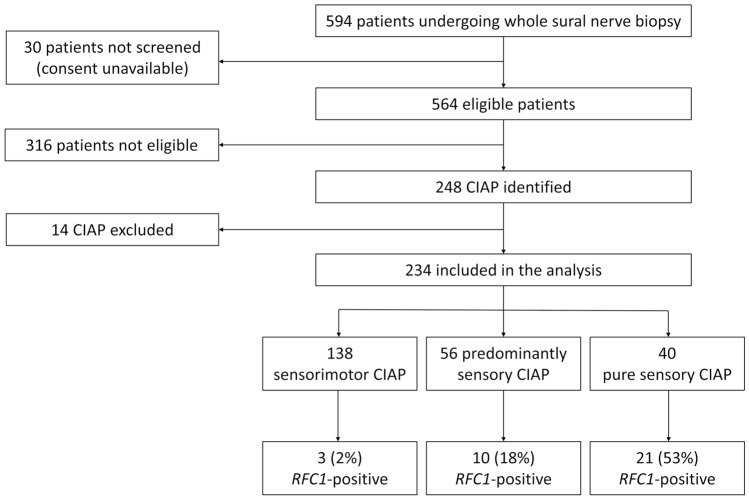
Methods: We screened 234 probands diagnosed with CIAP for a pathogenic biallelic RFC1 AAGGG repeat expansion. Patients were selected from 594 consecutive patients with neuropathy referred to our tertiary-care center for a sural nerve biopsy over 10 years.
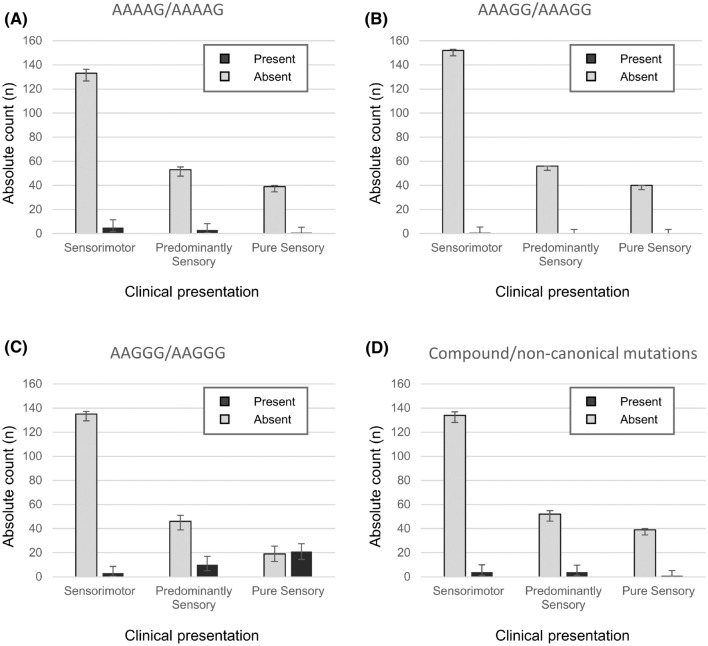
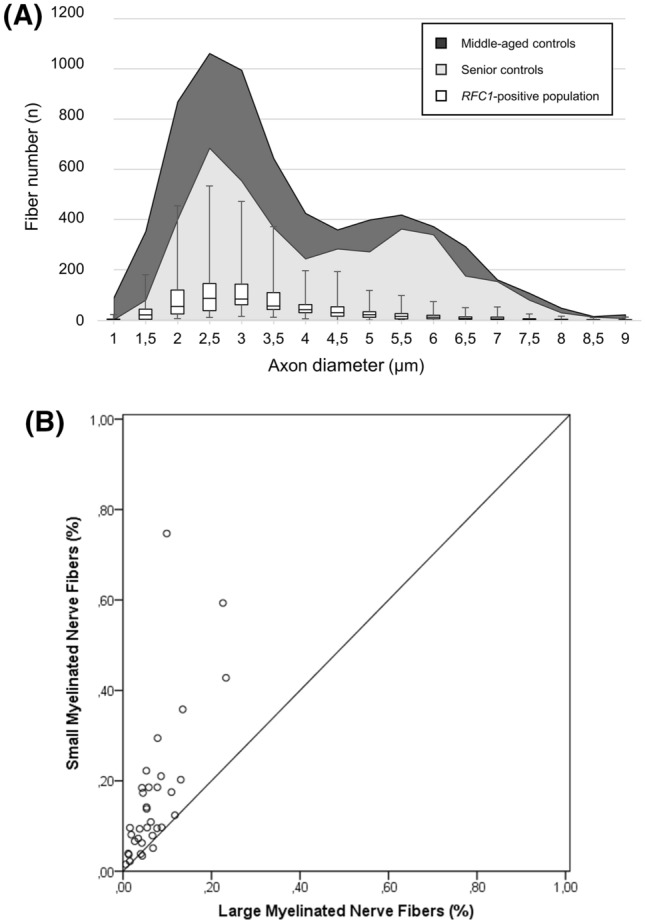
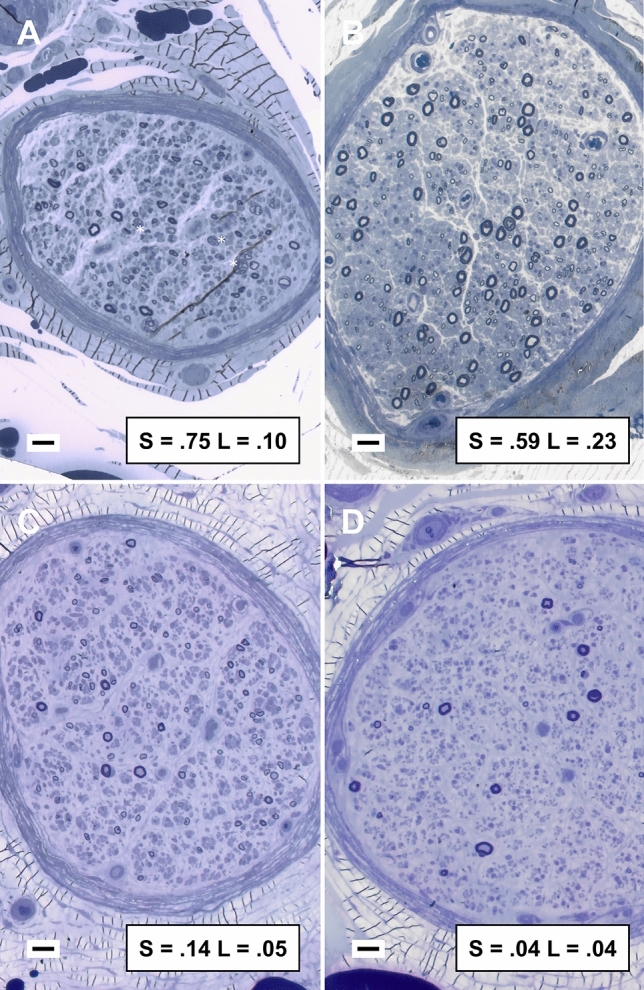
Results: The RFC1 AAGGG repeat expansion was common in patients with pure sensory neuropathy (21/40, 53%) and less frequent in cases with predominantly sensory (10/56, 18%, P < 0.001) or sensorimotor (3/138, 2%, P < 0.001) neuropathy. The mutation was associated with sensory ataxia (τb = 0.254, P < 0.001), autonomic disturbances (35% vs 8%, Prevalence Odds Ratio-POR 6.73 CI 95% 2.79-16.2, P < 0.001), retained deep tendon reflexes (score 18.0/24 vs 11.5/24, R = 0.275, P < 0.001). On pathology, we observed absent/scant regenerative changes (τb = - 0.362, P < 0.001), concomitant involvement of large (100% and 99%, n.s.), small myelinated (97% vs 81%, POR 7.74 CI 95% 1.03-58.4, P = 0.02) and unmyelinated nerve fibers (85% vs 41%, POR 8.52 CI 95% 3.17-22.9, P < 0.001). Cerebellar or vestibular involvement was similarly rare in the two groups.
Conclusions: This study highlights the frequent occurrence of the RFC1 AAGGG repeat expansion in patients diagnosed with CIAP and characterizes the clinical and pathological features of the related neuro(no)pathy.
Keywords: Cerebellar Ataxia; Chronic Idiopathic Axonal Neuropathy; Neuropathy; Replication factor C subunit 1; Vestibular Areflexia Syndrome.
© 2021. The Author(s).
Conflict of interest statement
M. Tagliapietra reports a training grant from Pfizer and received support for attending scientific meetings from Alnylam. S. Ferrari received support for attending scientific meetings from Sanofi-Genzyme, Merck and Euroimmun. G.M. Fabrizi served on Advisory Boards for Alnylam, Akcea and Pharnext-Vitaccess, received speaker fees from Akcea and support for attending scientific meetings by Pfizer and Akcea. D. Cardellini, M. Ferrarini, S. Testi, S. Monaco and T. Cavallaro report no disclosures.
Figures
References
-
- Senderek J, Lassuthova P, Kabzińska D, Abreu L, Baets J, Beetz C, Braathen GJ, Brenner D, Dalton J, Dankwa L, Deconinck T, De Jonghe P, Dräger B, Eggermann K, Ellis M, Fischer C, Stojkovic T, Herrmann DN, Horvath R, Høyer H, Iglseder S, Kennerson M, Kinslechner K, Kohler JN, Kurth I, Laing NG, Lamont PJ, Löscher W, Ludolph A, Marques W, Nicholson G, Ong R, Petri S, Ravenscroft G, Rebelo A, Ricci G, Rudnik-Schöneborn S, Schirmacher A, Schlotter-Weigel B, Schoels L, Schüle R, Synofzik M, Francou B, Strom TM, Wagner J, Walk D, Wanschitz J, Weinmann D, Weishaupt J, Wiessner M, Windhager R, Young P, Züchner S, Toegel S, Seeman P, Kochański A, Auer-Grumbach M. The genetic landscape of axonal neuropathies in the middle-aged and elderly: focus on MME. Neurology. 2020;95:e3163–e3179. doi: 10.1212/WNL.0000000000011132. - DOI - PMC - PubMed
-
- Cortese A, Simone R, Sullivan R, Vandrovcova J, Tariq H, Yau WY, Humphrey J, Jaunmuktane Z, Sivakumar P, Polke J, Ilyas M, Tribollet E, Tomaselli PJ, Devigili G, Callegari I, Versino M, Salpietro V, Efthymiou S, Kaski D, Wood NW, Andrade NS, Buglo E, Rebelo A, Rossor AM, Bronstein A, Fratta P, Marques WJ, Züchner S, Reilly MM, Houlden H. Biallelic expansion of an intronic repeat in RFC1 is a common cause of late-onset ataxia. Nat Genet. 2019;51:649–658. doi: 10.1038/s41588-019-0372-4. - DOI - PMC - PubMed
MeSH terms
Substances
LinkOut - more resources
Full Text Sources
Other Literature Sources
Miscellaneous
