


The Relationships between Coronal Plane Alignments and Patient-Reported Outcomes Following High Tibial Osteotomy: A Systematic Review
- PMID: 33884908
- PMCID: PMC8808848
- DOI: 10.1177/19476035211007903
The Relationships between Coronal Plane Alignments and Patient-Reported Outcomes Following High Tibial Osteotomy: A Systematic Review
Abstract
Objective: This systematic review aimed to determine whether coronal angular corrections correlate with patient reported outcomes following valgus-producing high tibial osteotomy (HTO).
Design: Ovid MEDLINE, Embase, and Web of Science were systematically searched. Studies that reported hip-knee-ankle angles (HKA) or femorotibial angles (FTA), and the Oxford Knee Score (OKS), visual analogue scale (VAS) score, Knee Injury and Osteoarthritis Outcome Score (KOOS), or EQ-5D before and after valgus-producing HTO were eligible. Correlation analyses were performed where appropriate to investigate the relationships between variables. PROSPERO ID: CRD42019135467.
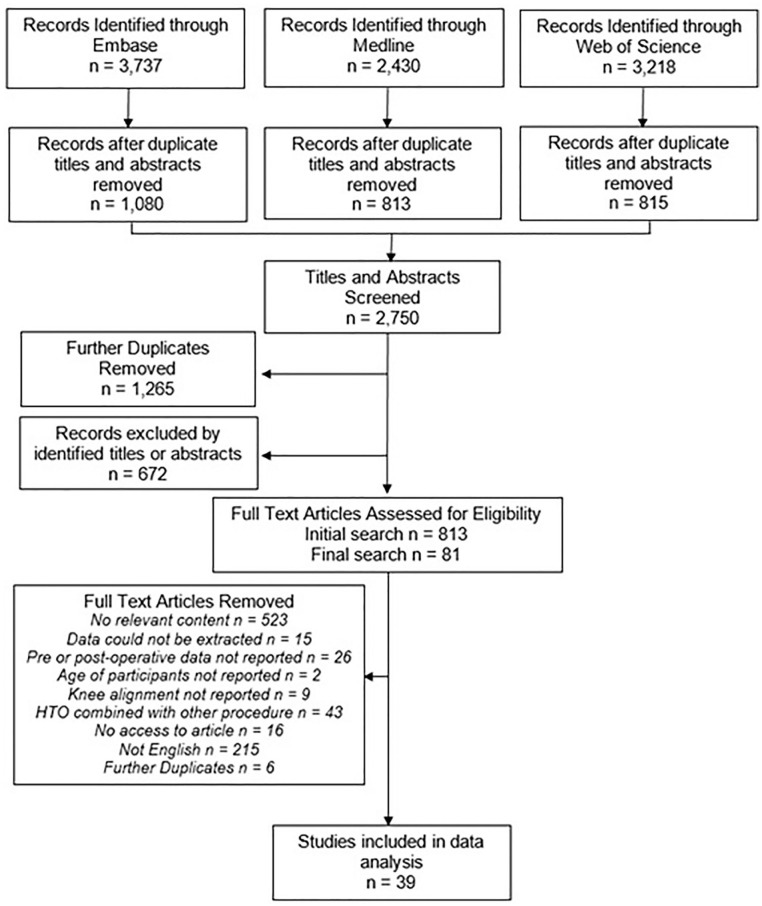
Results: This study included 39 articles including 50 cohorts. VAS was reported in 22 studies, OKS in 9, KOOS in 12 and EQ-5D in 2. The HKA angle was corrected from 7.1° ± 1.7° varus to 2.3° ± 1.7° valgus at final follow-up. The FTA changed from 3.0° ± 2.0° varus to 7.7° ± 1.3° valgus. Outcome scores improved with clinical and statistical significance postoperatively. Spearman correlations for nonparametric data revealed greater changes in knee alignment were moderately associated with larger improvements in VAS scores (r = 0.50). Furthermore, those who experienced greater changes in alignment showed larger improvements in the KOOS Activity and Quality of Life domains (r = 0.72 and r = 0.51, respectively).
Conclusion: On average, patients did not achieve the "ideal correction" of 3° to 6° valgus postoperatively. Nevertheless, statistical and clinical improvements in patient-reported outcome measure scores were consistently reported. This suggests that the "ideal correction" may be more flexible than 3° to 6°.
Keywords: high tibial osteotomy; knee; osteoarthritis; patient reported outcomes; review.
Conflict of interest statement
References
-
- Palmer H, Elson D, Baddeley T, Porthouse A. The United Kingdom Knee Osteotomy Registry: the first annual report 2018. Available from: https://secure.amplitude-registry.com/UKKOR/Content/Ukkor_AnnualReport_R...
-
- Zhang W, Moskowitz RW, Nuki G, Abramson S, Altman RD, Arden N, et al. Oarsi recommendations for the management of hip and knee osteoarthritis, Part II: Oarsi evidence-based, expert consensus guidelines. Osteoarthritis Cartilage. 2008;16(2):137-62. - PubMed
-
- Elson DW. The surgical accuracy of knee osteotomy. Knee. 2017;24(2):167-9. - PubMed
-
- Yin Y, Li S, Zhang R, Guo J, Hou Z, Zhang Y. What is the relationship between the “Fujisawa Point” and postoperative knee valgus angle? A theoretical, computer-based study. Knee. 2020;27(1_suppl):183-91. - PubMed
-
- Fujisawa Y, Masuhara K, Shiomi S. The effect of high tibial osteotomy on osteoarthritis of the knee. An arthroscopic study of 54 knee joints. Orthop Clin North Am. 1979;10(3):585-608. - PubMed
Publication types
MeSH terms
LinkOut - more resources
Full Text Sources
