


Psoriasis Prevalence and Severity by Expert Elicitation
- PMID: 33886086
- PMCID: PMC8163919
- DOI: 10.1007/s13555-021-00518-8
Psoriasis Prevalence and Severity by Expert Elicitation
Abstract
Introduction: An estimated 2-4% of Western populations are thought to have psoriasis, with a regional incidence ranging from 0.09% to 11.43%. Variance in estimates is a result of differences in study populations, methodology, regional differences, and definitions of disease. Reliable prevalence estimates of plaque psoriasis are challenging to establish. Further, the distribution of psoriasis severity in the population is unknown. This study aims to establish the utility of expert elicitation (EE) as a method for estimating unknown parameters in dermatology by (1) estimating the prevalence of psoriasis in the adult population, and (2) estimating previously unknown disease severity distribution.
Methods: An expert panel of 11 Canadian dermatologists with demonstrated expertise in psoriasis was formed. A proof-of-concept EE exercise estimated psoriasis prevalence in the general population in Canada, followed by estimation of psoriasis disease severity distribution by body surface area (BSA). Expert estimates were consolidated using Bayesian methods to statistically model the data and represent uncertainty.
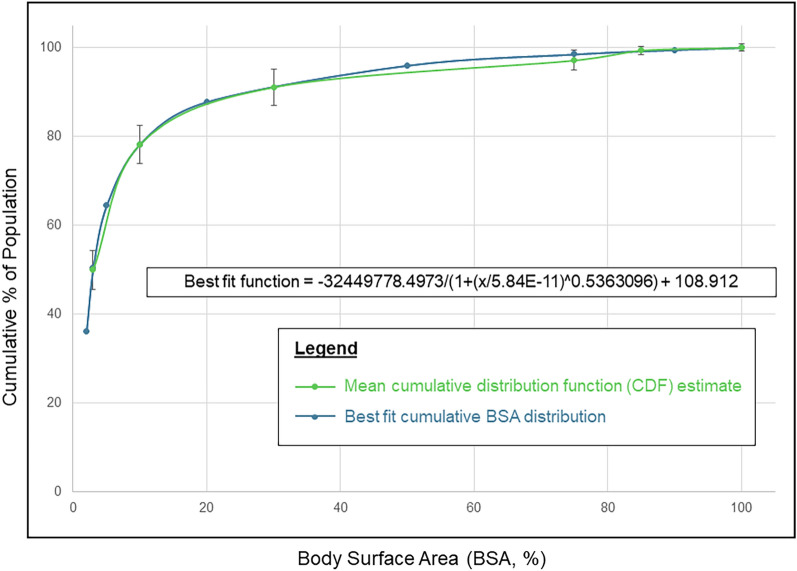
Results: The median prevalence of psoriasis in the adult population using the Bayesian estimate was 3.0% (95% credibility interval, 2.7-3.3%), compared with the estimated mean prevalence of 3.4% (95% confidence interval, 2.2-4.9%). By EE, the estimated cumulative distribution of disease severity assessed by BSA suggests that approximately 50% of patients have a BSA of < 3% and 78% of patients have a BSA of < 10%, with only 2% having a BSA of > 50%.
Conclusion: The EE approach resulted in prevalence estimates that had a narrow distribution and were consistent with published literature, supporting its value in dermatology as a complementary method to help guide decision-making in areas where evidence is scarce or uncertain.
Keywords: BSA; Bayesian; Disease severity; Expert elicitation; Prevalence; Psoriasis.
Plain language summary
Psoriasis is a common skin disease that affects 2–4% of the population. Prevalence estimates vary depending on factors such as study type and population studied. The distribution of disease severity (what proportion of patients have mild, moderate, or severe psoriasis) is not known. In this study, 11 dermatologists with expertise in psoriasis used an approach called expert elicitation to make educated guesses about prevalence and disease severity distribution in the real world. Using a statistical approach called Bayesian estimation, experts can represent the level of certainty in what they know and do not know and make inferences or assumptions about a population. Bayesian estimates are not based on the amount of data; rather, each datum contributes to a statistically meaningful result. The median prevalence of psoriasis in the adult population using the Bayesian estimate was 3.0%, which is in the expected range based on prior literature and supports the use of this expert elicitation method. This study provides the first expert estimate of disease severity distribution in the population assessed by body surface area affected by psoriasis. Approximately 50% of psoriasis patients have mild disease (< 3% body surface area involved) and 78% of patients have mild or moderate disease (< 10% body surface area involved). Only 2% of patients have more than 50% body surface area involved. This expert elicitation approach can be used to help guide decision-making in areas of dermatology where evidence is lacking or uncertain.
Figures

References
-
- World Health Organization . Global report on PSORIASIS. Geneva: World Health Organization; 2016.
-
- Kruschke J. Doing Bayesian data analysis: a tutorial with R, JAGS, and Stan. 2. Burlington: Academic Press; 2015.
LinkOut - more resources
Full Text Sources
Other Literature Sources
