Review
. 2021 Apr 22;17(4):e1009442.
doi: 10.1371/journal.ppat.1009442. eCollection 2021 Apr.

Some conditions apply: Systems for studying Plasmodium falciparum protein function

Affiliations
Review

Some conditions apply: Systems for studying Plasmodium falciparum protein function

Heather M Kudyba et al. PLoS Pathog. .

Abstract

Malaria, caused by infection with Plasmodium parasites, remains a significant global health concern. For decades, genetic intractability and limited tools hindered our ability to study essential proteins and pathways in Plasmodium falciparum, the parasite associated with the most severe malaria cases. However, recent years have seen major leaps forward in the ability to genetically manipulate P. falciparum parasites and conditionally control protein expression/function. The conditional knockdown systems used in P. falciparum target all 3 components of the central dogma, allowing researchers to conditionally control gene expression, translation, and protein function. Here, we review some of the common knockdown systems that have been adapted or developed for use in P. falciparum. Much of the work done using conditional knockdown approaches has been performed in asexual, blood-stage parasites, but we also highlight their uses in other parts of the life cycle and discuss new ways of applying these systems outside of the intraerythrocytic stages. With the use of these tools, the field's understanding of parasite biology is ever increasing, and promising new pathways for antimalarial drug development are being discovered.


Conflict of interest statement

The authors have declared that no competing interests exist.

Figures
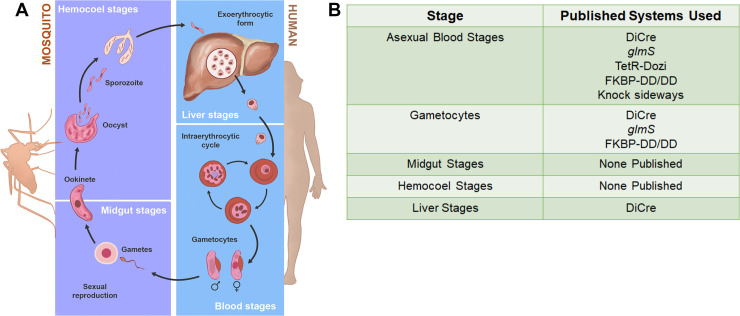
Fig 1
Fig 1. Conditional protein knockdown used throughout the Plasmodium falciparum life cycle.
(A) Schematic of the malaria life cycle in the human host and the mosquito vector. (B) Table outlining the conditional knockout/knockdown systems used at various life cycle stages of P. falciparum.
Fig 2
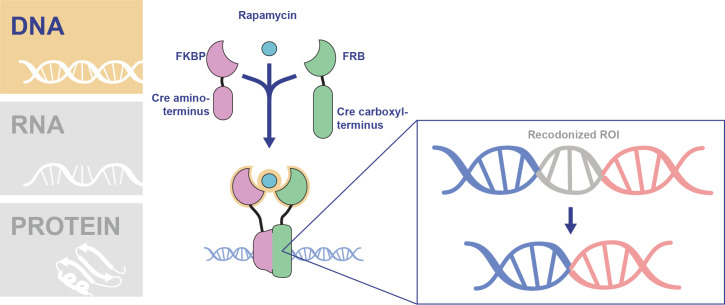
Fig 2. Conditional control of transcription in P. falciparum using the DiCre system.
Transgenic P. falciparum parasites are created expressing the Cre N-terminus fused to FKBP and the Cre carboxyl terminus fused to FRB. The addition of rapamycin dimerizes the FKBP and FRB proteins which results in the 2 inactive polypeptides joining together to form an active Cre recombinase. The DiCre transgenic parasites are genetically modified to introduce LoxP sites, the sequence recognized by the Cre recombinase, flanking the recodonized DNA sequence of interest. Upon activation of Cre in these parasites using rapamycin, the DNA flanked by LoxP sites is excised, resulting in a conditional knockout. FKBP, FK506 binding protein 12; FRB, FKBP12-rapamycin-binding; LoxP, locus of X-over in P1; ROI, region of interest.
Fig 3
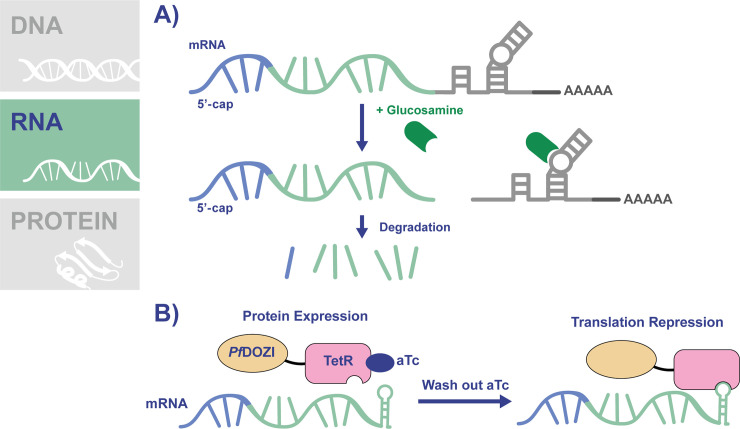
Fig 3. Conditional knockdown of translation using the glmS ribozyme or PfDOZI-TetR.
(A) The glmS ribozyme system works by inserting the ribozyme sequence in the parasite genome following the stop codon of the gene of interest. The transcribed mRNA will contain the glmS ribozyme (light gray mRNA), which is activated by glucosamaine-6-phosphate to cleave its associated RNA, resulting in transcript instability and degradation. (B) The TetR-DOZI system works by the insertion of 10 copies of the TetR aptamer sequence following the stop codon of the gene of interest. A PfDOZI-TetR fusion protein is expressed in these parasites. TetR recognizes and binds to the RNA aptamers (green hairpin), and PfDOZI directs the mRNA to sites of translation repression. The addition of aTc inhibits the binding of PfDOZI-TetR to the mRNA. Therefore, translation of the protein of interest can be regulated by the addition or removal of aTc. aTc, anhydrotetracycline.
Fig 4
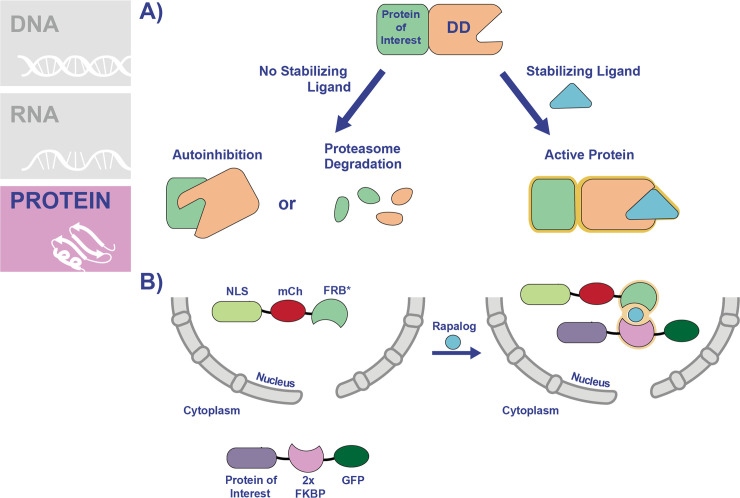
Fig 4. Conditional knockdown of protein function using degradation or KS systems.
(A) The FKBP-DD and DD systems work using a similar mechanism, thus a combined schematic of how these systems work is shown. For simplicity, both the FKBP-DD and DD are depicted and referred to as DD. The sequence encoding the DD is inserted into the genome in frame immediately following the gene of interest. The DD contains point mutations which render the protein domain unstable, causing the protein to be recognized for degradation by the proteasome. In the case of chaperone proteins appended to the DD, the unfolded domain is recognized by the chaperone, which results in autoinhibition. The DD is stabilized through the addition of a ligand (TMP for DD and Shld1 for FKBP-DD). Addition of the ligand stabilizes the DD to prevent its degradation by the proteasome or autoinhibition. (B) The KS system allows for the conditional mislocalization of proteins to inhibit their functions. In this system, the protein of interest is fused to 2 copies of the FKBP domain in a parasite line that expresses an FRB* “mislocalizer” fusion protein, engineered to localize to the nucleus or plasma membrane. Addition of rapamycin (or rapalog) dimerizes the FKBP/FRB* domains, resulting in the relocalization of the protein of interest to one of these sites. DD, destabilization domain; FKBP, FK506 binding protein 12; FKBP-DD, FK506 binding protein destabilization domain; FRB, FKBP12-rapamycin-binding; GFP, green fluorescent protein; KS, knock sideways; mCh, mCherry; NLS, nuclear localization signal; TMP, trimethoprim.

References

    1. World Health Organization. World malaria report 2020: 20 years of global progress and challenges. 2020;299.
    1. Tang Y, Meister TR, Walczak M, Pulkoski-Gross MJ, Hari SB, Sauer RT, et al.. A mutagenesis screen for essential plastid biogenesis genes in human malaria parasites. Striepen B, editor. PLoS Biol. 2019. February 6;17(2):e3000136. 10.1371/journal.pbio.3000136 - DOI - PMC - PubMed
    1. Smith RC, Vega-Rodríguez J, Jacobs-Lorena M. The Plasmodium bottleneck: malaria parasite losses in the mosquito vector. Mem Inst Oswaldo Cruz. 2014. August;109(5):644–61. 10.1590/0074-0276130597 - DOI - PMC - PubMed
    1. O’Neill MT, Phuong T, Healer J, Richard D, Cowman AF. Gene deletion from Plasmodium falciparum using FLP and Cre recombinases: Implications for applied site-specific recombination. Int J Parasitol. 2011. January;41(1):117–23. 10.1016/j.ijpara.2010.08.001 - DOI - PubMed
    1. Meissner M, Krejany E, Gilson PR, de Koning-Ward TF, Soldati D, Crabb BS. Tetracycline analogue-regulated transgene expression in Plasmodium falciparum blood stages using Toxoplasma gondii transactivators. Proc Natl Acad Sci U S A. 2005. February 22;102(8):2980–5. 10.1073/pnas.0500112102 - DOI - PMC - PubMed

Publication types

MeSH terms