


Comment
doi: 10.1016/j.jid.2020.11.008.
From Enhancers to Keratinocyte Cancers
Affiliations
- PMID: 33888214
- PMCID: PMC8175092
- DOI: 10.1016/j.jid.2020.11.008
Item in Clipboard
Comment
From Enhancers to Keratinocyte Cancers
J Invest Dermatol.
2021 May.
Abstract
Epigenetic dysregulation and disruption of gene enhancer networks are both pervasive in human cancers, and yet, their roles in keratinocyte cancers are poorly understood. Utilizing patient samples, Yao et al. (2020) provide an initial framework for understanding the underlying mechanisms by integrating enhancer and transcriptional alterations that occur during the progression of basal cell and squamous cell carcinomas.
Copyright © 2021 The Author. Published by Elsevier Inc. All rights reserved.
Conflict of interest statement
CONFLICT OF INTEREST
The author states no conflict of interest.
Figures
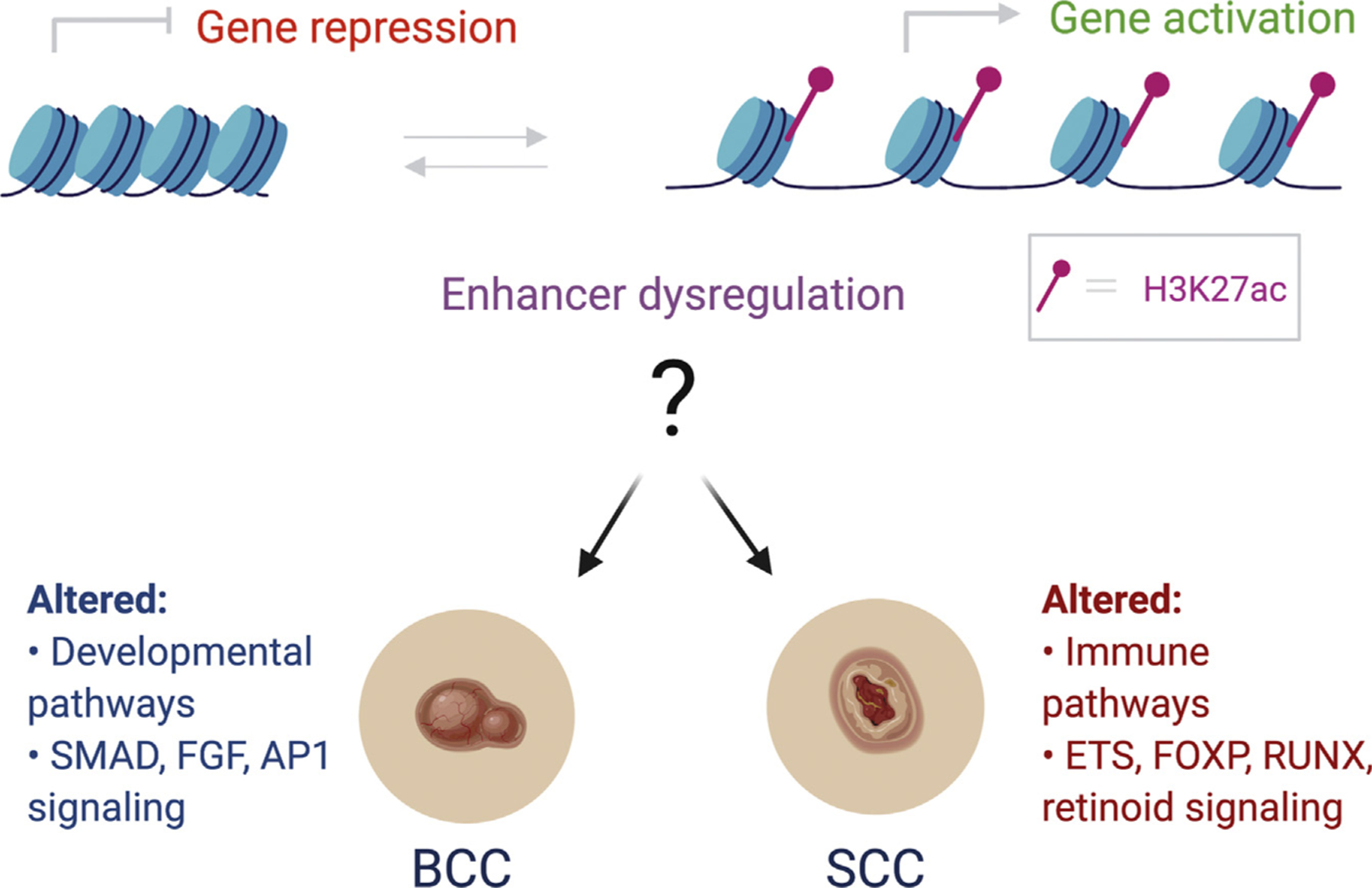
Dysregulation of these processes may be a key driver of KC cancers such
as BCC and SCC. The authors mapped H3K27ac, a modification associated with
active enhancers, in human patient samples to gain insights into epigenetic
contributions to these ubiquitous cancers. In the case of BCC, aberrant enhancer
activation is associated with developmental pathways and is enriched for
transcription factor motifs such as SMAD3 and/or SMAD4, FGFR2, and FOSL2. In
SCC, altered enhancers are enriched for immune-related pathways and display
gains in ETS1, FOXP3, RUNX1, and NF-κB/Rel transcription factor sites
along with a loss of H3K27ac enrichment and/or enhancer activity at
retinoid-related transcription factor motifs. AP-1, activator protein-1; BCC,
basal cell carcinoma; FGF, fibroblast GF; H3K27ac, acetylated histone H3 lysine
27; KC, keratinocyte; SCC, squamous cell carcinoma.
Comment on
-
Epigenetic Alterations in Keratinocyte Carcinoma.J Invest Dermatol. 2021 May;141(5):1207-1218. doi: 10.1016/j.jid.2020.10.018. Epub 2020 Nov 16. J Invest Dermatol. 2021. PMID: 33212152 Free PMC article.
References
-
- Baskin NL, Haynes KA. Chromatin engineering offers an opportunity to advance epigenetic cancer therapy. Nat Struct Mol Biol 2019;26:842–5. - PubMed
-
- Harwood CA, Leedham-Green M, Leigh IM, Proby CM. Low-dose retinoids in the prevention of cutaneous squamous cell carcinomas in organ transplant recipients: a 16-year retrospective study. Arch Dermatol 2005;141: 456–64. - PubMed
Publication types
MeSH terms
Grants and funding
LinkOut - more resources
Full Text Sources
Other Literature Sources
