Interstitial lung disease increases susceptibility to and severity of COVID-19
- PMID: 33888524
- PMCID: PMC8061231
- DOI: 10.1183/13993003.04125-2020
Interstitial lung disease increases susceptibility to and severity of COVID-19
Abstract
Background: There are limited data regarding the relationship between interstitial lung disease (ILD) and the natural course of COVID-19. In this study, we investigate whether patients with ILD are more susceptible to COVID-19 than those without ILD and evaluate the impact of ILD on disease severity in patients with COVID-19.
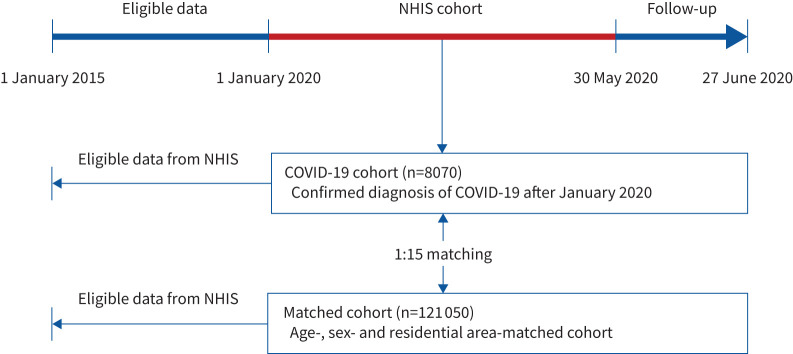
Methods: A nationwide cohort of patients with COVID-19 (n=8070) and a 1:15 age-, sex- and residential area-matched cohort (n=121 050) were constructed between 1 January 2020 and 30 May 2020 in Korea. We performed a nested case-control study to compare the proportions of patients with ILD between the COVID-19 cohort and the matched cohort. Using the COVID-19 cohort, we also evaluated the risk of severe COVID-19 in patients with ILD versus those without ILD.
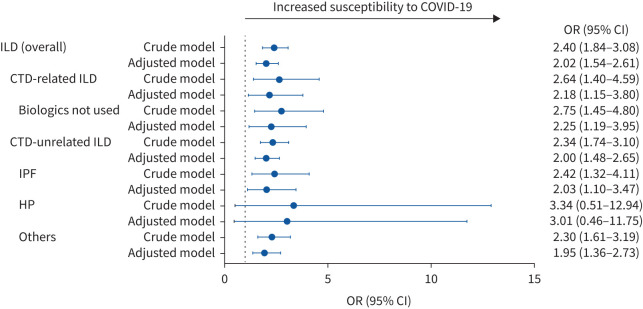
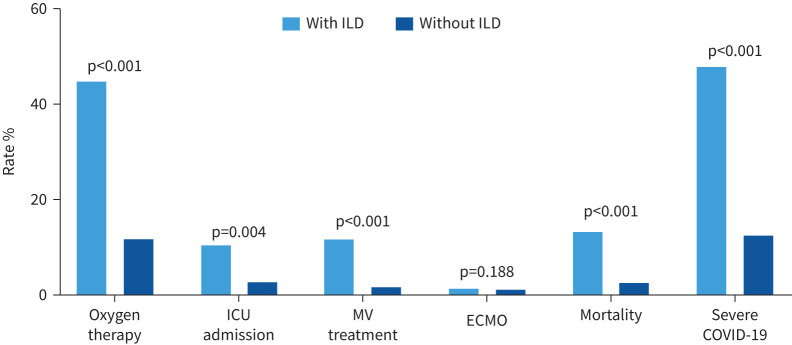
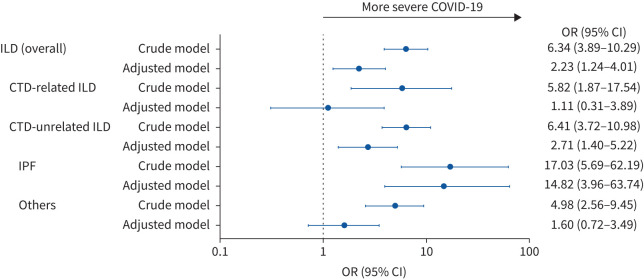
Results: The proportion of patients with ILD was significantly higher in the COVID-19 cohort than in the matched cohort (0.8% versus 0.4%; p<0.001). The odds of having ILD was significantly higher in the COVID-19 cohort than in the matched cohort (adjusted OR 2.02, 95% CI 1.54-2.61). Among patients in the COVID-19 cohort, patients with ILD were more likely to have severe COVID-19 than patients without ILD (47.8% versus 12.6%), including mortality (13.4% versus 2.8%) (all p<0.001). The risk of severe COVID-19 was significantly higher in patients with ILD than in those without ILD (adjusted OR 2.23, 95% CI 1.24-4.01).
Conclusion: The risks of COVID-19 and severe presentation were significantly higher in patients with ILD than in those without ILD.
Copyright ©The authors 2021.
Conflict of interest statement
Conflict of interest: H. Lee has nothing to disclose. Conflict of interest: H. Choi has nothing to disclose. Conflict of interest: B. Yang has nothing to disclose. Conflict of interest: S-K. Lee has nothing to disclose. Conflict of interest: T.S. Park has nothing to disclose. Conflict of interest: D.W. Park has nothing to disclose. Conflict of interest: J-Y. Moon has nothing to disclose. Conflict of interest: T-H. Kim has nothing to disclose. Conflict of interest: J.W. Sohn has nothing to disclose. Conflict of interest: H.J. Yoon has nothing to disclose. Conflict of interest: S-H. Kim has nothing to disclose.
Figures
Comment in
-
Interstitial lung disease before and after COVID-19: a double threat?Eur Respir J. 2021 Dec 2;58(6):2101956. doi: 10.1183/13993003.01956-2021. Print 2021 Dec. Eur Respir J. 2021. PMID: 34857587 Free PMC article.
References
Publication types
MeSH terms
LinkOut - more resources
Full Text Sources
Other Literature Sources
Medical