[A rare cause of mechanical occlusion in children: a case report]
- PMID: 33889237
- PMCID: PMC8033196
- DOI: 10.11604/pamj.2021.38.71.27634
[A rare cause of mechanical occlusion in children: a case report]
Abstract
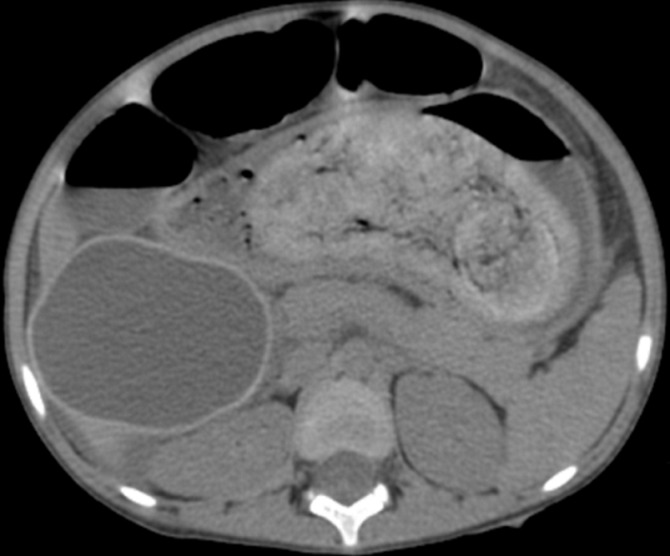
Gastrointestinal (GI) bezoars are aggregates of undigested material found in the GI tract. Trichobezoar is the most common type of bezoars and consists of ingested hair, carpet fibers or fitted carpet fibers. They are mainly located in the gastric region, rare forms extend to the duodenum or small intestine and are described as Rapunzel syndrome. Typical CT imaging features play a diagnostic and prognostic role. We report the case of a 13-year-old girl hospitalized for occlusive syndrome due to trichobezoar.
Les bézoards correspondent à la concrétion de substances ingérées non digestibles dans le tractus gastro-intestinal. Le trichobézoard est la forme la plus fréquente des bézoards, et correspond à l'ingestion de cheveux, poils ou fibres de tapis ou moquette. Principalement de localisation intra-gastrique, il existe des formes rares d'extension duodénale ou à l'intestin grêle définies par le syndrome de Rapunzel. L'imagerie notamment scanographique est typique et joue un double rôle diagnostique et pronostique. Nous rapportons le cas d'une enfant âgée de 13 ans hospitalisée pour un syndrome occlusif sur un trichobézoard.
Keywords: Bezoar; Rapunzel syndrome; case report; occlusion.
Copyright: Amina Mouffak et al.
Conflict of interest statement
Les auteurs ne déclarent aucun conflit d'intérêts.
Figures



References
-
- Mehta M, Patel RV. Intussusception and intestinal perforations caused by multiple trichobezoars. J Pediatr Surg. 1992 Sep;27(9):1234–1235. - PubMed
-
- Ibuowo AA, Saad A, Onkonkowo T. Giant gastric trichobezoar in a young female. Int J Surg. 2008 Dec;6(6):4–6. - PubMed
-
- DeBakey M, Ochsner A. Bezoars and concretions: comprehensive review of literature with analysis of 303 collected cases and presentation of eight additional cases. Surgery. 1939 Jan;5(1):132–160.
-
- Roche C, Guye E, Coinde E, Galambrun C, Glastre C, Halabi M, et al. Trichobézoard: à propos de 5 observations. Arch Pediatr. 2005 Nov;12(11):1608–1612. - PubMed