


Prognosis in fertilisation rate and outcome in IVF cycles in patients with and without endometriosis: a population-based comparative cohort study with controls
- PMID: 33889858
- PMCID: PMC8051192
- DOI: 10.52054/FVVO.13.1.007
Prognosis in fertilisation rate and outcome in IVF cycles in patients with and without endometriosis: a population-based comparative cohort study with controls
Abstract
Background: Subfertility occurs in 30-40% of endometriosis patients. Regarding the fertilisation rate with in vitro fertilisation (IVF) and endometriosis, conflicting data has been published. This study aimed to compare endometriosis patients to non-endometriosis cycles assessing fertilisation rates in IVF.
Methods: A population-based cohort study was conducted at the Leiden University Medical Center. IVF cycles of endometriosis patients and controls (unexplained infertility and tubal pathology) were analysed. The main outcome measurement was fertilisation rate.
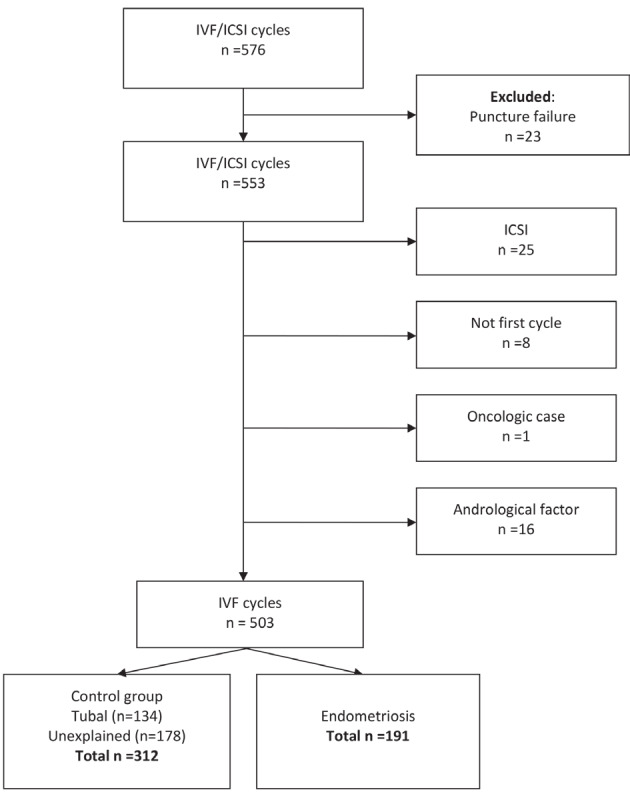
Results: 503 IVF cycles in total, 191 in the endometriosis group and 312 in the control. The mean fertilisation rate after IVF did not differ between both groups, 64.1%±25.5 versus 63.9%±24.8 (p=0.95) respectively, independent of age and r-ASRM classification. The median number of retrieved oocytes was lower in the endometriosis group (7.0 versus 8.0 respectively, p=0.19) and showed a significant difference when corrected for age (p=0.02). When divided into age groups, the statistical effect was only seen in the group of ≤ 35 years (p=0.04). In the age group ≤35, the endometriosis group also showed significantly more surgery on the internal reproductive organs compared to the control group (p<0.001). All other outcomes did not show significant differences.
Conclusion: Similar fertilisation rates were found in endometriosis IVF cycles compared to controls. The oocyte retrieval was lower in the endometriosis group, however this effect was only significant in the age group ≤ 35 years. All other secondary outcomes did not show significant differences. In general, endometriosis patients with an IVF indication can be counselled positively regarding the chances of becoming pregnant, and do not need a different IVF approach.
Keywords: Endometriosis; IVF; fertilisation rate; zona pellucida.
Copyright © 2021 Facts, Views & Vision.
Conflict of interest statement
Conflict of interest: All authors declare that they have no conflict of interest.
Figures
References
-
- Boer E, Tonkelaar I, Burger C, et al. The number of retrieved oocytes does not decrease during consecutive gonadotrophin-stimulated IVF cycles. Hum Reprod. 2004;19:899–904. - PubMed
-
- Cooper TG, Noonan E, von Eckardstein S, et al. World Health Organization reference values for human semen characteristics. Hum Reprod. 2010;16:231–245. - PubMed
-
- De Ziegler D, Borghese B, Chapron C. Endometriosis and infertility: pathophysiology and management. Lancet. 2010;376:730–738. - PubMed
LinkOut - more resources
Full Text Sources
Other Literature Sources