


Timing of Pubertal Onset in Girls and Boys With Constitutional Delay
- PMID: 33890108
- PMCID: PMC8372671
- DOI: 10.1210/clinem/dgab270
Timing of Pubertal Onset in Girls and Boys With Constitutional Delay
Abstract
Context: The decision whether to treat a child with delayed puberty with sex steroids is primarily based on patient, family, and provider preference. Knowing when children with constitutional delay eventually enter puberty would inform this decision.
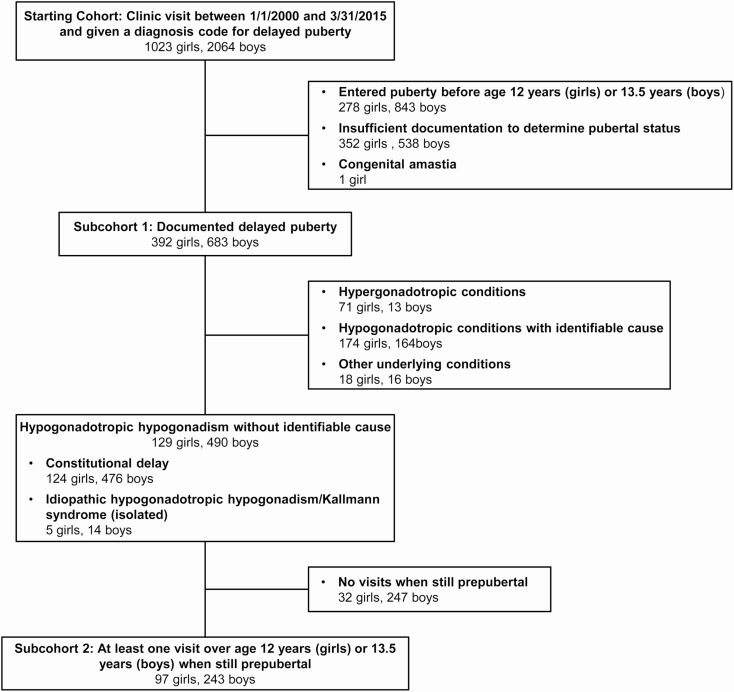
Objective, design, setting, participants, and outcome measures: To estimate and compare rates of pubertal entry, we conducted a retrospective cohort study by reviewing medical records of children evaluated for delayed puberty at a large academic medical center between 2000 and 2015, extracting data on pubertal status for all clinical visits, then conducting time-to-event analyses.
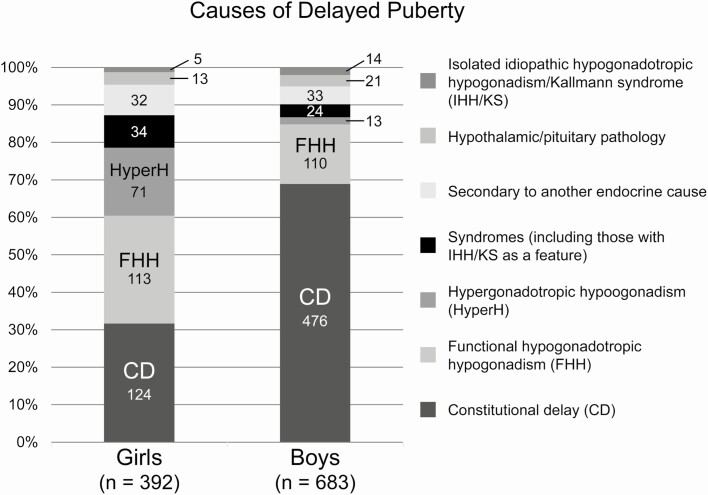
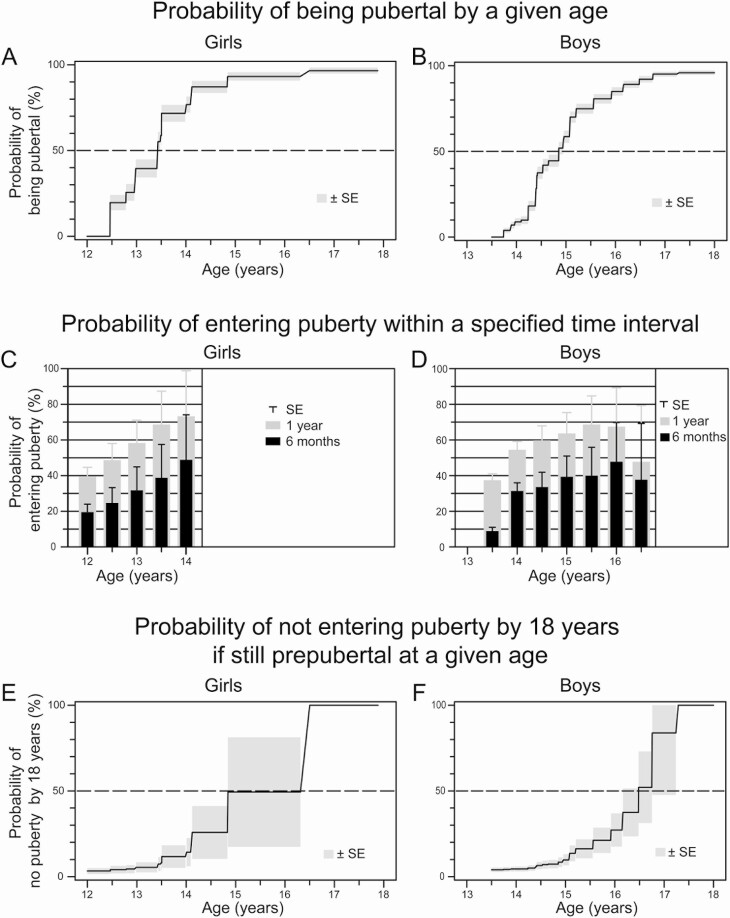
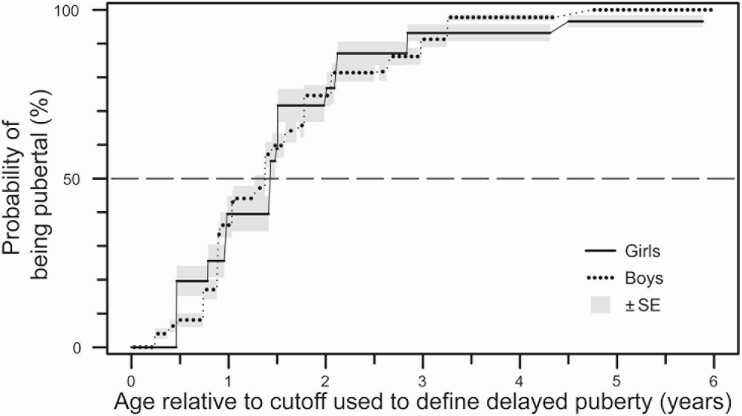
Results: Of 392 girls and 683 boys with delayed puberty, constitutional delay was the most common cause, found in 32% of girls and 70% of boys. In a subcohort of 97 girls and 243 boys who were prepubertal at one or more visits, we observed a broad age range for pubertal entry, up to >16 years for girls and >17 years for boys. The probability of entering puberty within the next year for 12- to 15.5-year-old girls and 13.5- to 16.5-year-old boys with delayed puberty ranged between 38% and 74%. No differences in the rates of pubertal entry were seen between girls and boys after data harmonization.
Conclusion: The broad range of ages at pubertal entry for children with constitutional delay challenges the concept that constitutional delay is merely an extreme of normal variation. Discussions with patients and families about management should consider the possibility that some children may need to wait years after presentation until puberty starts.
Keywords: constitutional delay; delayed puberty; hypogonadotropic hypogonadism.
© The Author(s) 2021. Published by Oxford University Press on behalf of the Endocrine Society. All rights reserved. For permissions, please e-mail: journals.permissions@oup.com.
Figures
References
-
- Palmert MR, Dunkel L. Clinical practice. Delayed puberty. N Engl J Med. 2012;366(5):443-453. - PubMed
-
- Wei C, Crowne EC. Recent advances in the understanding and management of delayed puberty. Arch Dis Child. 2016;101(5):481-488. - PubMed
-
- Crowley WF, Pitteloud N.. Approach to the patient with delayed puberty. Waltham, MA. UpToDate: Wolters Kluwer; 2018.
-
- Rosenfield RL, Cooke DW, Radovick S. Puberty in the female and its disorders. In: Sperling MA, Majzoub JA, Menon RK, Stratakis CA, eds. Sperling Pediatric Endocrinology. Philadelphia: Elsevier; 2020:528- 626.
Publication types
MeSH terms
Grants and funding
LinkOut - more resources
Full Text Sources
Medical
