Cardiac Corrected QT Interval Changes Among Patients Treated for COVID-19 Infection During the Early Phase of the Pandemic
- PMID: 33890991
- PMCID: PMC8065381
- DOI: 10.1001/jamanetworkopen.2021.6842
Cardiac Corrected QT Interval Changes Among Patients Treated for COVID-19 Infection During the Early Phase of the Pandemic
Abstract
Importance: Critical illness, a marked inflammatory response, and viruses such as SARS-CoV-2 may prolong corrected QT interval (QTc).
Objective: To evaluate baseline QTc interval on 12-lead electrocardiograms (ECGs) and ensuing changes among patients with and without COVID-19.
Design, setting, and participants: This cohort study included 3050 patients aged 18 years and older who underwent SARS-CoV-2 testing and had ECGs at Columbia University Irving Medical Center from March 1 through May 1, 2020. Patients were analyzed by treatment group over 5 days, as follows: hydroxychloroquine with azithromycin, hydroxychloroquine alone, azithromycin alone, and neither hydroxychloroquine nor azithromycin. ECGs were manually analyzed by electrophysiologists masked to COVID-19 status. Multivariable modeling evaluated clinical associations with QTc prolongation from baseline.
Exposures: COVID-19, hydroxychloroquine, azithromycin.
Main outcomes and measures: Mean QTc prolongation, percentage of patients with QTc of 500 milliseconds or greater.
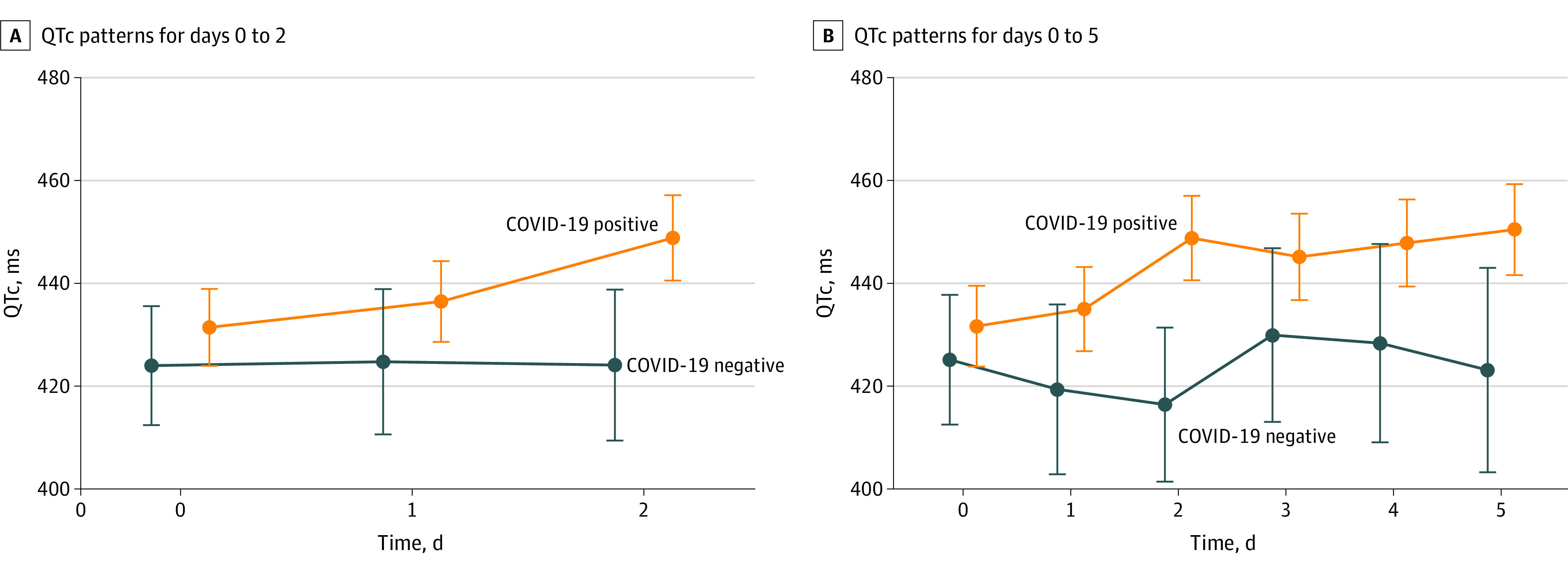
Results: A total of 965 patients had more than 2 ECGs and were included in the study, with 561 (58.1%) men, 198 (26.2%) Black patients, and 191 (19.8%) aged 80 years and older. There were 733 patients (76.0%) with COVID-19 and 232 patients (24.0%) without COVID-19. COVID-19 infection was associated with significant mean QTc prolongation from baseline by both 5-day and 2-day multivariable models (5-day, patients with COVID-19: 20.81 [95% CI, 15.29 to 26.33] milliseconds; P < .001; patients without COVID-19: -2.01 [95% CI, -17.31 to 21.32] milliseconds; P = .93; 2-day, patients with COVID-19: 17.40 [95% CI, 12.65 to 22.16] milliseconds; P < .001; patients without COVID-19: 0.11 [95% CI, -12.60 to 12.81] milliseconds; P = .99). COVID-19 infection was independently associated with a modeled mean 27.32 (95% CI, 4.63-43.21) millisecond increase in QTc at 5 days compared with COVID-19-negative status (mean QTc, with COVID-19: 450.45 [95% CI, 441.6 to 459.3] milliseconds; without COVID-19: 423.13 [95% CI, 403.25 to 443.01] milliseconds; P = .01). More patients with COVID-19 not receiving hydroxychloroquine and azithromycin had QTc of 500 milliseconds or greater compared with patients without COVID-19 (34 of 136 [25.0%] vs 17 of 158 [10.8%], P = .002). Multivariable analysis revealed that age 80 years and older compared with those younger than 50 years (mean difference in QTc, 11.91 [SE, 4.69; 95% CI, 2.73 to 21.09]; P = .01), severe chronic kidney disease compared with no chronic kidney disease (mean difference in QTc, 12.20 [SE, 5.26; 95% CI, 1.89 to 22.51; P = .02]), elevated high-sensitivity troponin levels (mean difference in QTc, 5.05 [SE, 1.19; 95% CI, 2.72 to 7.38]; P < .001), and elevated lactate dehydrogenase levels (mean difference in QTc, 5.31 [SE, 2.68; 95% CI, 0.06 to 10.57]; P = .04) were associated with QTc prolongation. Torsades de pointes occurred in 1 patient (0.1%) with COVID-19.
Conclusions and relevance: In this cohort study, COVID-19 infection was independently associated with significant mean QTc prolongation at days 5 and 2 of hospitalization compared with day 0. More patients with COVID-19 had QTc of 500 milliseconds or greater compared with patients without COVID-19.
Conflict of interest statement
Figures
Comment in
References
-
- US Centers for Disease Control and Prevention . COVID-19. Accessed July 20, 2020. https://www.cdc.gov/coronavirus/2019-nCoV/index.html
Publication types
MeSH terms
Substances
Grants and funding
LinkOut - more resources
Full Text Sources
Medical
Miscellaneous