Review
. 2021 Nov;12(11):836-857.
doi: 10.1007/s13238-021-00841-y. Epub 2021 Apr 23.

Ferroptosis, radiotherapy, and combination therapeutic strategies

Affiliations
Review

Ferroptosis, radiotherapy, and combination therapeutic strategies

Guang Lei et al. Protein Cell. 2021 Nov.

Abstract

Ferroptosis, an iron-dependent form of regulated cell death driven by peroxidative damages of polyunsaturated-fatty-acid-containing phospholipids in cellular membranes, has recently been revealed to play an important role in radiotherapy-induced cell death and tumor suppression, and to mediate the synergy between radiotherapy and immunotherapy. In this review, we summarize known as well as putative mechanisms underlying the crosstalk between radiotherapy and ferroptosis, discuss the interactions between ferroptosis and other forms of regulated cell death induced by radiotherapy, and explore combination therapeutic strategies targeting ferroptosis in radiotherapy and immunotherapy. This review will provide important frameworks for future investigations of ferroptosis in cancer therapy.

Keywords: GPX4; SLC7A11; combination therapy; ferroptosis; immunotherapy; lipid peroxidation; radiosensitization; radiotherapy.


Conflict of interest statement

The authors declare that they have no competing interests.

Figures

Figure 1
Figure 1
The ferroptosis signaling pathway and ferroptosis regulators with known and potential relevance to radiotherapy. Ferroptosis is driven by the accumulation of PUFA-PL peroxides, whose generation is facilitated by iron metabolism, PUFA-PL synthesis and peroxidation. Ferroptosis is counteracted by ferroptosis defense systems including the SLC7A11-GSH-GPX4, NAD(P)H-FSP1-CoQ, and GCH1-BH4 axes. Several regulators in the ferroptosis pathway that are modulated by radiotherapy are also highlighted. These regulators either have been confirmed to play roles or potentially might have roles in radiotherapy-induced ferroptosis
Figure 2
Figure 2
Mechanisms of radiotherapy-induced ferroptosis. Radiotherapy (RT) has been revealed to induce ferroptosis in the indicated cancers through several parallel pathways. RT-induced ROS in concert with RT-induced ACSL4 expression trigger PUFA-PL peroxidation and ferroptosis. RT also depletes GSH, dampens GPX4-mediated ferroptosis defense, thereby promoting ferroptosis. In addition, RT can repress SLC7A11 expression in an ATM-dependent manner to further promote ferroptosis or upregulate SLC7A11 expression as an adaptive response for ferroptosis protection, depending on the context
Figure 3
Figure 3
The crosstalk among RT-induced DSBs, immune system activation and ferroptosis. (A) Radiotherapy (RT) induces DSBs and thus activates ATM, p53 and RB, promoting senescence, apoptosis, necroptosis, autophagy, and ferroptosis. Immunogenic cell deaths (ICDs; including apoptosis, necroptosis, and autophagy), together with RT-induced senescence-associated secretory phenotype (SASP), contribute to T cell activation, which secretes IFNγ to further promote RT-induced ferroptosis. Additionally, RT-induced autophagy may modulate ferroptosis through ferritinophagy, lipophagy, clockophagy or chaperone-mediated autophagy (CMA). (B) Specific crosstalk mechanisms between ferroptosis and other forms of regulated cell death under RT-induced DSBs, in which ATM, p53 and RB play central roles
Figure 4
Figure 4
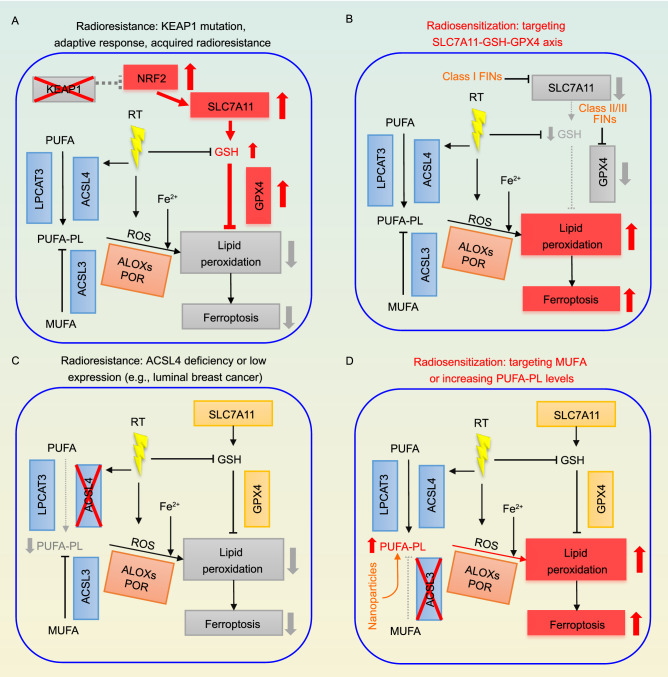
Radioresistance mechanisms due to ferroptosis inactivation and radiosensitization strategies by inducing ferroptosis. (A) Radiotherapy (RT) induces the expression of SLC7A11 or GPX4 as an adaptive response to protect cancer cells from ferroptosis, thereby compromising RT-induced cell death and possibly contributing to acquire radioresistance. In addition, KEAP1 mutant cancer cells are radioresistant due to ferroptosis resistance partly caused by high SLC7A11 expression. (B) Class I FINs targeting SLC7A11 or class II/III FINs targeting GPX4 potentiate RT-induced lipid peroxidation and ferroptosis, thereby sensitizing cancer cells to RT. (C) ACSL4 deficiency or low expression (such as in luminal breast cancer) inhibits RT-induced ferroptosis by blocking PUFA-PL synthesis, resulting in radioresistance. (D) Inhibiting ACSL3-mediated MUFA-PL synthesis or increasing PUFA-PL levels via nanoparticles promotes RT-induced ferroptosis, thereby sensitizing cancer cells to RT
Figure 5
Figure 5
Interactions of hypoxia with ferroptosis and radioresistance, and potential strategies targeting ferroptosis to overcome hypoxia-induced radioresistance. (A) Hypoxia causes radioresistance possibly through “oxygen fixation hypothesis” and HIF activation. Hypoxia also induces the levels of ROS and HIF1/2, which have been shown to promote lipid peroxidation. Therefore, this regulation can potentially increase the susceptibility of cancer cells to ferroptosis. However, hypoxia might also upregulate ferroptosis defense systems (e.g., the SLC7A11-GSH-GPX4 axis) to counteract ferroptosis. (B) By inhibiting ferroptosis defense systems, FINs promote RT-induced ferroptosis and might overcome the radioresistance caused by hypoxia

References

    1. Adjemian S, Oltean T, Martens S, Wiernicki B, Goossens V, Berghe TV, Cappe B, Ladik M, Riquet FB, Heyndrickx L. Ionizing radiation results in a mixture of cellular outcomes including mitotic catastrophe, senescence, methuosis, and iron-dependent cell death. Cell Death Dis. 2020;11:1–15. - PMC - PubMed
    1. Alim I, Caulfield JT, Chen Y, Swarup V, Geschwind DH, Ivanova E, Seravalli J, Ai Y, Sansing LH, Marie EJS. Selenium drives a transcriptional adaptive program to block ferroptosis and treat stroke. Cell. 2019;177(1262–1279):e1225. - PubMed
    1. Alvarez SW, Sviderskiy VO, Terzi EM, Papagiannakopoulos T, Moreira AL, Adams S, Sabatini DM, Birsoy K, Possemato R. NFS1 undergoes positive selection in lung tumours and protects cells from ferroptosis. Nature. 2017;551:639–643. - PMC - PubMed
    1. Anderson GJ, Vulpe CD. Mammalian iron transport. Cell Mol Life Sci. 2009;66:3241. - PMC - PubMed
    1. Angeli JPF, Conrad M. Selenium and GPX4, a vital symbiosis. Free Radical Biol Med. 2018;127:153–159. - PubMed

Publication types