Review
. 2021 Aug:50:101238.
doi: 10.1016/j.molmet.2021.101238. Epub 2021 Apr 20.

Metabolic-associated fatty liver disease and lipoprotein metabolism

Affiliations
Review

Metabolic-associated fatty liver disease and lipoprotein metabolism

Joerg Heeren et al. Mol Metab. 2021 Aug.

Abstract

Background: Non-alcoholic fatty liver disease, or as recently proposed 'metabolic-associated fatty liver disease' (MAFLD), is characterized by pathological accumulation of triglycerides and other lipids in hepatocytes. This common disease can progress from simple steatosis to steatohepatitis, and eventually end-stage liver diseases. MAFLD is closely related to disturbances in systemic energy metabolism, including insulin resistance and atherogenic dyslipidemia.

Scope of review: The liver is the central organ in lipid metabolism by secreting very low density lipoproteins (VLDL) and, on the other hand, by internalizing fatty acids and lipoproteins. This review article discusses recent research addressing hepatic lipid synthesis, VLDL production, and lipoprotein internalization as well as the lipid exchange between adipose tissue and the liver in the context of MAFLD.

Major conclusions: Liver steatosis in MAFLD is triggered by excessive hepatic triglyceride synthesis utilizing fatty acids derived from white adipose tissue (WAT), de novo lipogenesis (DNL) and endocytosed remnants of triglyceride-rich lipoproteins. In consequence of high hepatic lipid content, VLDL secretion is enhanced, which is the primary cause of complex dyslipidemia typical for subjects with MAFLD. Interventions reducing VLDL secretory capacity attenuate dyslipidemia while they exacerbate MAFLD, indicating that the balance of lipid storage versus secretion in hepatocytes is a critical parameter determining disease outcome. Proof of concept studies have shown that promoting lipid storage and energy combustion in adipose tissues reduces hepatic lipid load and thus ameliorates MAFLD. Moreover, hepatocellular triglyceride synthesis from DNL and WAT-derived fatty acids can be targeted to treat MAFLD. However, more research is needed to understand how individual transporters, enzymes, and their isoforms affect steatosis and dyslipidemia in vivo, and whether these two aspects of MAFLD can be selectively treated. Processing of cholesterol-enriched lipoproteins appears less important for steatosis. It may, however, modulate inflammation and consequently MAFLD progression.

Keywords: Adipose tissue; De novo lipogenesis; Lipoprotein; Liver; NAFLD; Triglycerides.


Figures

Figure 1
Figure 1
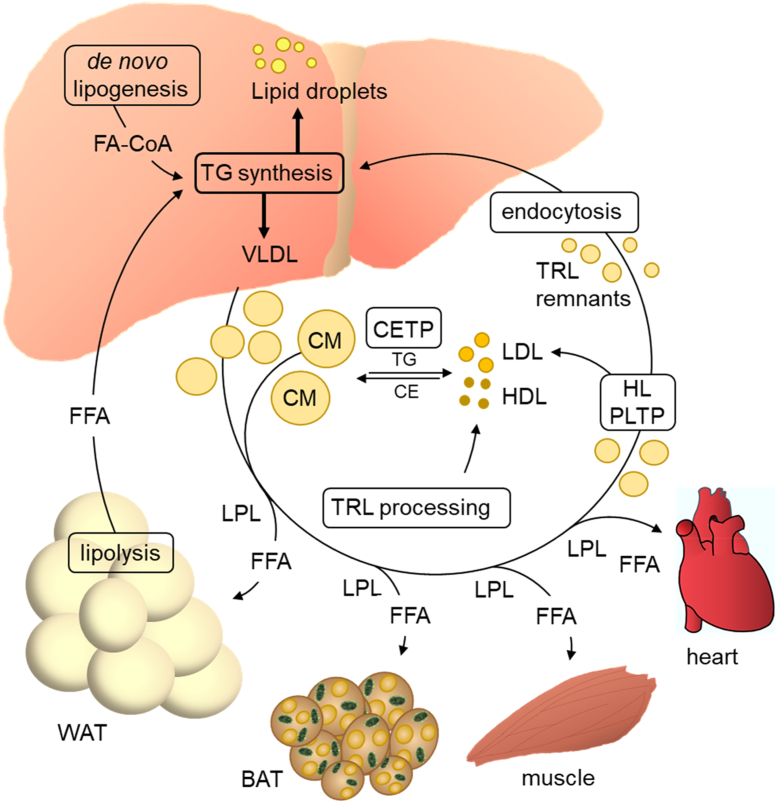
The liver as a central organ of lipoprotein metabolism. The liver internalizes lipids from the circulation including FFA released from WAT, TRL remnants and cholesterol esters from HDL (not shown). The fatty acids entering the hepatocytes together with fatty acids derived from de novo lipogenesis are used for the synthesis of triglycerides and other complex lipids (not shown). The triglycerides are in part stored in lipid droplets and in part used for the assembly of VLDL that are released into the circulation. Here, VLDL together with intestinal-derived chylomicrons (CM) are processed in the capillaries of adipose tissues, the heart, and skeletal muscle by the enzyme LPL. LPL hydrolyzes triglycerides and thereby generates FFA that are taken up by the cells of the respective organ for storage or energy generation. Through LPL-dependent triglyceride hydrolysis, TRL become smaller and are thus transformed to cholesterol-enriched TRL remnants that are eventually taken up by hepatocytes through endocytosis and digested in the endo-lysosomal compartment. Part of the VLDL remnants are further processed by other intravascular enzymes including hepatic lipase (HL) and phospholipid transfer protein (PLTP) to become LDL. HDL particles are generated from lipid-poor APOA1 secreted from the liver (not shown) and during TRL processing (surface remnants containing APOA1). Both LDL and HDL exchange cholesterol ester for triglyceride with TRL in a reaction catalyzed by CETP.
Figure 2
Figure 2
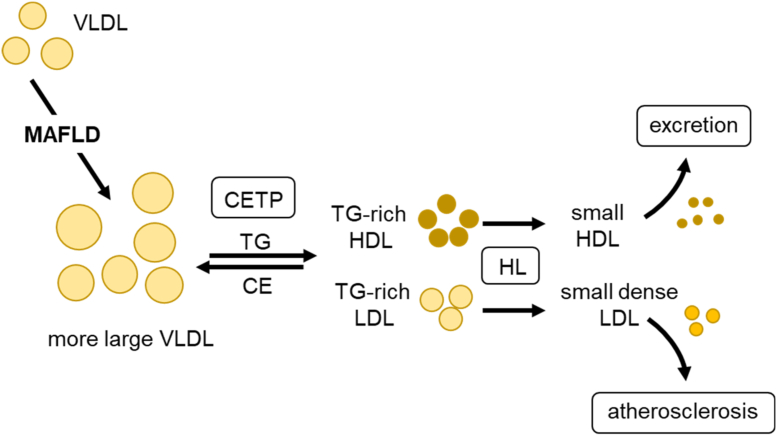
Role of VLDL in MAFLD-associated dyslipidemia. MAFLD is caused by a chronically positive energy balance that leads to elevated triglyceride synthesis in the liver. Part of the surplus triglycerides is funneled into synthesis of larger VLDL particles. Consequently, the concentration of these large triglyceride-rich VLDL particles in the circulation rises, a hallmark of MAFLD-associated dyslipidemia. Other important characteristics of MAFLD-dyslipidemia are the presence of small dense LDL and low HDL cholesterol levels. This is primarily caused by the high concentration of VLDL in the blood in combination with intravascular action of CETP and HL. In the presence of a high number of large VLDL particles, this leads to the generation of both triglyceride-rich LDL and HDL. These lipoproteins are further processed leading to small dense LDL and small HDL. Small dense LDL are more atherogenic than normal-sized LDL, because they pass endothelia more easily promoting plaque formation in the arterial wall. Because of their reduced size, small HDL particles exhibit an increased propensity for excretion via the kidneys and thus have a shorter half-life in the circulation explaining low HDL levels.
Figure 3
Figure 3
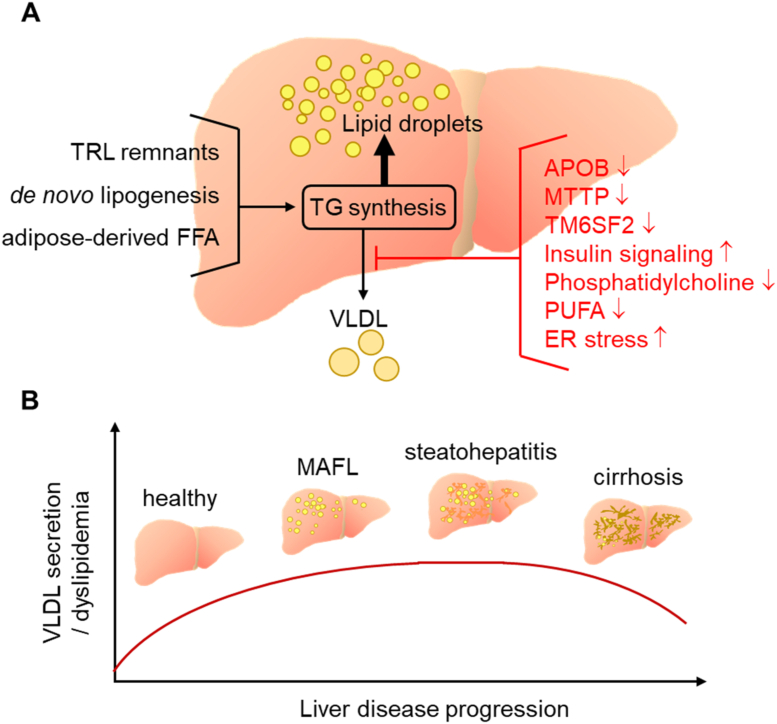
Relationship of liver steatosis with the VLDL secretory pathway. One important feature of hepatocytes is the ability to efficiently export excess triglycerides and other lipids as VLDL. (A) If the rate of VLDL assembly and secretion is limiting, triglycerides are diverted to lipid droplets and the extent of steatosis increases. Impairment of VLDL secretion can be caused by naturally occurring mutations in proteins pivotal for VLDL production (APOB, MTTP, TM6SF2), by insulin action, lack of the major VLDL surface lipid phosphatidylcholine and possibly by reduced polyunsaturated fatty acids (PUFA) or by endoplasmic reticulum stress. (B) Clinical studies report that VLDL secretion, and in parallel dyslipidemia, increase with progression of MAFLD along with liver steatosis. A plateau is reached at the MAFL or the steatohepatitis stage, probably because the VLDL secretory capacity has reached a limit. In advanced liver disease such as cirrhosis VLDL secretion is reduced again, likely reflecting the loss of functional hepatocytes.
Figure 4
Figure 4
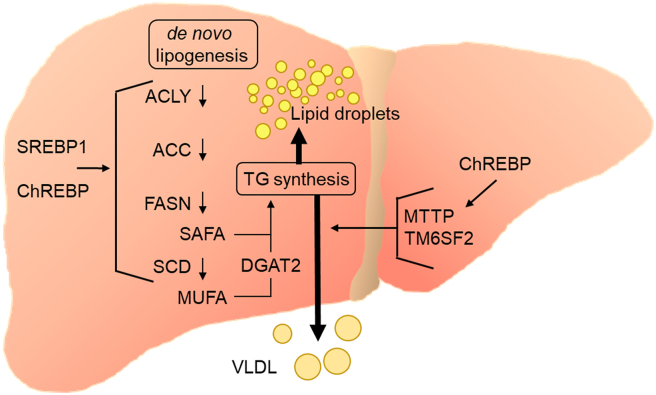
De novo lipogenesis drives both VLDL secretion and liver steatosis. Hepatic expression of the DNL enzymes depends on nutritional state. After food intake, increased glucose metabolism and elevated insulin signaling increase the activity of the transcription factors ChREBP and SREBP1, respectively. Under conditions of chronic energy excess and hyperinsulinemia prevalent in MAFLD, both lipogenic transcription factors and thus de novo lipogenesis are constantly active, which leads to elevated triglyceride synthesis from saturated fatty acids (SAFA) and monounsaturated fatty acids (MUFA). Stearoyl-CoA desaturase (SCD) catalyzes the generation of MUFA-CoA that are efficiently incorporated into triglycerides via diacylglycerol acyl transferase-2 (DGAT2) that directly associates with SCD. Of note, induction of SCD was observed to go along with increased VLDL secretion, and ChREBP promotes expression of proteins important for VLDL assembly (MTTP, TM6SF2). Together these findings indicate a strong link of DNL to VLDL secretion and dyslipidemia.
Figure 5
Figure 5
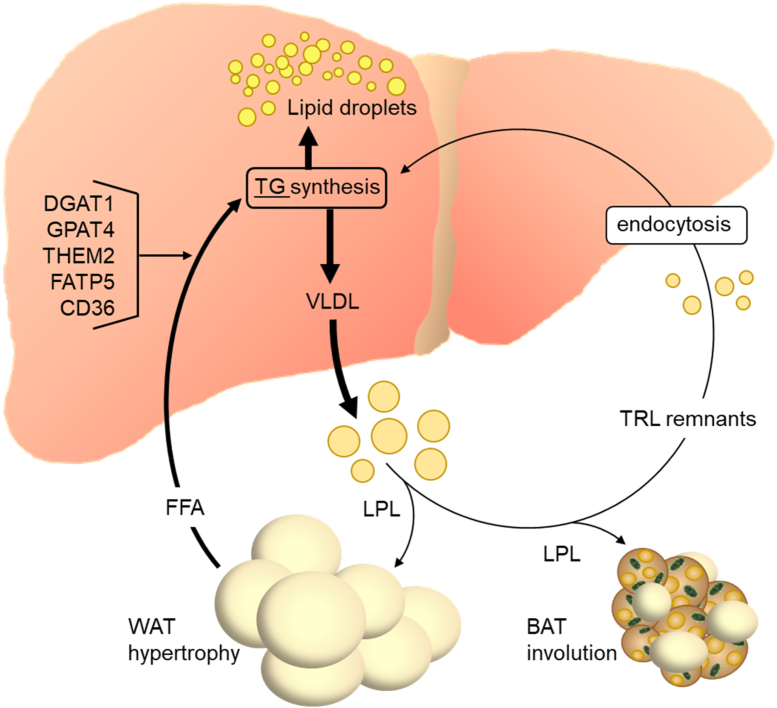
Impact of adipose tissues on liver steatosis and dyslipidemia. MAFLD is associated with hypertrophic WAT, which is characterized by increased flux of FFA to the liver. In hepatocytes, several transporter and enzymes (FATP5, CD36, THEM2, GPAT4, DGAT1) were found to be involved in the preferential incorporation of circulation-derived fatty acids into triglycerides. On the other hand, little evidence exists that these triglycerides are selectively used for VLDL, as plasma FFA-derived triglycerides are also efficiently incorporated into lipid droplet triglycerides. Interventions reverting WAT hypertrophy generally improve MAFLD by reducing the lipid flux to the liver. The mass and function of brown adipose tissue (BAT) is generally decreased in metabolically unhealthy states such as obesity and probably also in MAFLD, a process called BAT involution. As BAT can take up substantial amounts of lipid from the circulation and combust it, reactivation of BAT has the potential to divert lipid from the liver and thus ameliorate MAFLD.

References

    1. Dash S., Xiao C., Morgantini C., Lewis G.F. New insights into the regulation of chylomicron production. Annual Review of Nutrition. 2015;35:265–294. - PubMed
    1. Choi S.H., Ginsberg H.N. Increased very low density lipoprotein (VLDL) secretion, hepatic steatosis, and insulin resistance. Trends in Endocrinology and Metabolism. 2011;22(9):353–363. - PMC - PubMed
    1. Wu S.A., Kersten S., Qi L. Lipoprotein lipase and its regulators: an unfolding story. Trends in Endocrinology and Metabolism. 2021;32(1):48–61. - PMC - PubMed
    1. Basu D., Goldberg I.J. Regulation of lipoprotein lipase-mediated lipolysis of triglycerides. Current Opinion in Lipidology. 2020;31(3):154–160. - PMC - PubMed
    1. Vos D.Y., van de Sluis B. Function of the endolysosomal network in cholesterol homeostasis and metabolic-associated fatty liver disease (MAFLD) Molecular Metabolism. 2021:101146. - PMC - PubMed

Publication types

MeSH terms