. 2021 Jun 25;38(7):3022-3027.
doi: 10.1093/molbev/msab120.

MEGA11: Molecular Evolutionary Genetics Analysis Version 11

Affiliations

MEGA11: Molecular Evolutionary Genetics Analysis Version 11

Koichiro Tamura et al. Mol Biol Evol. .

Abstract

The Molecular Evolutionary Genetics Analysis (MEGA) software has matured to contain a large collection of methods and tools of computational molecular evolution. Here, we describe new additions that make MEGA a more comprehensive tool for building timetrees of species, pathogens, and gene families using rapid relaxed-clock methods. Methods for estimating divergence times and confidence intervals are implemented to use probability densities for calibration constraints for node-dating and sequence sampling dates for tip-dating analyses. They are supported by new options for tagging sequences with spatiotemporal sampling information, an expanded interactive Node Calibrations Editor, and an extended Tree Explorer to display timetrees. Also added is a Bayesian method for estimating neutral evolutionary probabilities of alleles in a species using multispecies sequence alignments and a machine learning method to test for the autocorrelation of evolutionary rates in phylogenies. The computer memory requirements for the maximum likelihood analysis are reduced significantly through reprogramming, and the graphical user interface has been made more responsive and interactive for very big data sets. These enhancements will improve the user experience, quality of results, and the pace of biological discovery. Natively compiled graphical user interface and command-line versions of MEGA11 are available for Microsoft Windows, Linux, and macOS from www.megasoftware.net.

Keywords: neutrality; phylogenetics; software; timetrees; tip dating.


Figures

Fig. 1.
Fig. 1.
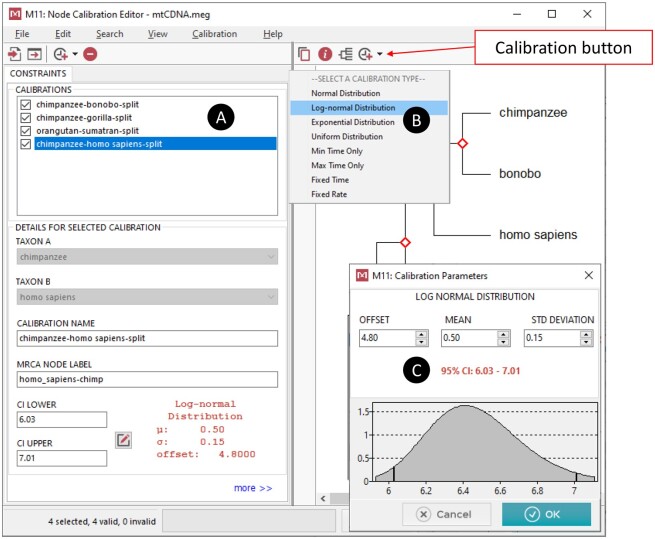
Calibration points for MEGA’s RelTime method are chosen in the Node Calibration Editor window (A), accessed via the Timetree Wizard system (see fig. 2A). The Node Calibration Editor displays the phylogeny where individual node calibrations and probability densities can be chosen by clicking the calibration button on the top toolbar for the selected node. A dropdown menu (B) with several calibration density types is displayed. The Node Calibration Editor then prompts the user for required distribution parameters, depending on the distribution selected: normal distribution (mean and standard deviation), lognormal (offset, mean and standard deviation), exponential (offset and decay parameter), uniform (min and max) (C).
Fig. 2.
Fig. 2.
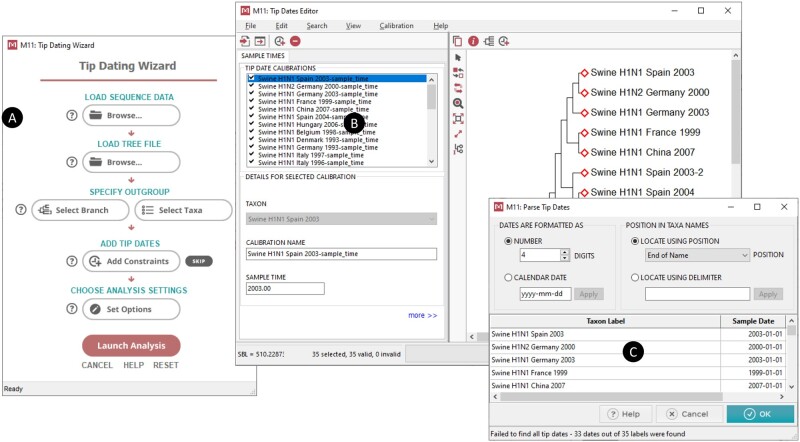
The Tip Dating Wizard (A) guides the user through the steps required to set up the RTDT analysis. Once a sequence alignment and/or a tree is provided, the user is prompted to specify the outgroup by selecting a node in the Tree Explorer or specifying outgroup taxa by name (not shown). Next, sample times are specified using the Tip Dates Editor (B) with facilities for parsing tip dates (C) encoded in taxa names, importing tip dates from a text file, and manually entering the dates. In the next step, the Analysis Preferences dialog (not shown) is displayed, allowing the user to set analysis options to estimate branch lengths used by RTDT. The estimated timetree is displayed in the Tree Explorer (see fig. 3).
Fig. 3.
Fig. 3.
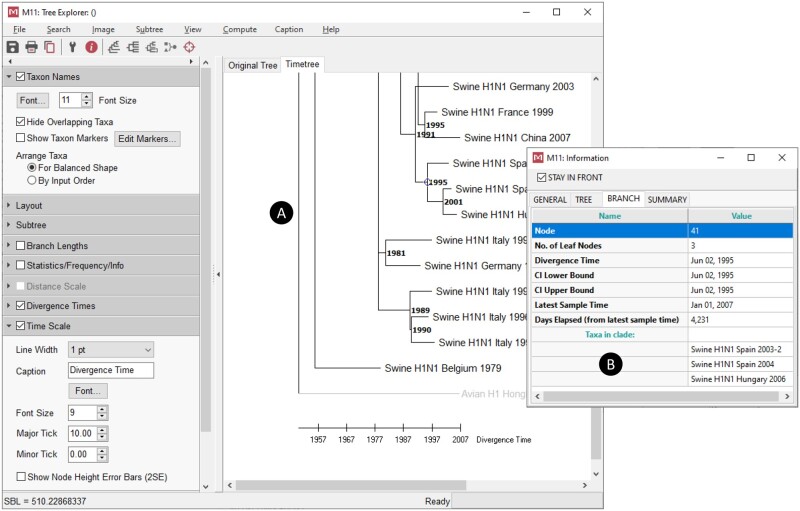
MEGA’s Tree Explorer (A) is a feature-rich, versatile viewer of phylogenies that provides many interactive exploration and customization facilities. In MEGA11, the new side toolbar of Tree Explorer makes formatting, rearrangement, and tree exploration tools more accessible and intuitive. Instead of a thin toolbar with nameless buttons, we have opted for a wide toolbar with text labels identifying each tool. The toolbar can be moved to either side of the window, and it can be toggled in and out of view. To organize related tools by groups and accommodate limited vertical space, collapsible panels are used. With the new toolbar, formatting tools previously displayed in external dialogs are readily accessible, and formats are applied instantly instead of after the user closes the external dialog. In addition to the updated toolbar, there are now options for auto-collapsing of nodes containing clusters of taxa belonging to the same group, user-specified cluster size, or by the branch length difference. For very large trees with many similar sequences, this feature can greatly facilitate the visualization of evolutionary events at a glance. An option has been added to export pairwise patristic distances between taxa to a text file for phylogenies and timetrees. For maximum likelihood and maximum parsimony trees where ancestral sequences are present, an option has been added to navigate through sites where a change in the estimated ancestral state differs between the parent and child on the currently selected branch. The tree information box (B) has been updated for timetrees to show branch- and node-specific information, such as earliest and latest sample times in the currently selected subtree, days elapsed between the divergence time for a selected node and the latest sample time, the nearest and furthest tip from a selected node, clade size and clade taxa, and spatiotemporal information if available.

References

    1. Caspermeyer J. 2018. MEGA software celebrates silver anniversary. Mol Biol Evol. 35(6):1558–1560. - PubMed
    1. Claramunt S, Cracraft J.. 2015. A new time tree reveals Earth history’s imprint on the evolution of modern birds. Sci Adv. 1(11):e1501005. - PMC - PubMed
    1. Hipsley CA, Müller J.. 2014. Beyond fossil calibrations: realities of molecular clock practices in evolutionary biology. Front Genet. 5:138. - PMC - PubMed
    1. Kimura M. 1983. The neutral theory of molecular evolution. New York: Cambridge University Press.
    1. Kumar S, Stecher G, Li M, Knyaz C, Tamura K.. 2018. MEGA X: molecular Evolutionary Genetics Analysis across computing platforms. Mol Biol Evol. 35(6):1547–1549. - PMC - PubMed

Publication types