


Cost effectiveness analysis of a polygenic risk tailored breast cancer screening programme in Singapore
- PMID: 33892705
- PMCID: PMC8066868
- DOI: 10.1186/s12913-021-06396-2
Cost effectiveness analysis of a polygenic risk tailored breast cancer screening programme in Singapore
Abstract
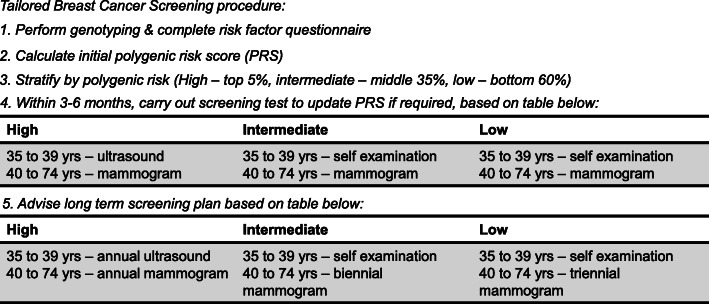
Background: This study aimed to evaluate the cost-effectiveness of a breast cancer screening programme that incorporates genetic testing using breast cancer associated single nucleotide polymorphisms (SNPs), against the current biennial mammogram-only screening programme to aid in its implementation into the current programme in Singapore.
Methods: A Markov model was used to compare the costs and health outcomes of the current screening programme, against a polygenic risk-tailored screening programme, which can advise a long-term screening strategy depending on the individual's polygenic risk. The model took the perspective of the healthcare system, with a time horizon of 40 years, following women from the age of 35 to 74. Epidemiological and cost data were taken from Asian studies, and an annual discount rate of 3% was used. The model outcome was the incremental cost-effectiveness ratio (ICER), calculated from the difference in costs per quality-adjusted life year (QALY). Scenarios with varying risk thresholds for each polygenic risk group were examined. One-way and probabilistic sensitivity analyses were performed to assess parameter uncertainty.
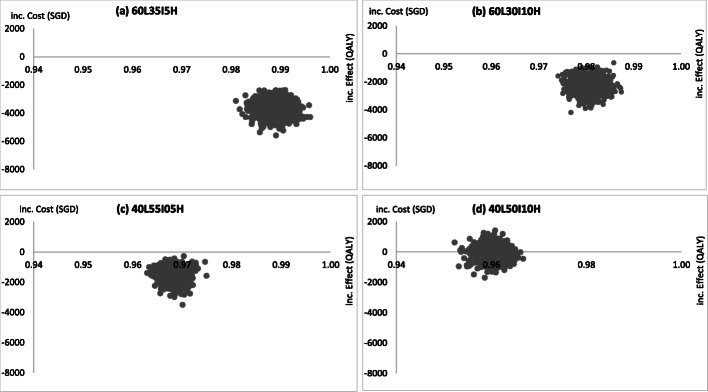
Results: The ICER for a polygenic risk-tailored breast cancer screening programme, compared with the current biennial mammogram-only screening programme, was - 3713.80 SGD/QALY, with incremental costs < 0 and incremental effects > 0. The scenario analysis of different polygenic risk cutoffs showed that the ICERs remain negative, with all ICERs falling within the south-east quadrant of the cost-effectiveness plane, indicating that tailored screening is more cost effective than mammogram-only screening, with lower costs and higher QALYs to be gained. This suggests that a polygenic risk-tailored breast cancer screening programme is cost effective, entailing lower cost than the current mammogram-only programme, while causing no additional harm to women.
Conclusion: Results from this cost-effectiveness analysis show that polygenic risk-tailored screening is cost effective with an ICER of - 3713.80 SGD/QALY. Tailored screening remains cost effective even across varying percentile cutoffs for each risk group. While the results look promising for incorporating polygenic risk into the current breast cancer screening programme, further studies should be conducted to address various limitations.
Keywords: Breast cancer screening; Cost effectiveness analysis; Economic evaluation; Polygenic risk scores; Risk stratification.
Conflict of interest statement
The authors declare that they have no competing interests.
Figures



References
-
- Health Promotion Board. National Registry of Diseases Office, (NRDO). Singapore cancer registry annual registry report 2015 national registry of diseases office (NRDO). Singapore Cancer Regist Annu Regist Rep. 2015;2017 June. https://www.nrdo.gov.sg/docs/librariesprovider3/Publications-Cancer/canc.... Accessed 4 Aug 2020.
-
- Globocan . Globocan 2018 - Singapore. 2018.
-
- Wang SC. The Singapore National Breast Screening Programme: principles and implementation. Ann Acad Med Singapore. 2003;32:466–476. - PubMed
MeSH terms
Grants and funding
LinkOut - more resources
Full Text Sources
Medical
