


[Evaluation of treatment with intra-articular injections in osteoarticular pathology of the shoulder in primary care]
- PMID: 33895613
- PMCID: PMC8093412
- DOI: 10.1016/j.aprim.2021.102051
[Evaluation of treatment with intra-articular injections in osteoarticular pathology of the shoulder in primary care]
Abstract
Main objective: To evaluate the clinical response at 24weeks after injection, measured as pain relief and functional recovery, in painful shoulder syndrome (PSS) in primary care (PC).
Design: Longitudinal case series with injection treatment in the scapulohumeral joint, describing functionality and pain evolution before and at 24weeks post injection.
Location: Non-urban primary care centres.
Participants: Patients with osteoarticular shoulder pathology susceptible to injection, failure of pharmacological treatment and rating on the visual analogue scale (VAS) ≥4 or constant score (CS) ≤70.
Interventions: Intra-articular injection of corticosteroid and local anaesthetic into the scapulohumeral joint, describing its evolution at 1, 4, 12 and 24weeks post injection.
Main measurements: Infiltration response according to EVA before and after, CS before and after, number of infiltrations, side effects, temporary inability to work (TIL).
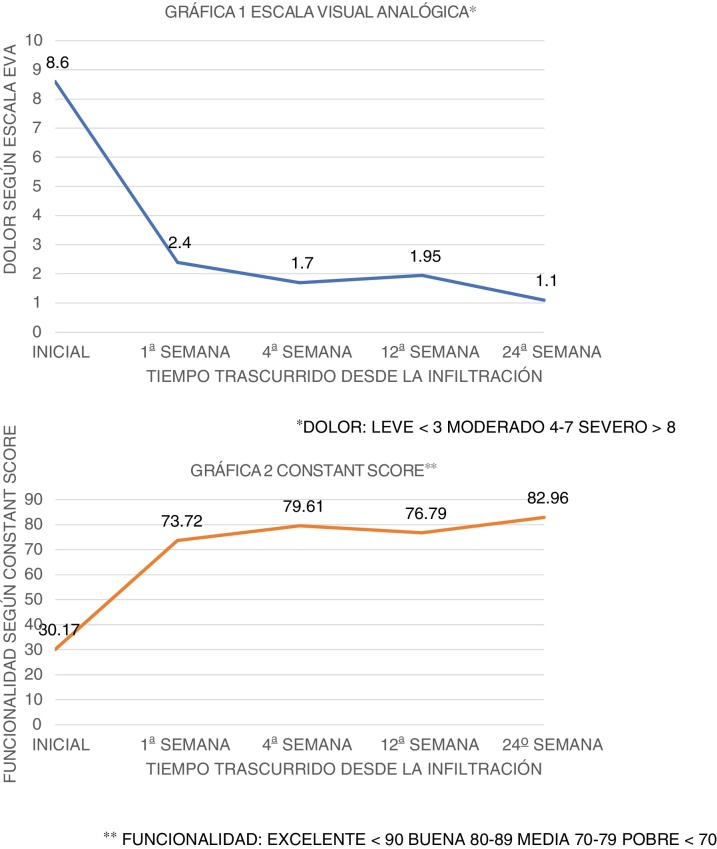
Results: Sixty-six patients receiving injection, mean age 51.1years (SD 14.7), 57.6% were women and 63.3% were injection in the right shoulder. A 22.7% required TIL and were discharged with a median of 14days (range 7-56days). They required an injection (80.3%) and the most frequent injection pathology was rotator cuff tendinitis (90.9%). They suffered mild side effects (9.4%). We found a decrease in pain from severe to mild and a functional improvement from poor to good. The variables: being retired (OR: 37.82, P=.001) and having an EVA score prior to injection >8 (OR: 15.67, P=.055, almost significant) were associated with poor response.
Conclusions: Intra-articular administration of corticosteroids in PSS reduces pain and provides functional improvement after the first week after injection, and is maintained in the long term. This allows a quick recovery to work after an injection at two weeks reducing recovery time by 50%, with few side effects.
Objetivo principal: Evaluar la respuesta clínica a las 24 semanas de la infiltración, medida como alivio del dolor y recuperación funcional, en el síndrome de hombro doloroso (SHD) en atención primaria (AP).
Diseño: Serie de casos longitudinal con tratamiento de inyección en la articulación escapulohumeral; se describen la funcionalidad y la evolución del dolor previa y a las 24 semanas postinfiltración.
Emplazamiento: Atención Primaria. Centro de salud no urbano.
Participantes: Pacientes con patología osteoarticular de hombro susceptible de infiltración, fracaso de tratamiento farmacológico y calificación en la escala analógica visual (EVA) ≥ 4 o Constant Score (CS) ≤ 70.
Intervenciones: Inyección intraarticular corticosteroide y anestésico local en la articulación escapulohumeral, describiendo su evolución a 1, 4, 12 y 24 semanas postinfiltración.
Mediciones principales: Respuesta de la infiltración según EVA antes-después, CS antes-después, número de infiltraciones, efectos secundarios, incapacidad laboral transitoria (ILT).
Resultados: Se infiltraron 66 pacientes, edad media 51,1 años (DE: 14,7), 57,6% mujeres, 63,3% infiltración hombro derecho. El 22,7% precisaron ILT y cursaron alta con una mediana de 14 días (rango de 7-56 días). Precisaron una infiltración (80,3%) y la patología infiltrada más frecuente fue la tendinitis de los rotadores (90,9%). Sufrieron efectos secundarios leves un 9,4%. Encontramos disminución de dolor de severo a leve y una mejoría funcional de pobre a buena. Las variables: ser jubilado (OR: 37,82, p = 0,001) y tener un puntaje EVA previo a la infiltración > 8 (OR; 15,67, p = 0,055, cuasi significativo) se asociaron a mala respuesta.
Conclusiones: La administración intraarticular de corticosteroides en el SHD disminuye el dolor y aporta una mejoría funcional tras la primera semana postinfiltración, manteniéndose a largo plazo. Esto permite una rápida incorporación laboral con una infiltración a las 2 semanas, disminuyendo en un 50% el tiempo de recuperación, con escasos efectos secundarios.
Keywords: Atención primaria; Hombro doloroso; Intra-articular injections; Inyecciones intraarticulares; Primary care; Shoulder pain.
Copyright © 2021 The Authors. Publicado por Elsevier España, S.L.U. All rights reserved.
Figures
References
-
- Rodríguez-Martín S., Melogno-Klinkas M. El dolor crónico de hombro en las actividades instrumentales de la vida diaria. Rehabilitación. 2018;52:38–44.
-
- Green S., Buchbinder R., Hetrick S. Intervenciones fisioterapéuticas para el dolor del hombro. The Cochrane Library. 2008;1:65–75.
-
- Sanfélix J., Giner V., Fluixá C., Millán J., Fuertes A. Manual de infiltraciones en atención primaria. Generalitat. Conselleria de Sanitat. 2007 Disponible en: http://publicaciones.san.gva.es/publicaciones/documentos/V.5192-2007.pdf.
-
- Pfenninger J.L. Inyections of joints and soft tissue. Part I. General guidelines. Am Fam Physician. 1991;44:1196–1202. - PubMed
-
- Arteaga Domínguez A., García González C. Dolor de hombro: diferentes desórdenes y distintos tratamientos. Med Integr. 1999;34:393–402.
