


Identifying the causal effect of child marriage on unmet needs for modern contraception and unintended pregnancy in Nepal: a cross-sectional study using propensity score matching
- PMID: 33895714
- PMCID: PMC8074563
- DOI: 10.1136/bmjopen-2020-043532
Identifying the causal effect of child marriage on unmet needs for modern contraception and unintended pregnancy in Nepal: a cross-sectional study using propensity score matching
Abstract
Objectives: This study aimed to investigate whether child marriage had causal effects on unmet needs for modern contraception, and unintended pregnancy, by estimating the marginal (population-averaged) treatment effect of child marriage.
Design: This study used secondary data from the Nepal Demographic and Health Survey 2016. Applying one-to-one nearest-neighbour matching with replacement within a calliper range of ±0.01, 15-49 years old women married before the age of 18 were matched with similar women who were married at 18 or above to reduce selection bias.
Setting: Nationally representative population survey data.
Participants: The sample consisted of 7833 women aged 15-49 years who were married for more than 5 years.
Outcome measures: Unmet needs for modern contraception and unintended pregnancy.
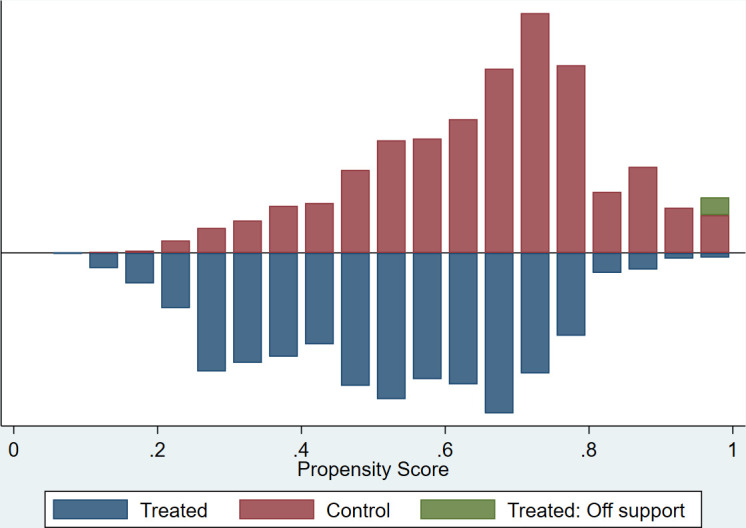
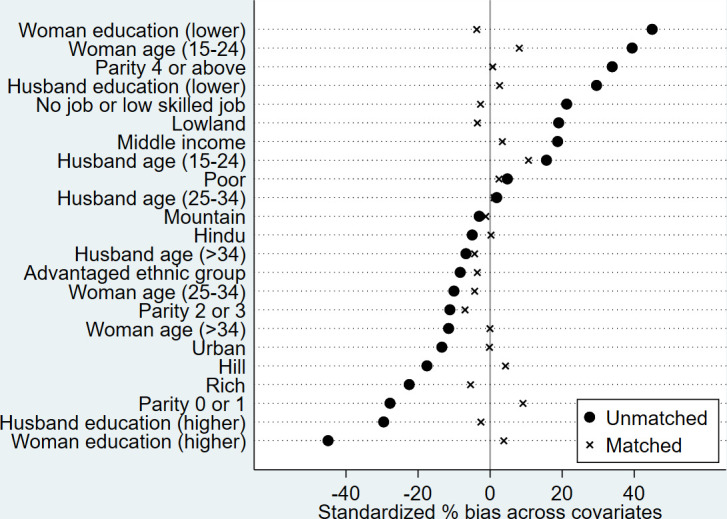
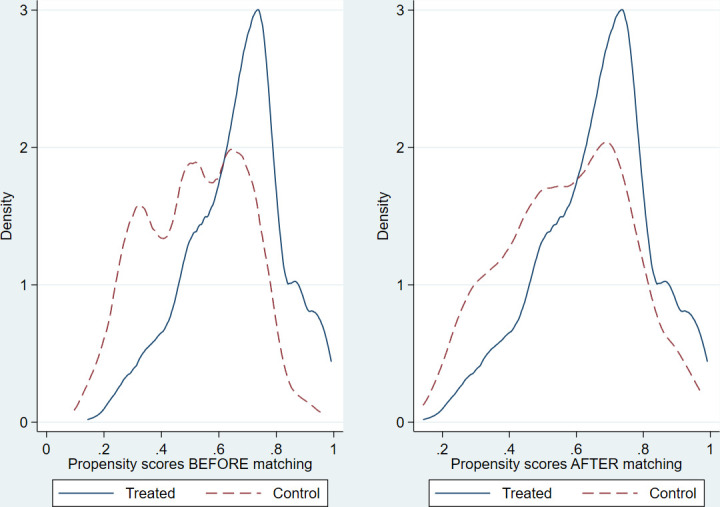
Results: The matching method achieved adequate overlap in the propensity score distributions and balance in measured covariates between treatment and control groups with the same propensity score. Propensity score matching analysis showed that the risk of unmet needs for modern contraception, and unintended pregnancy among women married as children were a 14.3 percentage point (95 % CI 10.3 to 18.2) and a 10.1 percentage point (95 % CI 3.7 to 16.4) higher, respectively, than among women married as adults. Sensitivity analysis indicated that the estimated effects were robust to unmeasured covariates.
Conclusions: Child marriage appears to increase the risk of unmet needs for modern contraception and unintended pregnancy. These findings call for social development and public health programmes that promote delayed entry into marriage and childbearing to improve reproductive health and rights.
Keywords: reproductive medicine; sexual medicine; social medicine.
© Author(s) (or their employer(s)) 2021. Re-use permitted under CC BY-NC. No commercial re-use. See rights and permissions. Published by BMJ.
Conflict of interest statement
Competing interests: None declared.
Figures
References
-
- United Nations Population Fund (UNFPA) . Accelerating the promise: the report on the Nairobi summit on ICPD25. NY: UNFPA, 2019.
-
- The Guttmacher Institute . Adding it up: the cost and benefits of investing in sexual and reproductive health 2014. New York: The Guttmacher Institute, 2014.
-
- Collumbien M, Gerressu M, Cleland J. Non-use and use of ineffective methods of contraception. : Ezzati M, Lopez AD, Rodgers A, et al., . Comparative quantification of health risks: global and regional burden of disease attribution to selected major risk factors. Geneva: World Health Organization, 2004: 1255–320.
-
- Singh S, Darroch JE, Ashford LS. Adding it up: the cost and benefits of investing in family planning and maternal and newborn health. New York: The Guttmacher Institute, 2009.
-
- The Guttmacher Institute . Adding it up: investing in contraception and maternal and newborn health, 2017. New York: The Guttmacher Institute, 2017.
Publication types
MeSH terms
LinkOut - more resources
Full Text Sources
Miscellaneous
