


A serial optical frequency-domain imaging study of early and late vascular responses to bioresorbable-polymer sirolimus-eluting stents for the treatment of acute myocardial infarction and stable coronary artery disease patients: results of the MECHANISM-ULTIMASTER study
- PMID: 33895962
- PMCID: PMC8926965
- DOI: 10.1007/s12928-021-00777-4
A serial optical frequency-domain imaging study of early and late vascular responses to bioresorbable-polymer sirolimus-eluting stents for the treatment of acute myocardial infarction and stable coronary artery disease patients: results of the MECHANISM-ULTIMASTER study
Abstract
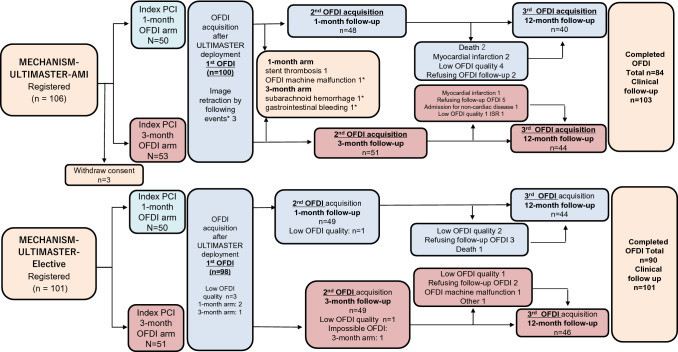
The purpose of this study was to assess early and late vascular healing in response to bioresorbable-polymer sirolimus-eluting stents (BP-SESs) for the treatment of patients with ST-elevation myocardial infarction (STEMI) and stable coronary artery disease (CAD). A total of 106 patients with STEMI and 101 patients with stable-CAD were enrolled. Optical frequency-domain images were acquired at baseline, at 1- or 3-month follow-up, and at 12-month follow-up. In the STEMI and CAD cohorts, the percentage of uncovered struts (%US) was significantly and remarkably decreased during early two points and at 12-month (the STEMI cohort: 1-month: 18.75 ± 0.78%, 3-month: 10.19 ± 0.77%, 12-month: 1.80 ± 0.72%; p < 0.001, the CAD cohort: 1-month: 9.44 ± 0.78%, 3-month: 7.78 ± 0.78%, 12-month: 1.07 ± 0.73%; p < 0.001 respectively). The average peri-strut low-intensity area (PLIA) score in the STEMI cohort was significantly decreased during follow-up period (1.90 ± 1.14, 1.18 ± 1.25, and 1.01 ± 0.72; p ≤ 0.001), whereas the one in the CAD cohort was not significantly changed (0.89 ± 1.24, 0.67 ± 1.07, and 0.64 ± 0.72; p = 0.59). In comparison with both groups, differences of %US and PLIA score at early two points were almost disappeared or close at 12 months. The strut-coverage and healing processes in the early phase after BP-SES implantation were significantly improved in both cohorts, especially markedly in STEMI patients. At 1 year, qualitatively and quantitatively consistent neointimal coverage was achieved in both pathogenetic groups.
Keywords: Bioresorbable-polymer sirolimus-eluting stents; Optical frequency-domain images; ST-elevation myocardial infarction; Stable coronary artery disease.
© 2021. The Author(s).
Conflict of interest statement
Itoh T, MD received lecture fees from Abbott Medical Japan and Daiichi-Sankyo, Otake H, MD received lecture fees from TERUMO, Sanofi, and Daiichi-Sankyo, grants and lecture fees from Abbott vascular, Shinke T, MD received grants from Terumo during the conduct of the study; lecture fees from Abbott Vascular, Sanofi, and Daiichi-Sankyo, grants and lecture fees from Bayer, Ishihara S, MD received lecture fees from Terumo, Abbott Medical Japan and Daiichi-Sankyo, Isshiki T, MD received lecture fees from Abott Medical Japan and Daiichi-Sankyo, Morino Y, MD received grants from Terumo during the conduct of the study; lecture fees from Abbott Vascular, Sanofi, and Daiichi-Sankyo, grants and lecture fees from Boston Scientific, Kimura T MD, Tsukiyama Y, MD, Kikuchi T MD, Okubo M MD, Hayashi T MD, Ph.D. and MBS, Okamura T MD, Kuramitsu S MD, Morita T MD, Soeda T MD, Sonoda S MD, Kuriyama N MD, and Hibi K MD have no conflicts of interest to declare.
Figures


References
-
- Nakazawa G, Finn AV, Joner M, Ladich E, Kutys R, Mont EK, et al. Delayed arterial healing and increased late stent thrombosis at culprit sites after drug-eluting stent placement for acute myocardial infarction patients: an autopsy study. Circulation. 2008;118:1138–1145. doi: 10.1161/CIRCULATIONAHA.107.762047. - DOI - PubMed
MeSH terms
Substances
LinkOut - more resources
Full Text Sources
Medical
Miscellaneous
