Review
. 2022 Aug;22(8):1017-1027.
doi: 10.1080/14712598.2021.1922665. Epub 2021 May 9.

Bispecific antibodies for the treatment of breast cancer

Affiliations
Review

Bispecific antibodies for the treatment of breast cancer

Patrick M Dillon et al. Expert Opin Biol Ther. 2022 Aug.

Abstract

Introduction: There are more than two dozen bispecific antibodies (BsAbs) in development with a variety of designs which are relevant to breast cancer. The field of BsAbs for breast cancer includes agents that co-direct immune recognition of the cancer cell, target unique cancer antigens, and target the microenvironment. BsAbs are being developed for use as antibody-drug conjugates and as homing signals for engineered T-cells.

Areas covered: This review covers potential targets for bispecific antibodies, agents in pre-clinical development, agents in clinical trials, combinatorial therapies, and future directions.

Expert opinion: There is no BsAb approval expected for breast cancer in the near term, but late-stage trials are underway. Future BsAb roles in breast cancer are possible given unmet needs in estrogen receptor+ disease, residual disease, and de-escalating chemotherapy use. The HER2+ space shows hints of success for BsAbs, but is already crowded. Areas of unmet need still exist.

Keywords: Bispecific antibody; breast cancer; cellular therapy; clinical trials; immunotherapy.


Conflict of interest statement

Declaration of interests

LG Lum is co-founder of Transtarget Inc. P Dillon is a site investigator for breast cancer trials sponsored by Pfizer, Novartis, Merck, Seattle Genetics, Radius, Syndax, Tesaro, Tolero. P Dillon has institutional clinical trial participation with Merck, Seattle Genetics, Tolero, Pfizer, Abb-vie, Radius. The authors have no other relevant affiliations or financial involvement with any organization or entity with a financial interest in or financial conflict with the subject matter or materials discussed in the manuscript apart from those disclosed.

Figures
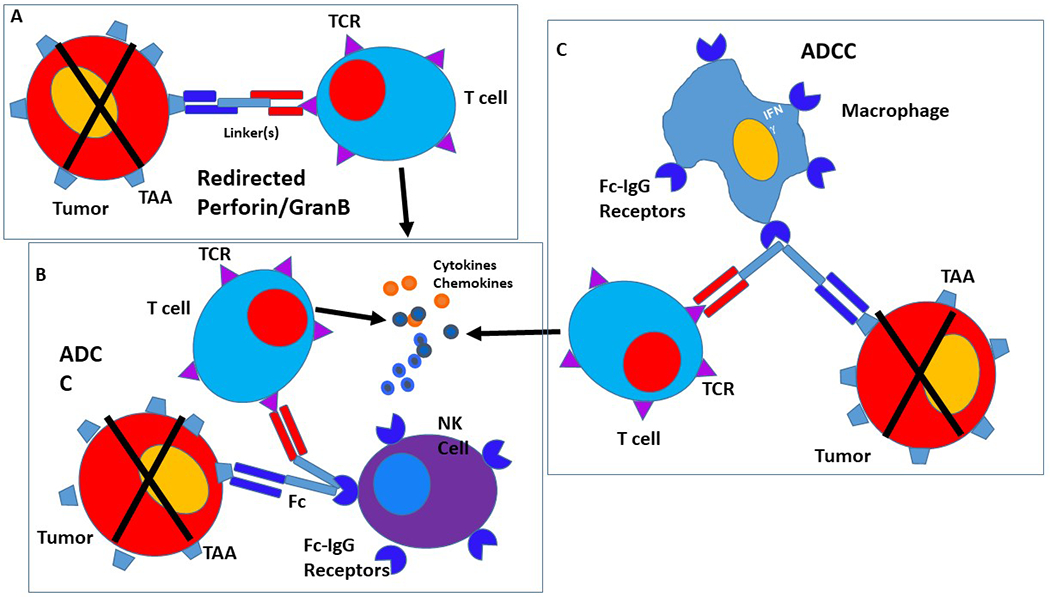
Figure 1:
Figure 1:
Mechanisms involved in bispecific antibody mediated cytotoxicity. A: Non-MHC restricted perforin/granzyme B mediated killing by redirected T cells. B: Antibody dependent cellular cytotoxicity mediated by Fc-recepter binding of bipecific antibody, NK cell and effector T cell. C: Antibody dependent cellular cytotoxicity mediated by T effector cell and monocyte.
Figure 2:
Figure 2:
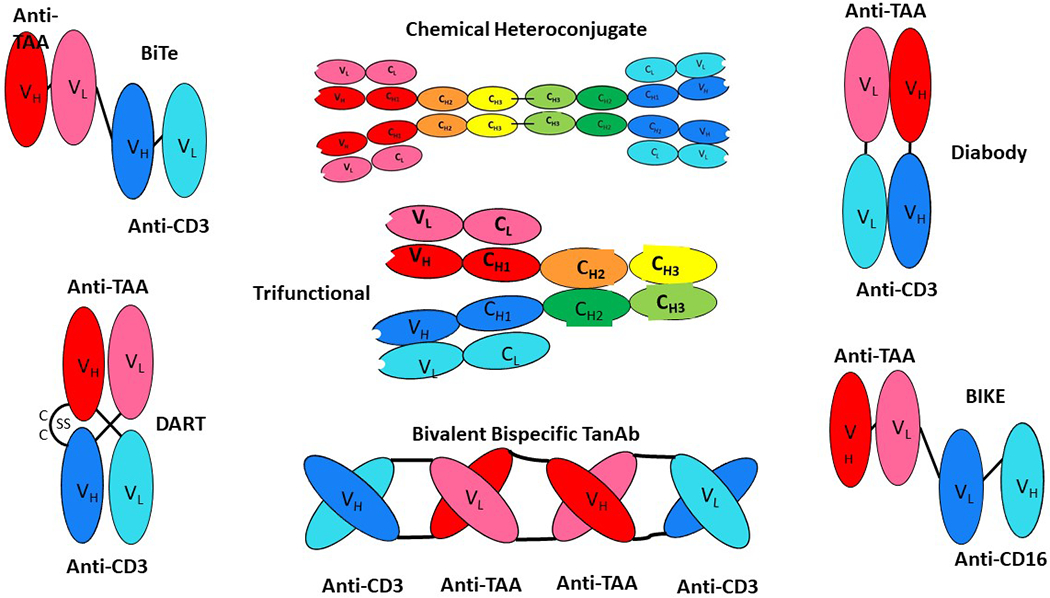
Various bispecific antibody formats are shown as whole antibody molecules or engineered antibody derivatives containing variable regions of heavy and light chains. The heavy chains targeting CD3 and TAA are depicted in dark blue and red respectively. The light chains targeting CD3 and TAA are depicted in light blue and pink, respectively BiTE = Bispecific T cell engager; Chemical heteroconjugate = two antibodies linked; DART= Dual-affinity retargeting bispecific antibody; Trifunctional Antibody: quadroma fusion with Fc-binding portion; TanB; bispecific tetravalent chimeric antibody construct; BIKE: Bispecific killer cell engagers; Diabody: basic construct of genetically fusing variable domains of the heavy and light chains with linkers. The heavy chains targeting CD3 and TAA are depicted in dark blue and red respectively. The light chains targeting CD3 and TAA are depicted in light blue and pink, respectively.
Figure 3:
Figure 3:
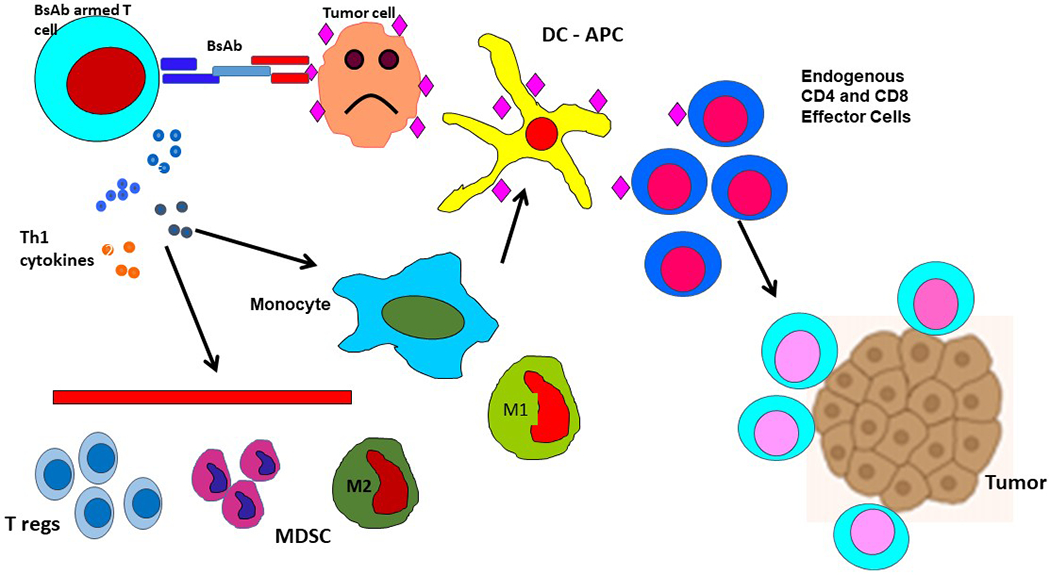
The proposed mechanism of BsAb armed T cell therapy. In this figure, the BsAb armed T cells are a population of T cells collected by apheresis and expanded ex vivo. Those T cells are then armed with an anti-CD3 BsAb with secondary specificity for a tumor antigen. Upon re-infusion into the body, the BsAb armed T cells preferentially collocate at the site of tumor antigen presence where cancer cells exist in the body. Th1 cytokine release ensues and cooperates in tumor cytolysis. The secondary process of additional tumor antigen release and presentation occurs and results in specific activation of endogenous, non-BsAb-armed CD4 and CD8 T cells and an expansion of tumor specific immune response as shown at the bottom right.

References

    1. Aalberse RC, van der Gaag R, van Leeuwen J. Serologic aspects of IgG4 antibodies. I. Prolonged immunization results in an IgG4-restricted response. Journal of immunology (Baltimore, Md : 1950). 1983;130(2):722–726. - PubMed
    1. Nisonoff A, Rivers MM. Recombination of a mixture of univalent antibody fragments of different specificity. Archives of biochemistry and biophysics. 1961;93:460–462. - PubMed
    1. Staerz UD, Kanagawa O, Bevan MJ. Hybrid antibodies can target sites for attack by T cells. Nature. 1985;314(6012):628–631. - PubMed
    1. Pullarkat V, Deo Y, Link J, et al. A phase I study of a HER2/neu bispecific antibody with granulocyte-colony-stimulating factor in patients with metastatic breast cancer that overexpresses HER2/neu. Cancer immunology, immunotherapy : CII. 1999;48(1):9–21. - PMC - PubMed
    1. Repp R, van Ojik HH, Valerius T, et al. Phase I clinical trial of the bispecific antibody MDX-H210 (anti-FcgammaRI x anti-HER-2/neu) in combination with Filgrastim (G-CSF) for treatment of advanced breast cancer. British journal of cancer. 2003;89(12):2234–2243. - PMC - PubMed

Publication types

Substances